

A sustained wave of sirens sounded across northern Israel on Wednesday evening, with alerts in the Golan Heights, Galilee communities and Haifa after launches from Lebanon, as officials warned residents to remain near shelters, expecting heavier fire overnight.
A senior official told ynet Wednesday evening: “We are on the eve of opening a broad campaign in Lebanon. We will call up reservists.”
Rockets from Lebanon rain over northern Israel as air defenses spring into action


The official added: “We knew in advance of their intention to fire a larger volume tonight. There is now a security discussion underway, and the campaign in Lebanon is set to expand significantly. Hezbollah, in its view, wants to divert our attention from Iran and believes that if it pulls us in deeper, we will ease off the campaign against Iran. It wants to create a new equation under which Israeli enforcement policy in Lebanon stops and we do not strike at all. That will not happen. So this entire event is heading toward a serious escalation.
“The Lebanese government is unfortunately not part of this. It does not appear that Hezbollah is listening to calls from the Lebanese government to stop. They do not care about the Lebanese government. Therefore, we are on the eve of opening a broad campaign, which will require an additional call-up of reservists. We have more capabilities and more tools, and we will be able to conduct a campaign simultaneously in Iran and Lebanon. We have fought on seven fronts.”

Dozens of rockets were fired toward Haifa and the Haifa Bay area. One rocket scored a direct hit on a house in the Lower Galilee town of Bi’ina, and the Magen David Adom emergency service said two people were lightly hurt in the attack. At the same time, the Israeli Air Force was striking Beirut’s Dahieh district, a Hezbollah stronghold.
Police said interceptor debris was found in several areas of the Galilee. “We call on the public to remain alert and follow instructions, not to go to impact sites or areas with munitions, not to touch shrapnel or interceptor fragments, and to allow police and rescue forces to carry out life-saving operations,” the police said in a statement.
After the barrage, Hezbollah announced the start of what it called “Operation Devoured Chaff.” Arab media used a similar name for Israel’s 2014 war in the Gaza Strip.

Bi’ina home takes direct hit from Hezbollah rocket
(Photo: Fire and Rescue Services)

(Photo: Fire and Rescue Services)
IDF spokesman Brig. Gen. Effie Defrin, speaking shortly after the heavy barrage from Lebanon, said: “It is important to emphasize: Follow only Home Front Command instructions. The IDF is prepared with strong defenses and will do whatever is required to protect Israel’s citizens. I say from here to all our enemies: Whoever tries to harm us will pay a heavy price.”
Defrin added: “We are well prepared in defense, including on the ground, and are striking Hezbollah constantly. As an army, we are prepared for this campaign to continue as long as required. We entered it in a calculated way to remove an existential threat, and we are deepening the blow.”
The barrage in the north came shortly after sirens were activated in central Israel, Jerusalem, the Sharon region, Judea and Samaria and the Lachish area following missile launches from Iran that were intercepted.
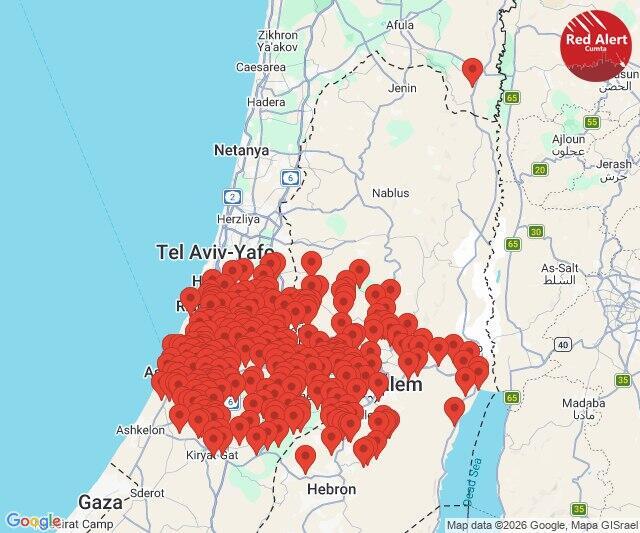
(Illustration: Cumta)

(Illustration: Cumta)
Officials said the latest barrage from Lebanon was coordinated and launched simultaneously from several areas, and the military said it was working to disrupt the fire. A short time later, sirens again sounded in northern Israel after a missile was launched from Iran toward the area.
About an hour later, additional sirens were activated in several towns near the Lebanese border and in the Golan Heights because of a drone infiltration alert. Shortly afterward, more sirens sounded in southern Israel due to missile fire from Iran. Military officials said all incoming threats in the attack on the south were intercepted.

(Illustration: Cumta)
Rumors circulated through the evening that broader attacks were expected in the coming hours. The reports appeared to stem from an IDF update to local leaders in the north saying the fire was expected to intensify significantly overnight, likely reaching longer ranges and possibly coming not only from Lebanon.
Even so, the military said there had been no change in Home Front Command instructions and that it was not expecting an unprecedented scale of fire beyond what Israel had faced in the past.
CNN reported, citing two Israeli officials, that Israel was preparing for a possible “significant expansion” of attacks from Iran and Hezbollah during the night. According to the report, Prime Minister Benjamin Netanyahu convened senior security and coalition officials Wednesday evening to discuss those developments.
Shlomi council head Gabi Naaman wrote to residents that an army representative had said that, despite no change in official instructions, it was known and likely expected that Hezbollah would launch fire overnight at a higher frequency than usual, somewhat beyond the pace of recent days, and might also try to strike farther beyond the northern border communities. “We all need to be careful, and no more than that,” Naaman wrote.

Incoming threat intercepted over northern Israel, March 7, 2026
(Photo: Gil Nechushtan)
Other local leaders said the military had explained that the fire was not expected to reach unprecedented levels, but would likely come at greater intensity.
Following the briefing, Mateh Asher Regional Council head Moshe Davidovich called on residents to remain near protected spaces, citing warnings received from security officials. Nahariya Mayor Ronen Marelly also urged residents to spend as little time outside their homes as possible.
Mateh Asher officials later clarified Davidovich’s message, saying that “in light of situation assessments and updates received in recent minutes from security officials about the possibility of broad fire in our area tonight, the council head chose to act with extra caution and instruct residents to stay near protected spaces.”
“It is a step of increased responsibility to safeguard human life,” the council said. “We ask the public to follow instructions, remain calm and monitor announcements from the council and the Home Front Command.”
In the Marom HaGalil Regional Council, officials issued what they described as a “special instruction” recommending that residents stay close to protected spaces and avoid gatherings.
Effie Defrin addressed the rumors directly, saying he was aware of public discussion in recent hours about the possibility of increased fire. “I want to emphasize that there is no change in Home Front Command defensive policy at this time,” he said.
“The IDF is prepared with strong defenses and will do whatever is required to protect Israel’s citizens. We continue to hold ongoing assessments and will update on any change if and when there is one. I emphasize: Continue to follow Home Front Command instructions. They save lives.”
Since the war began, authorities have identified more than 250 launches from Iran and more than 450 from Lebanon. In addition, more than 150 drones have been launched from Iran and more than 50 from Lebanon, according to the military.