

After four masked men broke into the Louvre Museum in Paris on Sunday and stole eight pieces of France’s crown jewels, authorities are racing to recover them before they vanish into the global black market. Although the stolen items are valued at an estimated $102 million, experts say the thieves are unlikely to make anywhere near that amount — if they manage to escape arrest at all.
Private investigators and security experts explain that when ransom isn't an option, thieves often smuggle such items to black-market jewelers willing to cut, melt down and reshape the pieces. Priceless gems are often broken into smaller, untraceable stones and sold off individually.

Part of what made these 19th-century jewels so appealing to the robbers is also what makes them nearly impossible to track. Unlike modern gems, which are often marked in laboratories with microscopic serial numbers, older stones have no such identifiers. “Who wants to be caught with an original Picasso under the bed,” said art recovery expert Chris Marinello to The Wall Street Journal, “when you can melt down the gold, pop out the stones, sew them into a jacket, and hand them to a shady jeweler?”
Indeed, the concern within the art and jewelry world is that these historical items will be dismantled and sold in parts. According to the FBI, the global stolen art network moves billions of dollars' worth of goods annually, stretching from diamond-cutting centers in Dubai and Delhi to jewelry stores in New York, Antwerp and Tel Aviv. In the United States alone, jewelry thefts total more than $1.2 billion a year.
Unlike a Picasso or a Rolex, gems can be easily removed from their settings, and gold frameworks can be melted — preserving their value as precious metals and stones, even if stripped of their historical significance. The resale value may be lower, but their natural characteristics still make them highly marketable.
The Louvre theft follows a series of gold-related heists across Europe in the past two years, a trend jewelers link to soaring gold prices. Experts say the lure has grown sharply, with gold climbing more than 60% in the past year alone, now selling for over $4,000 per ounce.
One puzzling element of Sunday’s robbery is that the thieves dropped the Empress Eugénie’s crown — set with nearly 1,400 diamonds and 56 emeralds — during their escape. According to investigators, that blunder suggests a relatively amateur operation, not a sophisticated gang.
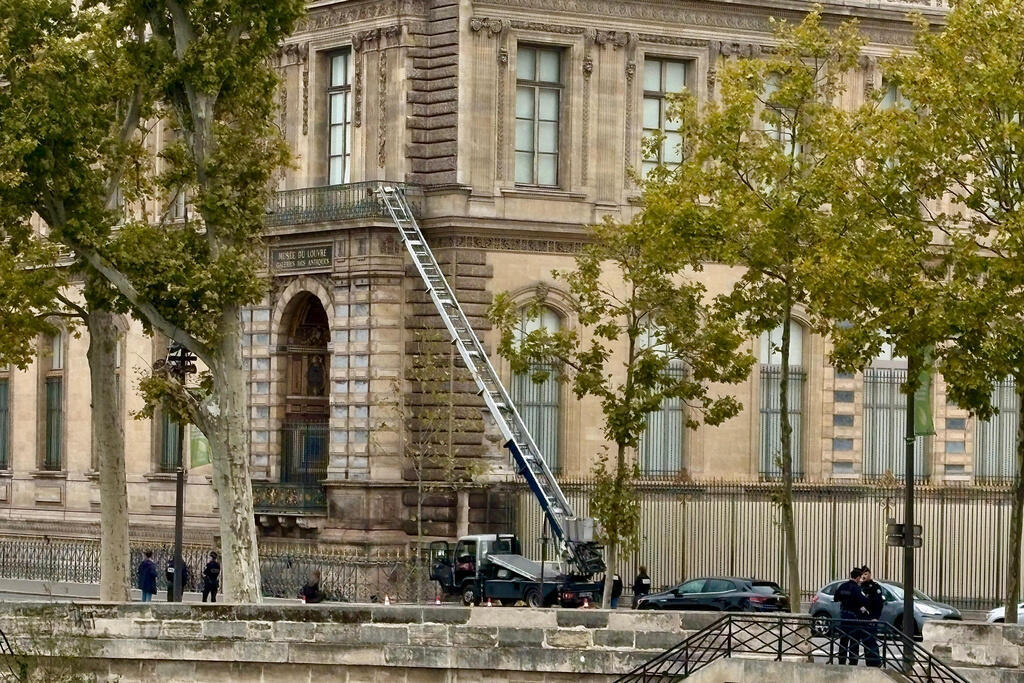
The ladder used by the thieves in the Louvre heist
(Photo: AP Photo/Alexander Turnbull)
The ladder used in the heist was also left behind, reinforcing expert assessments that this was not the work of professionals.
As for the stolen pieces’ material value, it remains unclear how pure the gold is. Historical items often contain lower-grade metals than contemporary jewelry. However, the sheer number of small diamonds may make the stolen items more appealing, as the stones can likely be sold without the need for recutting or alterations that might otherwise reveal their origins.
According to black-market trade experts, art and jewelry thieves typically receive no more than 10% of the stolen goods’ estimated market value. This deep discount reflects both the loss of historical worth once items are dismantled and the “confidentiality fees” paid to black-market dealers to keep quiet about the merchandise’s origins.
Still, stolen gems can be more profitable than stolen paintings. Unlike artwork, which is often logged in global databases, individual stones are harder to trace. Penalties for gemstone theft also tend to be significantly lighter than for crimes like armed bank robbery.