


Prime Minister Benjamin Netanyahu has not ruled out the possibility of a rotation agreement for the premiership as part of forming a unity government. Asked in closed-door discussions about the possibility of establishing a unity government with a rotating prime minister, Netanyahu replied: "We are examining everything. I am not completely ruling out any option."
Sources close to the prime minister who discussed the issue with him came away with the impression that he had left the matter open and was indeed considering every possible option. One of his associates said Sunday in response: "No proposal to form a unity government has been made yet."
Gallery
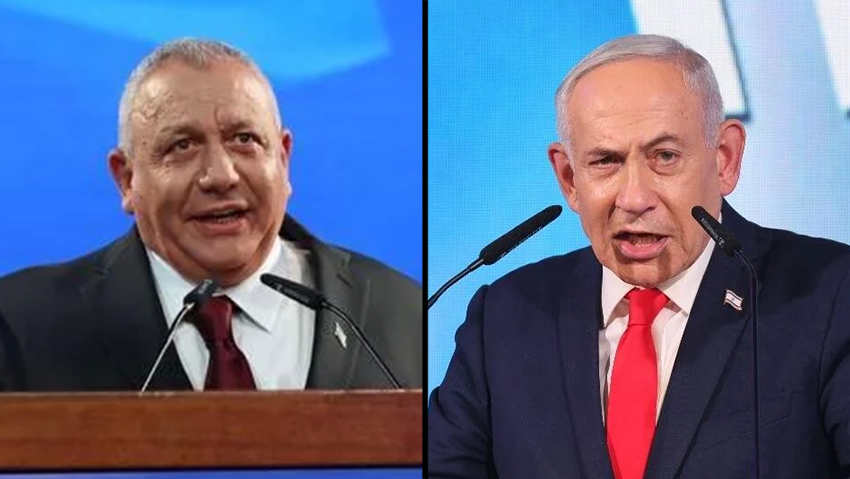
Heading toward a unity government? Eisenkot and Netanyahu
(Photos: Tal Shahar, Alex Kolomoisky)
In contrast to Netanyahu's remarks behind closed doors, Likud ministers and lawmakers who have addressed the unity government issue in recent days have given the impression that there would be no rotation agreement, since Netanyahu would not agree to serve as prime minister for only part of a term. Coalition Chairman Ofir Katz even issued an ultimatum Sunday, saying that if the change bloc ousts Knesset Speaker Amir Ohana, a unity government would not be possible.
Netanyahu himself, however, has not closed the door to a rotation agreement with Gadi Eisenkot, chairman of the Yashar! party. Netanyahu, who has yet to comment publicly on the possibility of forming a unity government or agreeing to a rotation, is deeply concerned about the change bloc forming a government with ultra-Orthodox and Arab parties, either as coalition partners or with their support from outside. He believes such a government could survive for a long time, potentially keeping him out of the prime minister's office altogether. "Our fear is that a government with Arabs and ultra-Orthodox parties, even with Shas' six seats, could last an entire term," a senior Likud official said.
On Sunday, amid those concerns, Netanyahu continued his campaign against the Arab parties and also addressed the ultra-Orthodox issue. "Eisenkot and his partners are trampling on the trust of Israel's citizens. They are breaking all their promises regarding cooperation with parties that support terrorism and are working to form a government with them. And in the ultimate display of contempt, after four years of relentless attacks on the ultra-Orthodox community, they are abandoning ultra-Orthodox conscription out of a lust for power. This must not be allowed to happen," Likud said in a statement.
Eisenkot's plan
For now, the change bloc is not pursuing a unity government. Instead, it is working on two parallel tracks: gaining control of key positions of power in the Knesset and forming a narrow government. According to political assessments, a narrow government led by Eisenkot could be established with outside support from Ra'am and United Torah Judaism as a coalition partner.
Meanwhile, the possibility of cooperating with Eisenkot is causing disagreements within United Torah Judaism. While Yitzhak Goldknopf is interested in advancing support for Eisenkot, Meir Porush expressed skepticism about the move Sunday, saying: "Eisenkot? Who would go with him? He hasn't even called us."
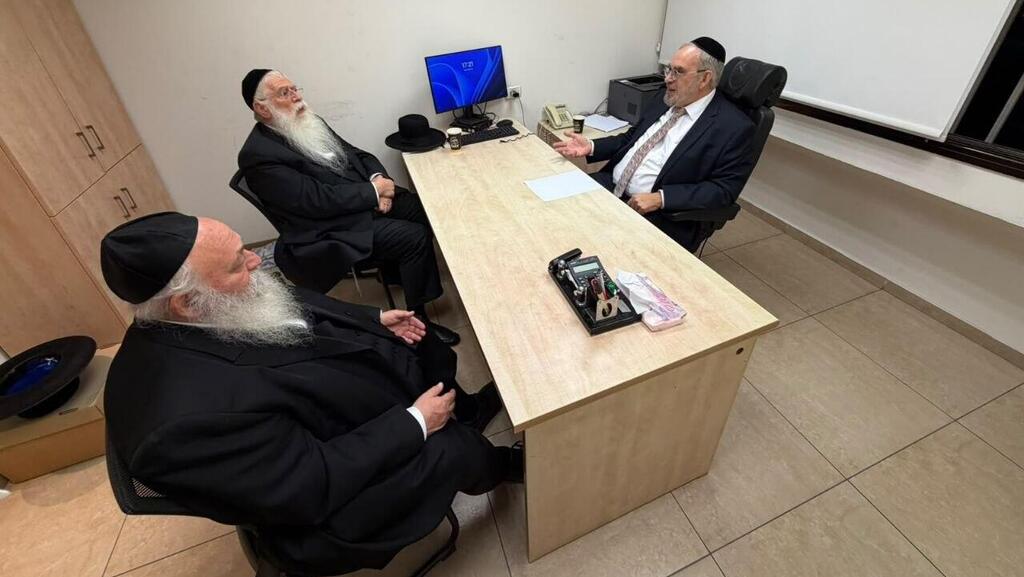
Awaiting a concrete proposal; United Torah Judaism leaders
Within United Torah Judaism, party officials understand that even without actively supporting Eisenkot, they can influence the first parliamentary moves of the 26th Knesset and potentially use that leverage to pressure Netanyahu. Senior party members are discussing the possibility of abstaining in a vote to replace Knesset Speaker Amir Ohana, a move that could allow the opposition to oust him without requiring United Torah Judaism to vote actively in favor.
At a meeting Sunday evening attended by senior party figures Yaakov Asher, Yitzhak Goldknopf and Meir Porush, it was decided that the issue would be discussed only after receiving a concrete proposal from Eisenkot. According to party sources, United Torah Judaism also decided that, at this stage, it would not recommend any candidate for prime minister.
Eisenkot is working to assemble a list of parties that will recommend him during consultations at the President's Residence, which are scheduled to begin Wednesday. Senior figures in the change bloc said it was important for the Yashar! chairman to be the first to receive the mandate to form a government.
A senior figure who is not a member of Eisenkot's party warned Sunday: "If the entire bloc does not recommend Eisenkot, all the judicial overhaul laws passed by the current coalition will take effect on January 1, 2027, as stipulated by law."
The legislation includes the law concerning the attorney general, the Police Internal Investigations Department law and the law changing the composition of the Judicial Selection Committee. Under the change bloc's plan, if President Isaac Herzog gives Eisenkot the mandate to form a government before Netanyahu, Eisenkot would also gain control of the Knesset's Arrangements Committee. That committee could decide two major issues on the change bloc's agenda: replacing the Knesset speaker and repealing the judicial overhaul laws.
Former Prime Minister Naftali Bennett's B'Yachad party announced Sunday that it would recommend Eisenkot to the president as its candidate to form the government. The change bloc also expects the Democrats to recommend Eisenkot.
The one leader who has yet to express a position on the matter, even in closed-door discussions among the change bloc's leaders, is Yisrael Beytenu Chairman Avigdor Liberman.
- Shilo Freid contributed to this report.