

Was a final agreement signed that brought an end to Israel and the United States’ war with Iran? In light of the continued mutual attacks last week and Donald Trump’s promise that “the Islamic Republic will not exist,” the clear answer is no. But according to betting market Polymarket, the answer is yes, and a permanent agreement to end the war was signed on June 15. The question is whether that determination by the betting market was authentic, or whether it rested on subjective financial motives unrelated to reality.
A group of bettors who lost significant sums on the wager argue it was the latter. They are now taking on Polymarket, in a fight they say exposes fundamental problems in the platform’s structure and dispute resolution process, which allows a few actors to tilt the final outcome of wagers and pocket illegitimate profits amounting to tens of millions of dollars.
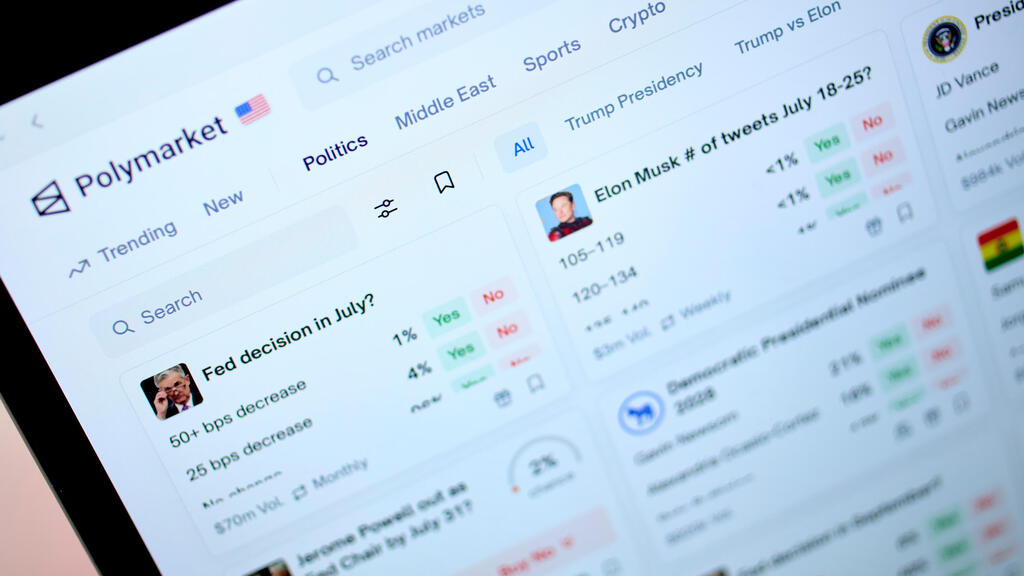
Polymarket
(Photo: Gabby Jones/Bloomberg)
“Users should be aware that putting money into Polymarket carries a real risk that the market will be resolved in a way that does not necessarily match the written rules or the factual reality,” said B., who lost 100,000 shekels on the bet. “Polymarket chose to ignore repeated appeals from users, refused to take responsibility for the disputed ruling and did not provide its users with a fair mechanism for reviewing the claims that were raised.”
'I thought that Polymarket would not let it close like this'
Every wager on Polymarket, or what the site calls a “market,” is on the binary outcome of a specific event. For example, will Brazil win or lose a World Cup match against Japan? At the same time, on the same game, will Japan win or lose, and will the match end in a draw, yes or no? In some markets, such as sporting events or awards ceremonies, it is easy to understand the correct outcome: whether a team won or lost, whether a film won an Oscar or not. But Polymarket also allows bets on current events, sometimes involving outcomes that are less clear-cut. For example, will traffic in the Strait of Hormuz return to normal by July 31, yes or no?
Although the market rules define the conditions for determining a “yes” outcome, the interpretation of those conditions can sometimes become disputed because of various nuances. That is the case in the market that asked whether the United States and Iran would sign a permanent peace agreement by a certain date. The market handled a total of $478.91 million, spread across different dates — for example, $24.17 million in bets on whether a permanent agreement would be signed by April 30. On June 14, Iran and the United States signed a memorandum of understanding to end military operations, and that is where the dispute at the heart of the ruling begins: Was this a final agreement or a temporary one?
“I was closely following the internet to understand whether any agreement had been signed,” B. told Calcalist. “I knew one was expected to be signed, but I also knew that a permanent peace agreement could not be reached before the nuclear issue was dealt with. When a tweet came out from the Pakistanis saying a peace agreement had been signed, the coin flipped and the market moved toward the ‘yes’ voters. At that point, I could have saved 80% of the money, but I wholeheartedly believed there would not be a permanent peace agreement here. Even before the agreement was published, a request had already been filed for the June 15 market to close in favor of ‘yes, a permanent agreement was signed’ — there were markets on the platform for whether an agreement would be signed by June 15, by June 30, by July 31 and so on — but I was not alarmed because I thought that when the moment of truth arrived, Polymarket would not let it close like this.”
The dispute is whether the memorandum of understanding between Iran and the United States meets the market’s definitions of a permanent peace agreement. According to the definitions, a permanent agreement must include a mutual commitment to a permanent cessation of military operations. Agreements that are explicitly temporary are excluded from this definition. The Islamabad memorandum of understanding does declare “the immediate and permanent end of military operations,” but it also includes language indicating that it is a temporary agreement: “Iran and the United States undertake to conduct negotiations and reach a final agreement within 60 days.” This wording creates a dispute over whether any of the agreement markets, regardless of date, can be resolved as “yes,” involving a total of about $260 million.
But with regard to the June 15 market, worth $177.37 million, the picture appears clearer: The market terms state that it will resolve as yes only after the United States and Iran officially sign the agreement, or after public announcements by both governments confirming that the agreement has been signed. Statements about contacts, progress or other statements that do not constitute an unequivocal declaration do not count. However, the official signing of the agreement took place only on June 17, when Trump himself was documented signing it alongside French President Emmanuel Macron.
“The agreement has to be written,” Omer Aganihu, who lost about $2,300 on the bet, told Calcalist. “No written agreement was published on that date at all, only on the 17th. Iran said it would sign only on the 17th. And before the deadline, they said they were signing an extension of the pause for 60 days in order to conduct negotiations toward a final cease-fire that would include a complete and permanent halt on all fronts. The second criterion — public announcements by the United States and Iran — was never met. At first, Iran said it had signed an agreement that permanently ended the fighting, but the United States never issued such an official statement. And before the end of the deadline, Iran itself also walked that back and said there were still issues that needed to be negotiated and that it had not yet been signed. The state of affairs between the United States and Iran shows pretty clearly that they never signed a permanent cease-fire, only a memorandum of understanding.”
Once a request is filed to rule that a market has closed with a certain outcome, a window of several hours opens during which the determination can be appealed. If an appeal is filed, the dispute is transferred to UMA, a crypto-based fact-checking platform that functions as a decentralized arbitration system for Polymarket. The platform is independent and is not controlled by the betting platform.
Every disputed Polymarket market goes to a vote on UMA, in which users who purchased the cryptocurrency it issues can participate. Voting lasts between 48 and 72 hours, with each participant’s voting power derived from the number of tokens they commit to the vote. The vote is decided by the largest number of votes, determined according to the number of tokens on each side rather than the number of voters. At the end of the vote, the committed tokens are redistributed, with voters on the majority side receiving a share of the tokens held by voters on the minority side. This mechanism is intended to create an incentive for participants to vote for the truth, in order to ensure that they receive additional tokens.
In the case of the disputed market, UMA’s vote ruled in favor of the “yes” camp, and the Polymarket markets were finally resolved as “yes, a final agreement was signed.” But UMA’s mechanism has several built-in problems that surfaced in the vote on the agreement with Iran.
First, a few voters with large token holdings, known as “whales,” can tilt the vote toward their preferred side regardless of objective reality. According to an analysis conducted by Aganihu, the largest whale in this vote controlled 16.7% of the votes, the five largest whales controlled 41.7% and the seven largest whales controlled 50.3%. All of them voted “yes.” In other words, a vote on the fate of a quarter of a billion dollars, in which 565 people participated, was effectively decided by only seven people.
Another problem is that UMA has no way to prevent people who hold a position in a Polymarket market from participating in the vote on that market’s fate. Aganihu’s analysis identified links between at least three crypto wallets that bet “yes” on Polymarket and also voted “yes” on UMA. “This requires a serious investigation,” he said.
UMA votes are also vulnerable to manipulation in the form of coordinated voting among participants. According to estimates, the mechanism allows for voting power of up to 15%.
After the ruling, a group of users who lost money on the bet organized. “We contacted Polymarket in every possible way, through dozens of emails and on social media, and received no response,” B. said. “We will use all legal tools at our disposal to bring the matter before the court.” Polymarket did not respond.