

Some may argue that U.S. President Donald Trump did not always act in Israel’s favor, despite its status as a close U.S. ally in the Middle East, but others see promise in the evolving U.S.-Israel tariff agreement.
For years, Israel benefited from nearly complete tariff exemption in trade with the United States, drawing envy worldwide thanks to the declared free trade zone between the two nations. However, Trump’s decision to tackle the U.S.’s multi-trillion-dollar trade deficit led him to launch a sweeping tariff initiative just two and a half months into his presidency, targeting much of the global market.
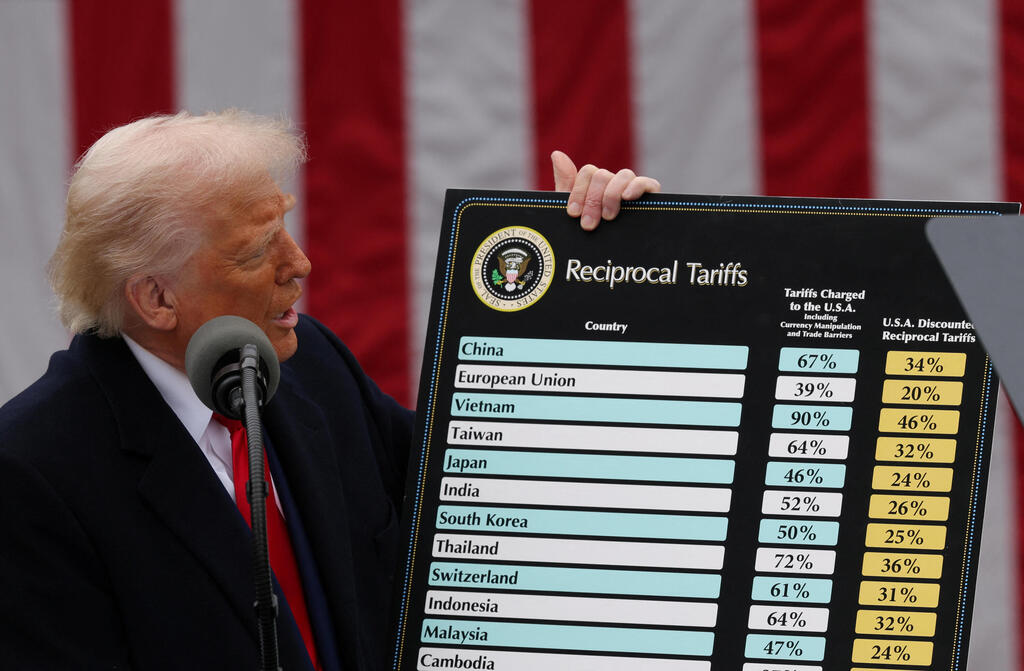
US President Donald Trump presents his sweeping tariff regime
(Photo: REUTERS/Carlos Barria)
Using a complex formula that calculated U.S. trade deficits with individual countries—based on the gap between imports and exports—the Trump administration initially imposed a 17% tariff on Israeli goods. While far higher tariffs were levied on countries such as China, other Asian nations, several European states and others across the Americas, the jump from 0% to 17% still dealt a serious blow to Israeli industry and exporters. In August, Trump responded to Israeli appeals and agreed to reduce the tariff to 15%.
Over the following months, Israeli government representatives, aided by economists and the Manufacturers Association, engaged in tough, drawn-out negotiations with Trump administration officials. The prime minister and finance minister also intervened, while Economy Minister Nir Barkat’s team worked to minimize the impact on Israeli exports.
In the end, the effort yielded a partial success, one that could grow significantly if the Abraham Accords expand to include nations such as Saudi Arabia, Indonesia and potentially even Syria and Lebanon in the future. The likely cost: an Israeli commitment to support the future establishment of a Palestinian state.
The expected outcome of the final agreement will see the 17% tariff reduced to 15%, short of Israel’s push for a 10% rate. Still, hundreds of products will remain duty-free, considered a major achievement. These include some of Israel’s top exports to the U.S., such as generic pharmaceuticals, microchips, diamonds, aircraft parts, auto components, metals and certain agricultural goods.
While Israel’s efforts to soften the blow of the new tariffs have largely succeeded, a full return to a free trade zone with the United States may only be possible if the Israeli government formally agrees to the creation of a Palestinian state within its borders.