

A staggering 2,281% — that is the return delivered over the past three years by shares of Next Vision, a company that develops and manufactures cameras mounted on drones and unmanned aerial vehicles to identify and mark targets. Tuesday, the stock jumped 17.4% after the company received the largest order in its history, worth about $76 million, from an existing client. On Wednesday, the share rose another 6%, bringing its gain since the start of the week to 33%.
The company, which went public in 2021 at a valuation of just 400 million shekels, is now worth 16 billion shekels. Since the start of the year, its stock has surged 210%, making it the top-performing share on the TA-35 index in 2025.

What turns a company that is still far from being a giant in sales terms — its revenue this year is expected to reach just $160 million — into a firm trading at a 16 billion shekel valuation? That is what chairman and partner Chen Golan seeks to explain. “Our products are game changers in the market,” he said.
The Russia-Ukraine war has changed the rules of the game when it comes to the importance of drones on the battlefield. Despite the fact that an unmanned aerial vehicle can cost as little as a few dozen dollars on AliExpress, drones today pose a serious threat and serve as an effective weapon against the enemy. Next Vision’s cameras act as the drones’ “eyes,” identifying and marking targets.
As unmanned aerial vehicles are expected to take an increasingly central role in future battlefields, the potential is enormous. According to Golan, as he said at an investor conference, “Our performance relative to camera weight is the best in the entire market.” The more drone swarms operate in combat zones, the more Next Vision cameras will be sold.
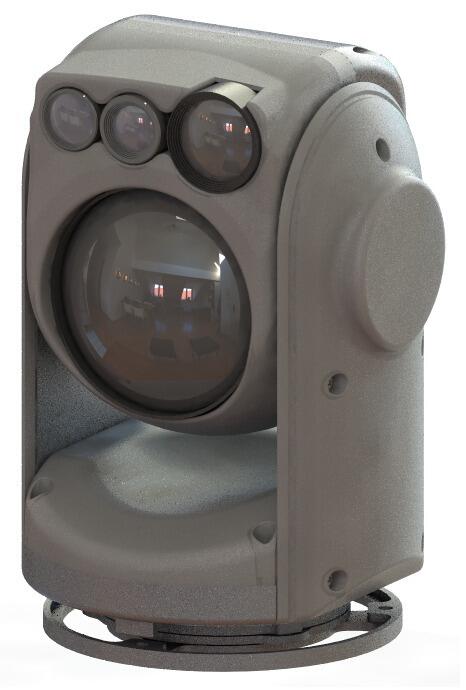
Next Vision camera
(Photo: PR)
The company, based in Ra’anana, was founded by Golan, a former Israeli Air Force pilot; Boris Kipnis, a former Unit 8200 officer who serves as chief technology officer; and CEO Michael Grossman, also a former 8200 officer. One of the company’s earliest investors was a resident of Metula who owns a gas station in the Galilee and invested 3 million shekels, an investment that yielded returns of tens of thousands of percent. Another early investor was Maj. Gen. (res.) Amiram Levin.
According to Golan, “This year, sales are growing by 45%. The year before, we grew by 120%. There are very few companies that show growth like that. Analysts expect another 50% growth next year. That is a major challenge. Today we have 190 customers. Twelve percent of our sales are to Israel, 57% to Europe, 27% to the United States and the rest to the rest of the world. Our latest product is a small camera weighing 1.5 kilograms with laser capabilities that further improve target marking. Every year we launch two to three new products that add significant value.”
The company reported revenue of $28 million in the third quarter of 2025, a 56% increase compared with the same quarter a year earlier. Its goals include growth through mergers and acquisitions and a Nasdaq listing.
Competitive edge
Next Vision is not the only company in the world developing similar products. Its advantage lies in the combination of camera size, performance and relatively low price. Performance is measured relative to camera weight, as the camera must be as light as possible to extend the drone’s flight time.
The company’s registered “patent” is a unique image stabilization engine that allows real-time stabilization even under difficult flight conditions, combined with electro-optical capabilities and artificial intelligence. “Next Vision can perform deep zoom from moving platforms and still deliver a stable image,” Golan said.
The camera can identify a human target from a distance of two kilometers. The technology also includes artificial intelligence that enhances target imaging during flight while maintaining a favorable weight ratio. In its latest model, the company has integrated laser capabilities into smaller cameras as well, further improving target designation accuracy.
Next Vision does not sell directly to militaries but to large defense companies such as Israel’s Elbit Systems, which manufacture drones and UAVs and win military tenders, with Next Vision serving as part of the winning supplier ecosystem.
If the Russia-Ukraine war ends and there is peace in the Middle East, will demand for your products continue?
Golan said, “Putin’s effect on Europe is so strong and long term that even if there is a peace agreement between Russia and Ukraine, the demand trend will not change. European countries have realized that the only way to preserve peace is to build strong military capabilities. Some NATO countries fear that Putin’s next target could be a conflict with NATO. They will not take the risk of being unprepared for such a war. The armament trend will continue, in our view, for at least the next three years. The potential for military conflicts exists not only with Putin but also between China and Taiwan and between India and Pakistan — which fuels all defense companies worldwide.”
Did your background as an Air Force pilot contribute to your success and to the product’s precision?
“No,” Golan said. “Next Vision is in the right place at the right time with the right products.”