

The U.S. military has helped tankers move more than 660 million barrels of crude oil through the Strait of Hormuz since the beginning of May, U.S. Central Command told CNBC this week.
The military has assisted about 1,300 commercial vessels transiting the strait during that period, U.S. Navy Capt. Tim Hawkins, a Central Command spokesperson, said Thursday in a statement. “Multiple routes remain free and open for commercial transit,” Hawkins said.
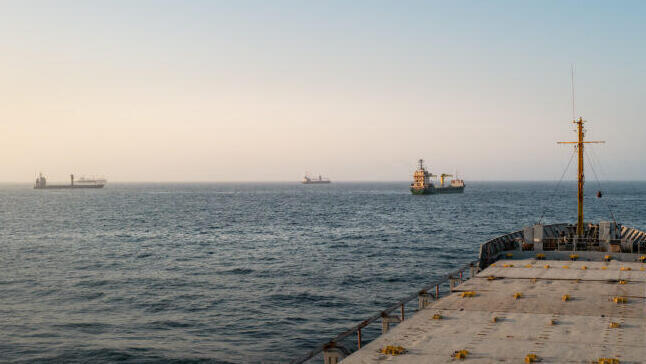
Tankers in the Strait of Hormuz
(Photo: Elke Scholiers/Getty Images)
The figures indicate that at least 160 million barrels, or more than 7 million barrels a day, passed through the strait over the past three weeks, based on previous military statements. On July 29, Central Command said U.S. forces had helped move 500 million barrels through Hormuz since May.
Shipments remain well below prewar fuel export levels, when about 20 million barrels a day of crude oil and petroleum products passed through Hormuz. Still, the U.S. military data indicates that a significant amount of oil continues to move through the strait despite threats and attacks by Iran.
It is unclear exactly how much oil is leaving Hormuz each day because the U.S. government has provided varying estimates, generally higher than figures from independent ship-tracking companies.
U.S. officials told Axios on Wednesday that about 10 million barrels a day had left the strait in recent weeks. U.S. Energy Secretary Chris Wright said Aug. 11 that the seven-day average had risen to nearly 9 million barrels a day.
Private monitoring firms provide different estimates. Shipping intelligence company Windward estimates that crude oil exports through Hormuz averaged about 5 million barrels a day in July, up from about 4 million barrels a day in June and 1.6 million barrels a day in May.
Exports in August are also expected to rise from July levels, said Michelle Wiese Bockmann, a senior maritime intelligence analyst at Windward. “My assessment is that it’s scaling and it’s scaling quickly despite the fact that Iran is placing enormous pressure on maritime security,” Bockmann said. “The Gulf states have got U.S military protection — that’s not a secret,” she said, adding that those countries are “ready to do whatever they can” to increase oil exports.
There is a shortage of reliable information on the precise volume of oil passing through Hormuz because of the difficulty of tracking vessels during wartime, said Bridget Diakun, director of maritime intelligence and research at Lloyd’s List.
Ships often pass through the strait at night, while satellite images are generally taken only in the morning, she said. “There’s a lot of unknowns,” Diakun said during a briefing Thursday.
The security situation in the Strait of Hormuz remains disputed. Iran said Tuesday that it had closed Hormuz until the United States fulfills its commitments under a temporary peace agreement signed June 17. President Donald Trump, by contrast, insists the strait is open and under U.S. control.
For months, Hormuz has effectively been divided into two separate shipping lanes. The U.S. military assists ships using the southern route along the coast of Oman. At the same time, it has imposed a naval blockade on ports in Iran.
Tehran is demanding that ships use the northern route, which passes through its territorial waters, or risk attack.
“It’s a contested security situation in the Strait of Hormuz,” said Jakob Larsen, chief safety officer at BIMCO, one of the world’s largest shipping associations.
The strait is 21 miles wide at its narrowest point. Larsen said the United States has greater control in the area closer to Oman, while Iran has greater control near its own coastline.
“But both sides are still able to project power on either side of the strait,” he said. “It’s not really possible for either side to completely defend their own interests in the territorial waters of Oman and the territorial waters of Iran.”
At least 17 commercial vessels were attacked in and around the Strait of Hormuz in July and August, according to the International Maritime Organization, a United Nations agency. At least four crew members were killed in the attacks and more than a dozen were injured.
Still, tankers making the voyage can earn $500,000 a day, Bockmann said. Crew members are being paid double or triple wages to transit the strait, she added.
“It’s a very intense, serious operation to get the oil out — high risk, high profit,” Bockmann said.