

The Israel Innovation Authority’s 2026 High-Tech Status Report points to a mixed picture for the country’s most important growth engine: record exports, exits and fundraising, alongside the first decline in a decade in the number of R&D employees in Israel and a continued shift of activity abroad.
The report, published Sunday, shows that Israeli high-tech generated $85 billion in exports, $84 billion in exits and nearly $15 billion in fundraising in 2025. High-tech output rose 8.2% to 352 billion shekels, and the sector accounted for 58% of all Israeli exports.

But behind the strong headline figures, the report identifies several worrying structural trends: growing activity by Israeli companies outside Israel, rising relocation requests and the movement of management, senior positions and R&D activity abroad.
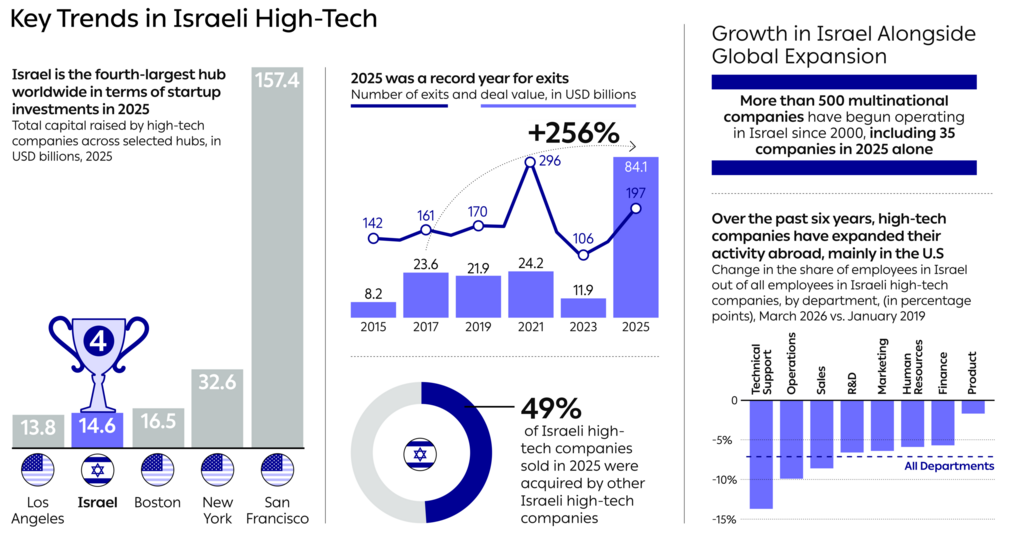
According to data from March 2026, only 62% of employees at private Israeli high-tech companies are employed in Israel, down from 69% in 2019. The rest are employed mainly overseas, with the United States continuing to grow as a center of operations for Israeli high-tech companies.
What concerns the Innovation Authority most is not only the movement of sales and support jobs abroad, but the shift of senior management and R&D roles. The share of senior high-tech executives based in Israel declined by about 9.6%, while the number of senior executives employed in the U.S. grew, a trend the report says may indicate that management and decision-making centers are gradually moving away from Israel.
Israeli high-tech companies are also continuing to transfer R&D activity outside the country, mainly to Eastern Europe and the U.S. The report notes that Israel’s share of development activity continues to erode. The weak dollar is also adding pressure: because high-tech companies operate in international markets, exchange-rate volatility affects their profitability and may increase the incentive to move activity abroad.
The report includes a simulation showing that a drop in the average dollar exchange rate from 3.7 shekels in 2024 to 3.45 shekels in 2025 translates into a 21 billion shekel reduction in high-tech GDP, about 1.1% of Israel’s GDP.
For the first time in more than a decade, the number of R&D employees in Israeli high-tech declined. The sector lost about 3,500 R&D workers, and their share of total high-tech employment fell from 51% to 49%. At the same time, product positions grew to 24%, a shift the Innovation Authority says may be partly linked to the growing use of artificial intelligence tools that streamline and accelerate development work.
Despite those warning signs, the report shows that Israeli high-tech returned to growth in 2025 and drove about half of Israel’s economic expansion. High-tech contributed 1.44 percentage points out of Israel’s total GDP growth of 2.9%.
Most of the growth came from higher output per employee, not from a sharp rise in the number of workers. Annual output per high-tech employee reached about 827,000 shekels, the highest in the economy and significantly above other major sectors, including financial and insurance services, commerce and construction.
The total number of high-tech employees rose to about 400,000 in 2025, representing 11.4% of all employed people in Israel. That reflected growth of 2.5% from 2024, still far below the sector’s average annual employment growth of about 6% over the previous decade.
High-tech exports reached a record $85 billion in 2025, making up 58% of all Israeli exports. Exports account for 79% of Israeli high-tech GDP, compared with only 26% in the rest of the economy, highlighting the sector’s heavy dependence on global markets and currency fluctuations.
Israel also maintained its position as one of the world’s leading technology hubs. In 2025, it ranked as the fourth-largest hub globally for capital raising, behind San Francisco, New York and Boston, and the largest outside the U.S. Israeli technology companies raised about $14.6 billion, a 30% increase from 2024.
The recovery, however, was concentrated. The number of funding rounds continued to decline, and rounds under $10 million fell to their lowest level in a decade. Most of the increase in fundraising came from mega-rounds by growth-stage companies.
Exits also reached record levels. In 2025, 198 exits involving Israeli companies were recorded, including 189 mergers and acquisitions totaling about $18.5 billion. When including the Wiz, CyberArk and Armis transactions signed in 2025 and approved in 2026, total exit value rises to about $84 billion.
The report also points to signs of renewed entrepreneurial activity. After a decade-long decline, about 775 new start-ups were founded in Israel in 2025, compared with about 750 in 2024 and 743 in 2023. The figure remains far below the peak of more than 1,400 new companies founded in 2014, but the Innovation Authority described the increase as an encouraging sign.
The number of multinational companies operating in Israel also grew to 511, with 35 new multinational companies added in 2025.
Another major trend identified in the report is the shift of Israeli high-tech toward deep tech and artificial intelligence. The report highlights growing activity in defense tech, space, quantum technologies and AI infrastructure among newly established companies and across investment activity. Artificial intelligence continued to expand its share of Israeli high-tech, with 35% of all investments directed toward core AI companies.
Cybersecurity, enterprise software and fintech accounted for more than 60% of total capital raised, while the share of digital health and medical devices in fundraising declined significantly.
The report also underscores Israeli high-tech’s continued dependence on foreign capital. According to the Innovation Authority, 47% of business-sector R&D funding in Israel comes from foreign sources, compared with an OECD average of only 9%. In 2025, 70% of venture capital investments in Israel were classified as foreign investments.
At the same time, 61% of active investors in Israel are Israeli, mainly local venture capital funds and angel investors, while foreign venture capital funds account for about 25% of active investors. Israeli venture capital funds raised about $2.4 billion during the year, a 57% increase from the previous year, though the average size of Israeli funds has fallen in recent years.
Innovation, Science and Technology Minister Gila Gamliel said the report shows that Israeli high-tech continues to demonstrate strength during a period of security, economic and social challenges.
“Israeli innovation is not only an economic growth engine, but also a national asset with deep significance for the country’s future, resilience and international standing,” she said. “Our responsibility is to continue creating the conditions that will ensure Israel’s technological advantage for decades to come.”
Dr. Alon Stopel, chairman of the Israel Innovation Authority, said Israel’s advantage has never been the size of its market or its natural resources, but “its ability to think differently, take risks and turn breakthrough technologies into reality.”
He warned, however, that Israel must make sure that advantage does not erode as competition over technology, capital and talent becomes more aggressive each year. He called for continued investment in R&D, expanded international collaboration and a strategic focus on building large, established Israeli high-tech companies.
Innovation Authority CEO Dror Bin said the findings show both resilience and real challenges.
“Israeli high-tech is currently at a crossroads,” he said. “On the one hand, while many countries around the world slowed down, Israel continues to build breakthrough companies, attract investment and lead at the forefront of global technology. On the other, part of the activity, workforce and capital is moving outside Israel.
“This may not be a trend felt overnight, but over time it could erode the relative advantage upon which the Start-Up Nation was built. Our main challenge now is not only to continue generating innovation, but to ensure that this innovation continues creating value, jobs and growth here in Israel.”