

Israeli airline Arkia's owners have approached rival carrier Israir with a proposal to sell the company, as mounting financial losses and disputes with employees complicate efforts to secure fresh investment. Israir confirmed that an initial meeting had taken place but stressed that no due diligence has been conducted. The approach comes as Arkia faces an estimated annual loss of $30 million to $40 million, while tensions between the airline's controlling shareholders, the Nakash family, and CEO Oz Berlovitz raise questions about its future management.
"We received an approach from Avi Hormaro, a representative of Arkia's owners, offering us the opportunity to acquire the company. Israir's legal counsel, CEO Uri Sirkis and I attended the meeting. We heard the proposal and will examine it," Israir Chairman Moti Hazan told ynet.

"I did not attend the meeting. We have not yet conducted due diligence on Arkia. This is only a preliminary stage," Israir's controlling shareholder, Rami Levy, added. Hormaro has also approached numerous other companies in the Israeli market, including El Al.
The Nakash Group, which owns Arkia, said in a statement: "In light of the situation the company has reached under the management of CEO Oz Berlowitz, the shareholders are working vigorously to rehabilitate the company and are examining various alternatives in Israel and abroad. At the same time, brothers Rafi, Joe and Avi Nakash have appointed Avi Hormaro, CEO of the Nakash Group, to manage the situation on their behalf."
The Nakash brothers' response suggests that they hold Berlowitz at least partly responsible for Arkia's current difficulties and may also be reconsidering his position. The statement is surprising because Berlowitz has been regarded as something of a success story at the airline, having expanded its operations, launched new routes and strengthened its brand. A source close to Arkia indicated that the brothers allegedly blame the CEO for siding with employees at the expense of the family's interests.
Arkia's management responded: "The company is proud of its achievements in recent years, including 2024 and 2025, which were among the most profitable years in its history. Arkia significantly expanded its international operations, launched new routes to the Far East and the United States, broke longstanding monopolies and led important initiatives to increase competition.
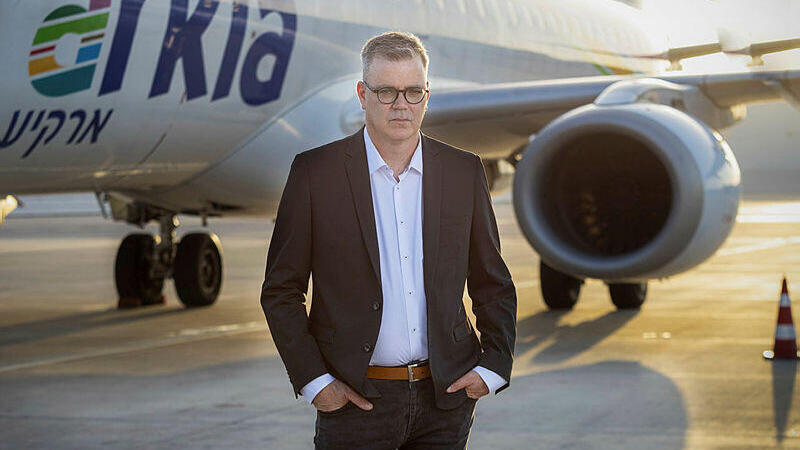
Arkia CEO Oz Berlowitz
(Photo: Avigail Uzi)
"The company's management remains focused on day-to-day operations and continued development, even during the current challenging period, against the backdrop of rising fuel prices and changing geopolitical conditions. The company continues to operate responsibly, make the necessary adjustments and prioritize its customers and employees."
Previous merger attempts failed
Israir's interest in Arkia is not new. In 2021, during the COVID-19 crisis, Arkia sought to advance a merger with Israir, and a three-way merger involving El Al also was examined. Preliminary merger discussions between Arkia and Israir reportedly were renewed in late 2023, but none of these efforts resulted in a deal.
One of the main obstacles to an acquisition or merger is the Israel Competition Authority, which previously blocked an attempted merger between El Al and Israir over concerns about reduced competition. A check with the authority found that Israir has not yet submitted a merger application involving Arkia, and the regulator could ultimately oppose such a deal.
Arkia has been up for sale for about a year and a half. The Nakash family, which controls the airline, decided to sell its holdings and appointed Hormaro to oversee the process, but negotiations with prospective buyers have repeatedly failed. The most recent potential buyer whose name emerged was American Haredi investor Ezra Unger, but those discussions also failed to produce an agreement. One issue raised during the talks was employees' refusal to accept his demand that the airline suspend operations on Shabbat.
Employee ownership complicates sale
Beyond disagreements within the Nakash family, a major complication in any sale of Arkia is that employees own 20% of the airline's shares. Over the years, disputes have emerged between employees and the owners on various issues, including the current disagreement over financing.
The Nakash family is willing to inject capital into the company, but employees, who do not intend to contribute additional funds themselves, refuse to accept dilution of their ownership stake.
Arkia has undergone a significant transformation in recent years, strengthening its brand and substantially expanding operations, partly by using aircraft leased together with their crews. The airline is privately held, and its financial statements are not publicly disclosed.
According to sources close to the company, Arkia was profitable in 2024 and 2025 but has accumulated losses this year. Those losses stem from a sharp rise in jet fuel prices and the launch of new routes, including its service to the United States, which is still operating at a loss.
Because approximately 50% of Arkia's flights are operated using aircraft leased with their crews, its profit per flight is lower than El Al's.
Arkia is estimated to end the year with losses of $30 million to $40 million. The company needs a capital injection, but the funding has been delayed. The owners have made their investment conditional, in part, on employees agreeing to a restructuring plan, while employees remain unwilling to see their holdings diluted.