

The end of the Gaza war has pushed the Tel Aviv Stock Exchange to new highs, sharply reduced risk levels reflected in falling government bond yields, and strengthened the shekel. Yuval Bar-Even, portfolio manager for Mivtachim at Migdal, discussed with Calcalist how the ceasefire agreement is reshaping Israel’s financial markets.
“I think this agreement marks the end of two very difficult years,” Bar-Even said. “After years of reservists being called up, disruptions for employers, visible and hidden boycotts of Israel, and canceled arms deals, alongside heavy fiscal strain from the cost of war, I hope we’re now turning a corner.”
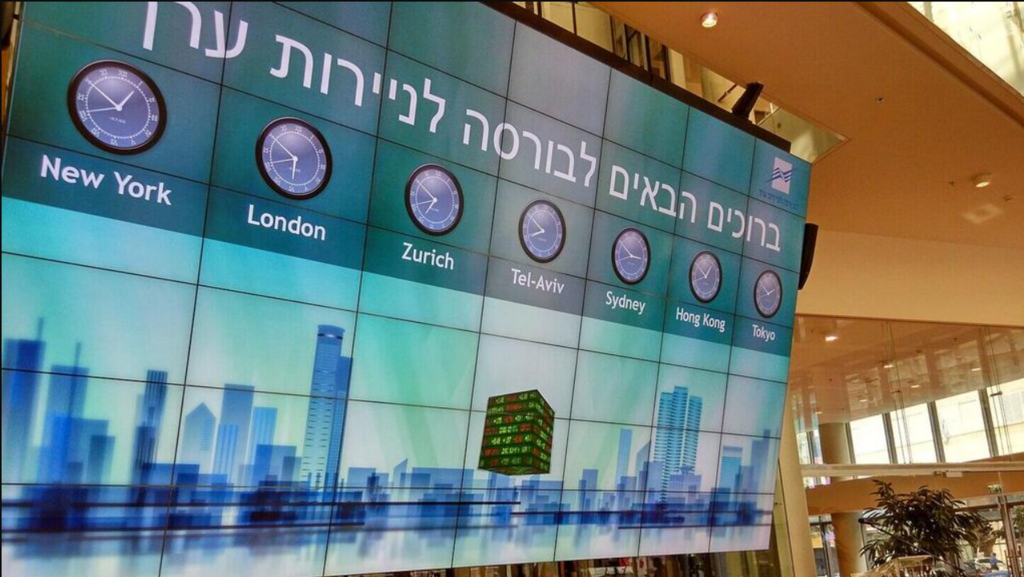
Tel Aviv Stock Exchange
(Photo: Wikipedia)
According to him, the signs are encouraging. “This isn’t the time to sell,” he said. “We’ve seen money flow out of local markets into the S&P 500. If even one-eighth or one-tenth of that money returns, it will be significant. In fact, we’re already seeing some money moving back into Israeli funds, even if not in large volumes yet.”
Bar-Even said the drop in government bond yields has effectively lowered financing costs for both the government and corporations. “It’s like an interest rate cut before the central bank acts,” he said. “This reflects a decline in Israel’s risk premium. We see this clearly in the shekel, and it could continue. If investors who moved money abroad, particularly into the S&P 500, bring some back, it would increase demand for both the shekel and Israeli equities.”
Currently, the yield gap between 10-year Israeli and U.S. bonds is about 100 basis points. “If the risk premium keeps shrinking and returns to prewar levels, that gap could narrow to 60–70 points,” he said.
Asked whether the current rally still has room to grow, Bar-Even replied: “The market is a reflection of scenarios. Until now, investors priced in a 70–80 percent chance of a deal. There’s still some upside until the agreement is finalized. I don’t expect a rally like the one we’ve seen, but there’s still room for further gains.” Bar-Even believes the end of hostilities could also influence Israel’s credit outlook. “In the medium term, rating agencies could at least raise Israel’s outlook,” he said. “Security uncertainty was one of the main reasons for the downgrade. Given Israel’s strong debt-to-GDP ratio within the OECD, there’s no reason not to.”
Among the sectors likely to benefit, he highlighted residential and commercial real estate. “Housing is affected by interest rates and public sentiment, so if rates fall, we’ll see an impact. Commercial real estate will also benefit from lower rates and a postwar consumption boom. That’s why we’re seeing those stocks climb.” Infrastructure companies also stand to gain, he said. “There’s a lot to rebuild, and Israel may supply materials for Gaza’s reconstruction. That supports infrastructure firms. Telecommunications companies could also profit as foreign airlines resume flights, increasing roaming package sales—though eSIM technology poses new competition.” Renewable energy companies could see an indirect boost, Bar-Even added, since lower financing costs improve their margins.
As for sectors that might underperform, he pointed to defense companies. “Demand from the IDF will likely fall somewhat, though they’ll still restock, and export opportunities could rebound now that international deals are no longer being canceled,” he said. Food retailers that benefited from Israelis staying home during the war may also lose momentum as travel resumes, and competition could rise again in aviation and apparel. “After wars, consumption usually spikes, but if travel returns, people might buy more abroad,” he said.
Regarding IPOs, Bar-Even said a new wave is already underway. “The concern is a return to 2021, when many weak companies went public and some didn’t survive. I expect more offerings, but investors will differentiate—strong companies will attract demand, while weaker ones will be priced accordingly.”
Looking ahead, he cautioned that risks remain. “Diplomatically, the situation is unprecedented, with the U.S., Turkey, Qatar, and Egypt involved. But we’re dealing with a terror organization, not a state, so disruptions can happen,” he said. Economically, he noted, “Consumption has been relatively high, and if infrastructure spending is cut, that could create challenges. Still, Israel’s economy is strong enough to handle it.”
Bar-Even concluded that Israel faces a key challenge in rebuilding its reputation. “Returning to normal after two years isn’t simple. Some still don’t want to be associated with Israel. A ceasefire doesn’t immediately restore the country’s image. We need to rebuild the brand of doing business with Israel. There are challenges, but the outlook is good.”