

The construction project EIN KAREM TOWER, also referred to as the "Jerusalem Burj Khalifa," is far from beginning but has already sparked numerous objections, primarily due to its height and location. The tower, which will combine residential, industrial, and commercial spaces, is expected to rise 40 stories high in the Epstein complex in Jerusalem, near Ein Kerem, Mount Herzl, and Yad Vashem. Until now, the ambitious project's developers have avoided public exposure but are now changing their strategy. This Thursday, May 8, the Subcommittee for Appeals of the National Planning Council will hold a discussion on the plan, and ahead of it, Amnon Merhav, former Director-General of the Ministry of Economy and the Jerusalem Municipality, who is currently managing the project, has decided to speak publicly for the first time.
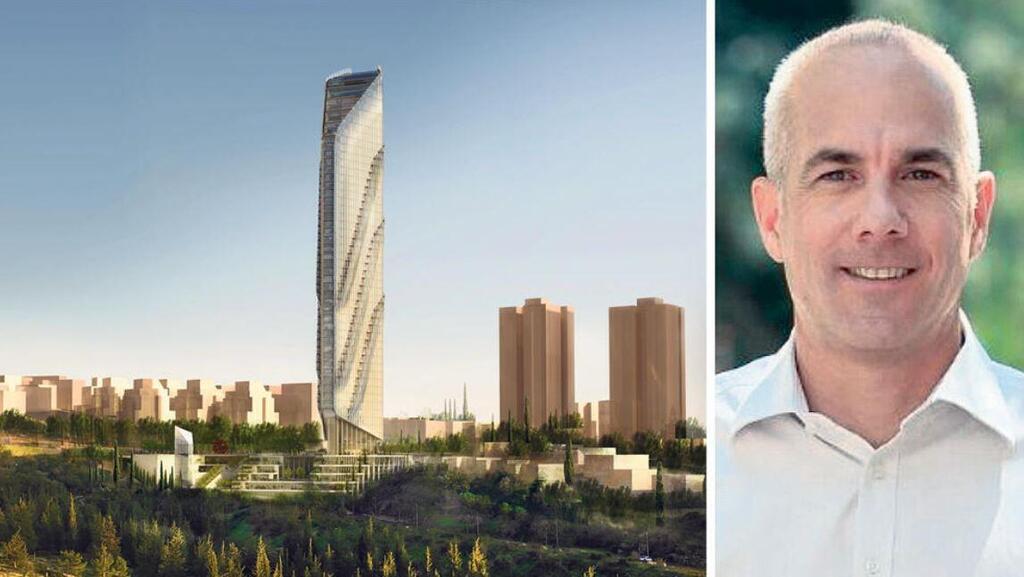
Amnon Merhav and an approximation of the project
(Photo: Calcalist)
"The objections to the project are politically motivated, meant to attack the mayor, and lack any legitimate planning arguments," Merhav claims in an interview with Calcalist. The Appeals Committee will review objections submitted by attorney Yossi Havilio, Deputy Mayor of Jerusalem, Dr. Yuval Sheiner, Chair of the Community Administration of Yuvalim, and the Israeli Association of Architects and Urban Planners. These objections were filed with the National Planning and Building Council following the district committee's decision. Discussions in the National Council's Appeals Committee are extremely rare, and in this case, the recommendation of the Jerusalem District Committee Chair was required. While the Chair approved holding the discussion, they clarified that "the plan displays noteworthy architectural quality and a substantial upgrade to the public infrastructure."
Until now, the developer listed in the project's documents was the ultra-Orthodox entrepreneur Ilan Rosenthal. The additional investors had not been disclosed. Merhav is now clarifying the situation: "The company M.O. Epstein is controlled by Ilan Rosenthal, who has been involved in construction in Israel for 35 years. Other shareholders include Lev Leviev, who owns approximately 35%, Mizrahi-Tefahot Bank with 12%, and adv. Dror Waxler, who holds about 2%."
As part of their preparation for the Appeals Committee discussion, the developers created a five-minute video featuring simulations illustrating how the tower fits into the vision of 500 towers being promoted by Jerusalem Mayor Moshe Lion. The video showcases architect Yigal Levi, who represents architects Gordon Gill and Adrian Smith, designers of the Burj Khalifa in Dubai. "The tower will become a new icon for the city. It’s an international structure where people can take Instagram-worthy photos, turning it into a significant landmark, much like other iconic locations worldwide. The entire complex will become part of the city's renewed fabric," Levi says in the video.
Shira Talmi-Babai, Chair of the Jerusalem District Planning Committee, also appears in the video, stating: "This entire corridor is full of approved towers. Across the street, there are two towers, and on the other side, there are 30-story structures. This will be a very strong development axis, and it’s perfectly fine. The light rail passes here, it’s on the edge of the city, and people will enjoy the view while preserving open spaces."
The plot designated for the project is triangular, bordered by Kiryat Hayovel Street to the south, the road descending into Ein Kerem to the north, the light rail’s park-and-ride lot to the east, and Shmaryahu Levin Street to the west. The current building on the plot previously housed a yeshiva and is now leased to the Jerusalem Municipality for use as a school. "Ilan Rosenthal is an ultra-Orthodox individual and a real estate genius," Merhav shares. "He engages in classic entrepreneurship. He doesn’t purchase land from the Israel Land Authority (ILA) with ready-made development plans but instead buys private land and upgrades it. Ilan recognized the potential of this plot at the entrance to Kiryat Hayovel and understood it was ideal for construction. We've been in planning processes with the district committee for seven years. The current zoning plan allows for two 20-story towers. However, the district committee suggested, as their idea, consolidating the construction into one tall structure with a footprint of 770 square meters, leaving as much open space as possible with views."
The ambitious project's estimated cost is 1 billion shekels. In September 2024, the Objections Committee of the Jerusalem District Planning Committee approved the plan after reviewing 196 objections. The plan includes the construction of a residential, commercial, and employment tower on a 7-dunam plot on the Herzl-Hantke Boulevard axis in Jerusalem, overlooking Ein Kerem. Due to the sloped nature of the plot, the tower will rise 40 stories above Kiryat Hayovel Street, with an additional four stories facing Ein Kerem and four subterranean levels. Following recommendations from the Jerusalem Local Committee, the district committee decided to lower the tower’s height by 30 meters after objections, but the number of floors will remain at 40. This change will be achieved by reducing the height of the upper floors, which were initially designed to be twice the standard height.
One vocal opponent of the plan is Professor Eran Feitelson, a researcher and lecturer in geography and planning at the Hebrew University. He argued that constructing such a tower "will overshadow Mount Herzl and Yad Vashem, constituting an invasive disruption to the area. The plan undermines the fundamental values of Israeli planning in western Jerusalem for the sake of momentary entrepreneurial profit. The only ones who might benefit are foreign residents and the upper 1%, at the expense of the landscape. This plan belongs in the trash bin of grandiose schemes occasionally proposed in Jerusalem." The Yad Lebanim organization, representing bereaved families, also initially opposed the plan, claiming that building a massive tower near Mount Herzl would cause "severe emotional harm" to families. However, they later withdrew their objection.
Merhav remains confident the plan will be approved. "When you look closely, there are no real planning arguments in the objections," he says. "The opposition discourse has evolved from calling it an ugly, shocking tower to acknowledging its beauty. The main discussion now revolves around its location, near Mount Herzl and Yad Vashem. Take note of who isn’t among the opponents: major representative bodies like Yad Vashem and the World Zionist Organization, which technically owns Mount Herzl. As someone with experience in planning and building law and as a former Director-General of the Jerusalem Municipality, I can say the opposition is primarily political, intended to attack the mayor. A small fraction of opponents hold outdated planning views that harm Jerusalem."
Who will live in the tower?
"It will include nearly eight floors of rental housing and 50 small apartments. This is not a project for the global elite. It’s the kind of venture Jerusalem’s pluralistic sector should embrace. About 90% of the residents will be productive individuals. You won’t see an ultra-Orthodox population here because they don’t live in towers – it doesn’t suit their housing preferences. Moreover, the tower policy is attracting the diverse populations Jerusalem desperately needs. We need to let go of the fear of ghost apartments for the wealthy. This isn’t Mamilla’s David Village. There won’t be 250-square-meter apartments here; only average-sized ones."
What about claims that the project diminishes memorial sites?
"At the Appeals Committee’s request, the municipality prepared simulations showing Jerusalem’s skyline in a few years. Mount Herzl is at the heart of the city, surrounded by more and more towers being built. This doesn’t diminish the site; on the contrary, it symbolizes the nation’s revival and reconstruction."