

Israeli cybersecurity company XM Cyber is selling its intellectual property, but most of its employees in Israel have already been laid off. Calcalist has learned that of the company's approximately 300 employees in Israel, only 50 remain, primarily serving existing customers. In fact, the company has carried out extensive layoffs since the initial announcement in July that it would sell its technology to CrowdStrike. XM Cyber employed 400 people worldwide, 75% of them in Israel.
On Tuesday, XM Cyber sought to present the sale as a $600 million exit, but the reality is more complicated. While the company acknowledged that it was undergoing restructuring following the deal with CrowdStrike, it sought to downplay the scale of the layoffs.
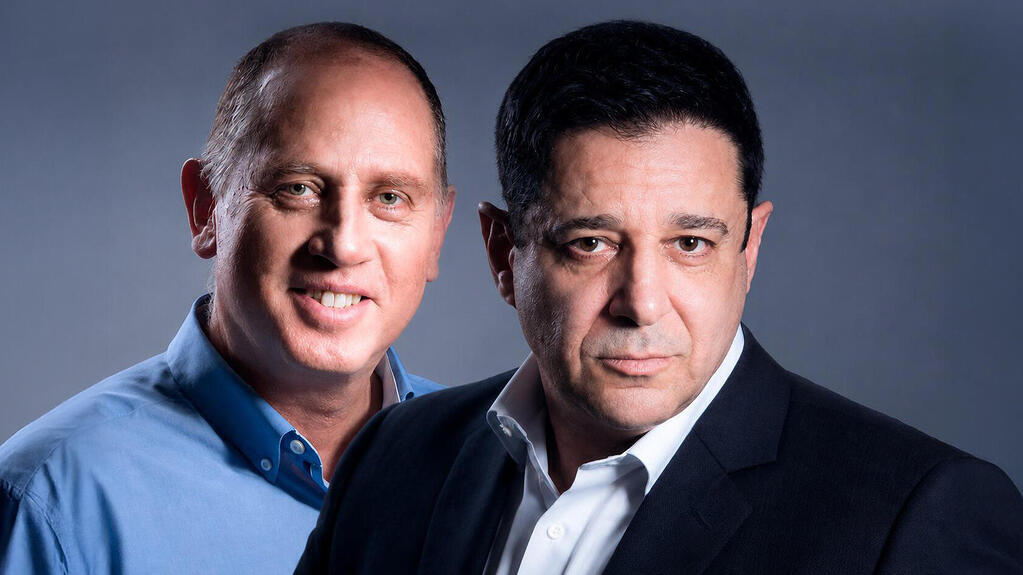
XM Cyber co-founders Boaz Gorodissky and Noam Erez
(Photo: Yoram Reshef)
Cybersecurity giant CrowdStrike announced in July that it was acquiring the technology of Israeli cybersecurity company XM Cyber. At the time, the company did not disclose the purchase price, as the deal, conducted largely in stock, was considered immaterial. The only amount specified when the agreement was signed was $145 million in cash, with an additional stock component to be determined upon completion.
Now, with the acquisition finalized, CrowdStrike has disclosed the full $600 million transaction value in a filing with the U.S. Securities and Exchange Commission (SEC). The stock component significantly increases the value of the deal. XM Cyber's owners will receive 2.1 million CrowdStrike shares valued at $208 each. Combined with the cash payment, the transaction represents the largest amount ever paid for technology assets rather than an entire company, according to the report.
CrowdStrike's share price has risen further since the deal closed, allowing XM Cyber's founders and employees to benefit from the increase. With the acquisition complete, XM Cyber is expected to undergo a major restructuring, including significant layoffs affecting its workforce, including in Israel.
According to the company, all employees will benefit financially from the exit based on the stock options they hold. Market estimates put the total value of employee payouts at tens of millions of dollars. Substantial retention bonuses are also expected for employees who remain with the company in the coming years.
The biggest beneficiary of the deal is Germany's Schwarz Group, which acquired XM Cyber five years ago for $700 million.
XM Cyber was founded in 2016 by former Mossad director Tamir Pardo, along with Noam Erez, Boaz Gorodissky and businessman Shaul Shani. Pardo is no longer involved in the company and holds no position there. Erez serves as CEO, while Gorodissky is chief technology officer.
The company still employs Israeli staff at its offices in Herzliya, although the center of its operations has shifted to Germany. XM Cyber developed technology for simulating cyberattacks and identifying potential attack paths within organizations' networks.
In 2021, XM Cyber was sold for $700 million after raising just $48 million in funding, generating substantial returns for its founders and early investors. However, Schwarz Group appears to have struggled to develop the business as it had hoped, ultimately leading to the sale to CrowdStrike.
One possible explanation is that Schwarz Group is primarily a major retail conglomerate rather than a technology company. It sought to expand into cloud computing and digital services during the peak of the technology boom.
CrowdStrike has now clarified that it is acquiring XM Cyber's source code and 45 patents, but not its revenue streams or customer base. The remaining XM Cyber business will be able to continue operating under a license to use the technology from CrowdStrike. According to estimates, XM Cyber currently has an order backlog worth approximately $450 million.
Meanwhile, CrowdStrike is currently in negotiations to acquire another Israeli cybersecurity startup, Orion, for approximately $500 million In recent years, the cybersecurity giant has acquired several Israeli startups, including Seraphic Security for $400 million earlier this year, Adaptive Shield and Flow Security in 2024 for a combined $700 million, and Bionic for $350 million in 2023.