


On Tuesday, November 3, Americans will head to the polls for the midterm elections, with all 435 seats in the House of Representatives, 35 of the Senate's 100 seats, 36 governorships and thousands of local offices up for grabs. Republicans currently control both chambers of Congress, but recent polls have shown a Democratic advantage, raising questions about the extent of the party's potential gains.
One possible consequence of a significant Democratic victory would be a larger progressive presence in Congress. The scenario outlined in Calcalist's original report envisages roughly 100 lawmakers identifying as progressives, including between five and 10 who call themselves socialists.
Gallery
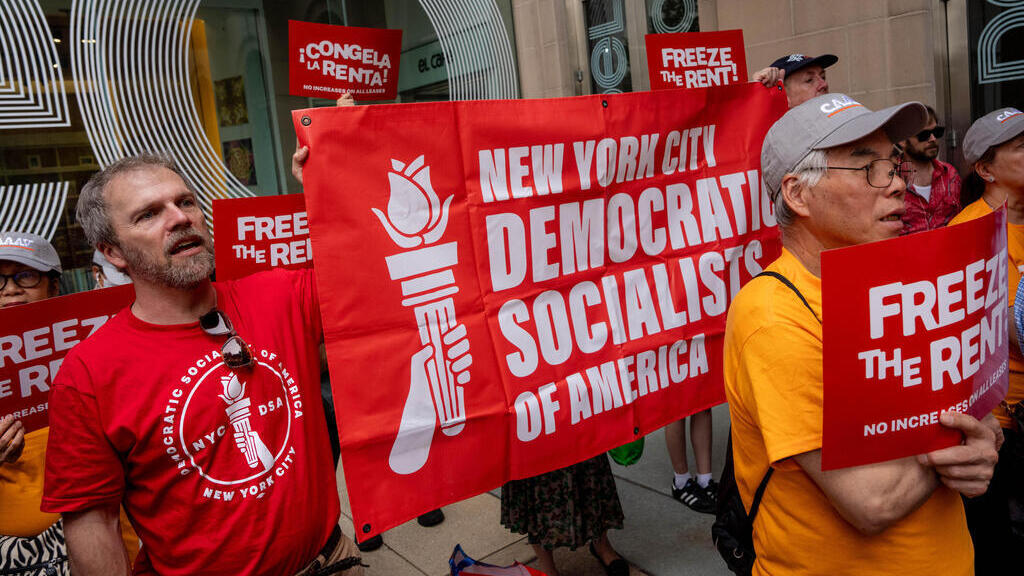
Democratic socialist protesters in New York in June. A Gallup poll found that 43% of Americans now view socialism favorably
(Photo: Adam Gray/Bloomberg)
These politicians generally favor economic policies associated with Western European social democracy. As they seek greater influence over the direction of the American economy, and perhaps even over how the country sees itself, their ideas are enjoying a level of public acceptance not seen in decades.
Two weeks ago, comedian Larry David published a satirical essay that went viral, poking fun at the Democratic Socialists of America (DSA), an organization associated with prominent politicians including New York City Mayor Zohran Mamdani and Rep. Alexandria Ocasio-Cortez.
Published in the digital magazine Air Mail, the essay offered a series of mocking additions to the DSA platform: paid leave for employees whose pets die, mandatory beds at workplaces to accommodate two naps during the working day, permission for people who identify as animals to relieve themselves wherever they wish, and a reparations scheme under which white people would become servants to Black families.
The humor aside, what was more striking was what David chose not to mock: the reasons socialism is experiencing an extraordinary revival in America, perhaps its most significant since President Franklin D. Roosevelt's New Deal in the 1930s.
Those reasons include growing public demand for government-funded health care, expanded public housing, a higher federal minimum wage, tuition-free education and affordable child care.
David, whose comedic genius made him a multimillionaire, might well agree with many of those goals. They are increasingly appealing to young Americans who look toward the future with a growing sense of despair.
John E. Roemer, 81, is one of the leading socialist thinkers in American academia. He taught at Yale University for more than two decades and has written 15 books, including A Future for Socialism, published in 1994, shortly after the collapse of the Soviet bloc, at a moment when others were confidently declaring socialism dead.
Roemer's parents were socialists, and he has held socialist views since childhood. Yet even he cannot recall a moment of comparable optimism for his political camp.
"I'm very surprised by the current rise of socialism," Roemer told Calcalist Magazine. "I think there's definitely an ideological shift taking place in the United States, and it's much easier today to run on a left-wing platform. Mamdani's victory was quite significant."
"I don't know whether that means an openly socialist candidate can run anywhere in the United States. We're probably not there yet. But the mayor of the country's most important city ran on an explicitly social-democratic platform, won, and in his first year is already fulfilling many of his campaign promises. People can see that it isn't what they were frightened into believing. Everyone is happy to send their children to daycare for free."
Don't call me a socialist
The word "socialist" carries enormous political weight in the United States. The Cold War remains deeply embedded in the country's collective memory, while millions of immigrants who fled authoritarian regimes in Central and South America carry genuine trauma associated with the political systems they left behind.
For Republicans, labeling Democratic presidential candidates socialists has long been almost automatic. John F. Kennedy was portrayed as a socialist controlled by communists. Bill Clinton was called a socialist. Barack Obama was labeled both a socialist and a communist. Hillary Clinton received the same treatment. Joe Biden, whose family experienced financial hardship in Pennsylvania, was also branded a lifelong socialist.
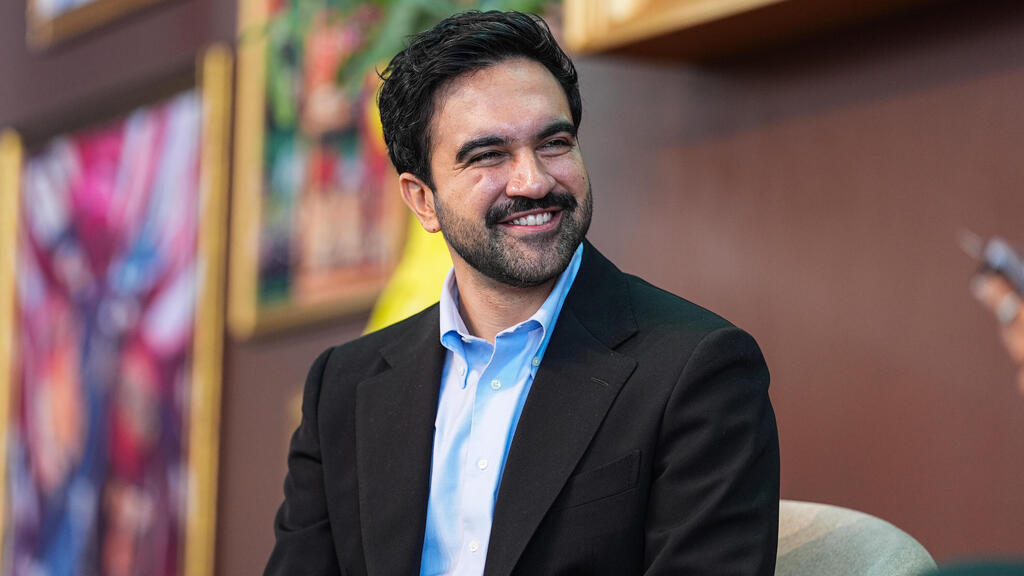
New York City Mayor Zohran Mamdani
(Photo: John Nacion/Getty Images)
Over the years, however, the Republican practice of applying the label to almost every prominent Democrat gradually weakened its political impact. To many observers, mainstream Democrats appeared to offer little more than a somewhat more moderate version of the economic policies embraced by Republicans.
In recent months, though, socialism has returned to the center of the political debate. This time, there are prominent Democrats who openly identify with the ideology.
President Donald Trump has repeatedly depicted the socialist left as a grave threat to the United States. In remarks attacking what he described as communism, he compared the danger to a cancer that spreads unless it is stopped.
But the hostility is not confined to Republicans. Much of the Democratic establishment also wants little to do with politicians who identify as socialists, some of whom are outspoken opponents of Israel.
After several sitting Democratic lawmakers lost their primaries to left-wing challengers, establishment figures resisted supporting the winners.
"If you're a socialist, you're not a Democrat," declared New Jersey Democratic Rep. Josh Gottheimer.
"We are capitalists, not socialists," read a letter signed by a group of House Democrats.
Mamdani himself encountered substantial resistance from senior Democrats after winning his party's mayoral primary. Senate Democratic leader Chuck Schumer, also from New York, declined to endorse him. House Democratic leader Hakeem Jeffries held out for months before finally endorsing Mamdani in October 2025, shortly before the general election.
Despite the excitement surrounding the movement, polling indicates that support for socialism, while growing, remains limited.
A Gallup survey published in September found that 43% of Americans now have a positive view of socialism, the highest figure recorded since the organization began tracking attitudes toward the term in 2010. The same proportion expressed a negative view of capitalism, although 55% still viewed capitalism positively.
Until last year, most of the increase in favorable attitudes toward socialism came from Democrats. Their positive rating rose from 50% in 2010 to 66% in 2025.
This year's increase, however, came entirely from political independents. Among that group, favorable views rose from 37% last year to 45% in 2026. Among Democrats, the figure stands at 65%, while among Republicans it remains below 15%.
Yet interpreting these figures is complicated because Americans do not share a single definition of socialism. That confusion appears in almost every survey.
Many Americans consider government-funded health care a form of socialism but do not apply the same label to public schools. When asked about specific policies associated with socialist platforms, respondents often express strong support. When those same policies are explicitly described as socialist, enthusiasm falls.
Health care is a particularly revealing example. Polling cited in the original report points to broad support for government-backed health coverage, a significant change from the political climate before 2016.
When the Affordable Care Act, commonly known as Obamacare, was enacted in 2010, even the possibility of adding a government-run insurance option alongside private insurers generated intense opposition.
Other signs of changing attitudes include support for government assistance with college tuition, longstanding backing for paid parental leave and broad support for publicly funded child care. Surveys also suggest that many Americans favor reducing economic inequality through higher taxes on the wealthy.
The attraction, in other words, may have less to do with revolutionary ideology than with everyday economic pressures.
A renewed promise of a better future
The first socialists imagined a prosperous world in which humanity lived in harmony, but they never managed to agree on how that vision should be achieved.
The familiar struggle between pragmatists and ideological purists exists in every political movement. Yet socialism has survived because when stock markets crash, leaders become corrupt and people need loans just to fill their gas tanks, it can offer, at least in theory, the possibility of something better.
These are pressures Americans have experienced repeatedly in the 21st century.
Asked why an ideology built around fairness and relative economic equality has so often failed and acquired such a damaging reputation, Roemer draws a distinction between socialism and the authoritarian governments that claimed to represent it.
"That failure was really an indictment of autocracy, not socialism," he says. "But we've tried capitalism, and look where it's brought us. So perhaps it's worth giving more equal distribution and a cooperative, democratic economy another chance."
So you're not talking about taking control of the means of production?
"No. People simply want a more expansive welfare state, like the one Israel has had since its founding, for example, and they're interested in redistributing income.
"Income growth among the bottom five deciles of the population has been very slow for roughly 50 years, and that's what bothers people more than anything else. They might express that sentiment as wanting a welfare state, higher wages or a lower cost of living, but it all comes down to the same problem of wealth distribution.
"People feel they haven't been treated fairly. Young Americans know their future won't be as good as their parents' past, when it was supposed to be the other way around."
American socialism's strongest roots are in the cities
The United States has always celebrated individual liberty and remained suspicious of collective solidarity. It is therefore hardly surprising that organized socialism did not emerge there until the late 19th century.
The Socialist Party of America was founded in 1901, and Eugene V. Debs, a labor leader from Indiana, became its most recognizable figure. In the 1912 presidential election, he won approximately 6% of the popular vote, an extraordinary result for a socialist candidate in American politics.
Yet the movement's greatest electoral successes came at the municipal level, another reason Mamdani's victory in New York should not have been entirely surprising.
Milwaukee, for example, had three socialist mayors who governed during much of the first half of the 20th century. They improved water and sewage systems, built libraries and parks, invested in public education and established a tradition of pragmatic municipal socialism that proved popular with voters.
When capitalism collapsed during the Great Depression, Franklin D. Roosevelt, himself one of the wealthiest presidents in American history, created Social Security and launched public works programs that employed millions of jobless Americans.
But the Cold War transformed the political landscape. Socialists and communists were increasingly lumped together as a common enemy, pushing socialism as an ideology into a prolonged period of political isolation.
When communist regimes eventually collapsed, it appeared that American socialists might disappear altogether. By the beginning of the 21st century, the Democratic Socialists of America had only about 5,000 members.
Today, the organization has grown to more than 120,000.
History, however, rarely follows a straight line.
The financial crisis of 2008 sent millennials into the worst job market since the Great Depression, leaving many receptive to the ideas promoted by Bernie Sanders, the Jewish senator from Vermont who has described himself as a democratic socialist throughout his political career.
Sanders failed to win the Democratic presidential nomination in 2016, but a decade later his influence on American politics is unmistakable.
"Sanders made this vision accessible and popular because he genuinely believes in it and doesn't apologize for it," Roemer says.
Why did the 2008 financial crisis push millennials, and later Generation Z, toward socialism?
"The fact that nobody went to prison after the 2008 financial crisis, not the heads of the big banks and not those responsible for the collapse, and that even Obama didn't punish them, broke something in the younger generation that grew up during that period. People lost their homes. Young people were deeply disappointed."
Maybe the American political DNA simply cannot accommodate policies based on sharing and mutual sacrifice?
"The only way to bring about change is to try to make people care about other people. There are ways to develop solidarity.
"Crises are events that begin a chain of developments that can lead people to change their values. Economic crises reduce everyone to the same situation: loss of wealth, unemployment or losing a home. In those circumstances, it's easier to create some form of universal insurance.
"A society in which nobody is without health insurance is a more pleasant society for everyone. Social Security also faced tremendous opposition when Roosevelt introduced it, and conservative ideologues still oppose it today and try to eliminate it. But older conservatives all over the country love it."
A changing Democratic electorate
Perhaps the most important reason for the current political success of democratic socialists is their recognition that the pragmatists were right about how to gain influence.
"This is the first time that a socialist organization has decided, as a tactic, to run in elections within the Democratic Party rather than independently," wrote Michael Kazin, a history professor at Georgetown University.
Still, taking over the Democratic Party from within, as conservatives associated with the Tea Party movement did within the Republican Party, may prove considerably more difficult.
Until recently, the main obstacle was the Democratic Party's relatively moderate voter base. But that electorate is changing.
Millennials are now entering politics not only as voters but also as members of Congress and mayors. More importantly, Generation Z is beginning to exert its own political influence.
Some Democrats argue that this is precisely the moment when their party should reaffirm its commitment to capitalism. But the growing support for progressive economic policies suggests that the party's internal debate is moving in a different direction.
Ideas associated with the socialist left, including government-funded health coverage, public employment guarantees, major infrastructure investment, universal preschool and tuition-free higher education, have increasingly entered the Democratic policy conversation.
A September New York Times/Siena University poll illustrated both the opportunities and limitations facing the movement. Only 13% of likely voters said they would prefer a Democratic candidate who identifies as a democratic socialist, while 44% said the label would make no difference to their choice.
The same survey found that 51% viewed socialism unfavorably, compared with 31% who viewed it favorably. The results suggest that many voters may be more receptive to individual progressive candidates or policies than to socialism as an ideological label.
For Sanders and his supporters, however, the growing movement represents the culmination of years of political organizing.
"We are on the verge of the political revolution that we have fought for so long," Sanders said this month.
Tuesday's midterm elections, and perhaps even more importantly the 2028 presidential election, could provide a clearer indication of whether the movement's recent gains represent a lasting realignment in American politics or a more limited response to the country's economic frustrations.
What is already clear is that socialism, once one of the most politically toxic words in the United States, has become part of a serious national argument about who benefits from the American economy and what government should do for those left behind.