

Israel’s civil aviation chief warned that the large presence of U.S. military aircraft at Ben Gurion Airport is severely disrupting Israeli airlines and the country’s aviation industry, in a move he said could drive up ticket prices.
Shmuel Zakay, director general of the Civil Aviation Authority, wrote to Transportation Minister Miri Regev and ministry Director General Moshe Ben Zaken that turning Israel’s main international airport into what he described as a military base is harming the return of foreign airlines and threatening the financial stability of Israeli carriers.
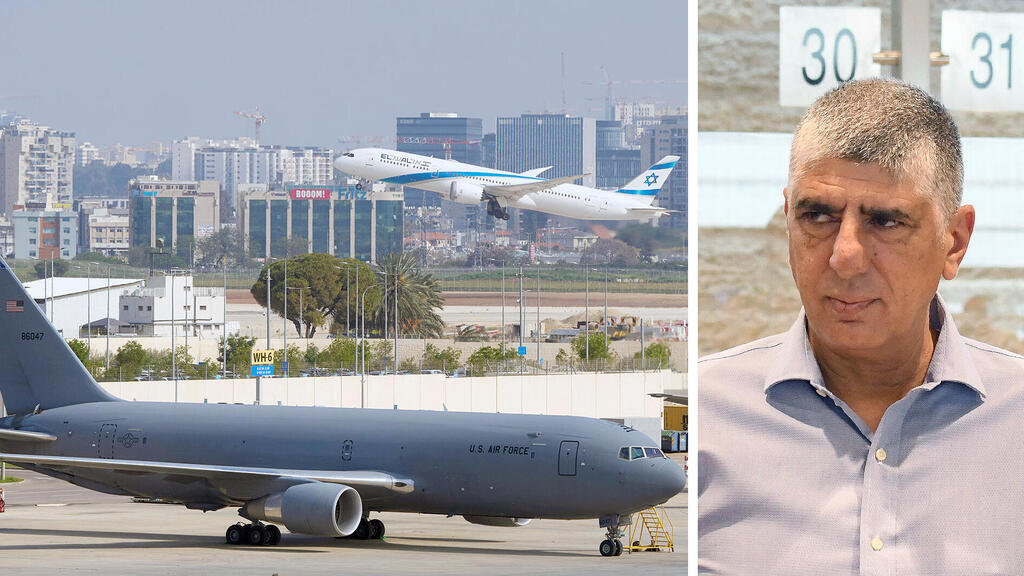
US military aircraft at Ben Gurion Airport; Civil Aviation Authority Director General Shmuel Zakay
(Photo: Ohad Zwigenberg/AP, Yair Sagi)
At the start of Operation Roaring Lion, launched Feb. 28 as part of the war with Iran, Israeli airlines moved many of their aircraft abroad. They have yet to return all of them to Israel. Israir CEO Uri Sirkis told the Knesset Economic Affairs Committee on Sunday that the airline, which normally keeps 17 planes at Ben Gurion Airport, is currently allowed to park only four there overnight. The situation, he said, is making flights more expensive and limiting the number of flights Israeli airlines can operate.
In his letter, Zakay said the prolonged tension and regional instability are having a dramatic effect on civilian aviation worldwide, especially in the Gulf and the Middle East.
“The stringent working assumption is that this crisis and regional instability will continue for months and spill into the summer,” he wrote.
The former IDF general said the massive presence of U.S. aircraft at Ben Gurion Airport is severely harming Israeli airlines’ ability to operate efficiently and increase the number of flights. It is also hurting foreign airlines’ ability to resume service to Israel.
“It appears the defense establishment lacks sufficient understanding of the severity of the damage to civil aviation and the effect the number of flights has on prices and on all citizens of the country,” Zakay wrote. “The defense establishment is preventing the Transportation Ministry from fulfilling its role and responsibility. In the current situation, the State of Israel does not have an international airport that can operate efficiently. Ben Gurion Airport has become a military airfield with limited civilian activity.”
Zakay defended Israeli airlines, saying they have been badly hurt by the removal of Israeli aircraft from Ben Gurion and restrictions caused by the American planes. He said the situation poses a real threat to the stability of Israel’s smaller airlines, compared with El Al: Israir, Arkia and Air Haifa.
Those companies, he said, are being forced to operate with expensive jet fuel and difficult, costly operating conditions as demand for flights at Ben Gurion grows.
Zakay urged Regev and Ben Zaken to work to remove U.S. aircraft from Ben Gurion and transfer them to other military airfields.
“Ben Gurion Airport is the main civilian airport of the State of Israel. Turning it into a military base harms not only the airlines, but all citizens of the country,” he wrote.
He also requested financial assistance for Israeli airlines. The current aid package does not compensate carriers for lost revenue, but reimburses them for millions of shekels spent on parking aircraft and crews abroad — costs airlines do not normally pay when operating from their home airport.
Zakay said any state assistance should be conditioned on airline owners injecting an equal amount of capital into the companies, similar to previous aid models.
The cost issue is also being passed on to consumers, Zakay said. Without parking space at Ben Gurion, foreign airlines cannot return to Israel, and the limited number of flights is reducing supply and increasing prices.
Zakay asked Regev, who is a member of the decision-making Security Cabinet, to act immediately to evacuate the U.S. aircraft fleet from Ben Gurion. He also called for an interministerial team with representatives from the finance and transportation ministries and Israeli airlines to help stabilize the companies and increase flight supply.
The state of Israeli aviation was also discussed Sunday at the Knesset Economic Affairs Committee, which considered compensation for passengers stranded abroad — another financial burden on airlines.
Sirkis said that as long as Israel remains under a home front emergency designation, the Aviation Services Law, known in Israel as the Tibi Law, which defines compensation for passengers stranded abroad, is irrelevant because it does not apply when routine aviation services are unavailable. He said the situation also undermines foreign airlines’ motivation to return to Israel.
Shlomi Zafrany, El Al’s vice president for commercial and international relations, told the committee that operating from abroad rather than Israel carries major financial and logistical consequences.
“It is important to understand what it means for an Israeli company to operate from abroad and not from Israel, without coordination with foreign authorities,” he said. “There are many economic and operational implications.”
Or Libis, senior deputy director general for economics, budget and strategy at the Transportation Ministry, said that following a meeting with airline CEOs, Ben Zaken ordered the issue to be examined with the Finance Ministry and for a framework to be found.