

As Israel closes the chapter on 2025 and looks toward 2026, few voices sit at the intersection of capital, philanthropy and national responsibility as clearly as Shira Ruderman. A senior figure in Israel’s investment and fund-management landscape, Ruderman joined ynet Global in the studio at a moment shaped by economic volatility, political instability and prolonged war.
Looking back, she described 2025 as a year defined less by any single event than by a constant sense of uncertainty. “Instability was the fundamental feeling,” she said. “Every day felt like adding another challenge to an already overflowing bucket.” Managing capital under such conditions, she explained, meant navigating not only markets but people, institutions and communities under pressure.
Studio interview Shira Ruderman


The challenges, she stressed, could not be separated into neat professional and personal categories. “In reality, it’s all mixed,” Ruderman said. As a mother, a Jewish leader active in the United States and Israel, and a board member across multiple organizations, she found that values and emotions inevitably shaped day-to-day decisions. Rising antisemitism abroad, the war in Israel and concern for children—both at home and serving in the army—blurred any boundary between leadership and personal responsibility.
At the core of her approach, Ruderman said, is an insistence on remembering that institutions ultimately exist to serve people. “When we say organizations or initiatives, we are talking about human beings,” she said. Decisions around funding, staffing or strategy translate directly into whether someone receives medical care, food assistance or emotional support during wartime. Leadership, in her view, meant pushing forward while fully acknowledging exhaustion, fear and grief. “It’s not just staying alive,” she said. “It’s moving things forward, even if only a little at a time.”
That experience reshaped how she now defines risk. Ruderman said the past year amplified a belief she always carried: people come first. After Oct. 7, she acknowledged, her priorities narrowed sharply. “I didn’t care about anything other than what was best for Israel and my people,” she said. Opinions may shift, she added, and relationships may change, but values cannot. “You do not change who you are because times are uncertain.”
For Ruderman, this values-driven approach naturally ties capital management to national and communal resilience. She rejected the idea that philanthropy, investment and social impact operate in isolation. “Everything is connected—local, national, international,” she said. Resilience, in her view, is not one flagship project or dramatic intervention, but a web of actions: food security, mental health services, youth movements, rebuilding Israel’s south and north, and strengthening Jewish communities worldwide. “Resilience is hundreds of actions and thousands of initiatives,” she said.
Her framework places the individual at the center. Addressing one need without the others, she argued, is ineffective. “If you give someone food but they don’t sleep, is that enough?” she asked. “If they sleep but are hungry, can they function?” Whether dealing with wounded soldiers, first responders or displaced families, Ruderman said solutions must be holistic, even when applied in simple, practical steps.
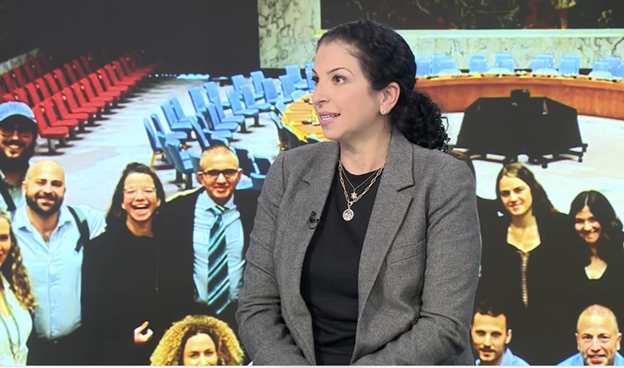
Shira Ruderman
She acknowledged that such an integrated approach is not standard across the investment world. “I say this modestly,” she noted, “but I wish more investors and leaders would think this way.” Doing so, she argued, would save both time and money—two resources in short supply amid what she described as a daily “tsunami of bad news.” Impact, she warned, is harder to achieve when efforts are fragmented and reactive.
Asked how global investors currently view Israel, Ruderman said many professionals understand the country’s underlying economic strengths despite negative headlines. “They know Israel’s resilience is real,” she said. “They know our entrepreneurial DNA cannot be taken away.” At the same time, she acknowledged concrete headwinds: reduced investment volumes and growing barriers for Israeli technologies in global markets. “It’s slowing down,” she said. “But it’s not stopping.”
Looking ahead to 2026, Ruderman said she is watching for scale—specifically, the ability to connect local strength with global reach. Israelis, she observed, often swing between thinking too big and too small. The challenge now, she said, is to hold both perspectives at once. Her own criteria are clear: investments must engage Israeli companies or technologies. “If they don’t, we don’t invest,” she said. “There’s nothing to discuss.”
Underlying that stance is her belief that standing firm on values ultimately leads to long-term success. Even in times of war and crisis, she argued, abandoning those values erodes both trust and impact. Faith, she added, plays a central role in keeping her grounded. “It reminds us that we are just a dot in history,” she said, and that falling apart at times is human—but not a solution.
Partnership, in her view, is equally essential. No country or community can solve today’s challenges alone. Israel’s security and economic future, she said, depend on alliances and shared responsibility, particularly with the United States. True partnership, however, requires humility and recognition of difference. “We are not all the same,” she said. “Each of us brings something unique.”
Ruderman concluded with a challenge to global Jewish leadership. Despite the past two years, she noted, less than 2% of Jewish wealth worldwide is directed toward Jewish causes or the State of Israel. “There is so much more out there,” she said. Rebuilding a shared narrative—one that reconnects Jewish identity, collective destiny and long-term investment—is, in her view, essential.
“I ask people to imagine the next 100 years of Israel and the Jewish people,” Ruderman said. “Most of us don’t yet share the same vision.” Defining that vision, she suggested, may be the most important investment of all.