

“At 55, I have to reinvent myself. I have to walk away from something I am good at and love, and it breaks my heart. I am being forced to close a business that loses money every month, and I have no idea what I will do tomorrow.”
That is how a longtime member of the Israel Diamond Exchange, whose name is being withheld, describes the free fall of one of the country’s most prestigious industries.
He entered the trade after completing his IDF service in 1994, beginning as a salesman before eventually establishing an independent company specializing in large, high-end colored stones known in the industry as fancy diamonds.
At his peak, he sold to Asian markets, operated a branch in Hong Kong and generated annual turnover worth millions of dollars. Today, he says he has been living off his savings for a year and is waiting to sell his remaining inventory before closing the business for good.
“In my assessment, around 50% of the traders at the exchange have already left and are looking for other ways to make a living,” he said.
“When you arrive at the exchange today, it is pure depression. So many offices are closed. I know a diamond dealer who used to sell me merchandise worth millions, and today he walks around the exchange as a money changer, exchanging dollars for people. Others have become taxi drivers or even greengrocers.”
During the industry’s boom years, he said, a dealer in his early 30s could operate alone, without employees, and turn over $10 million.
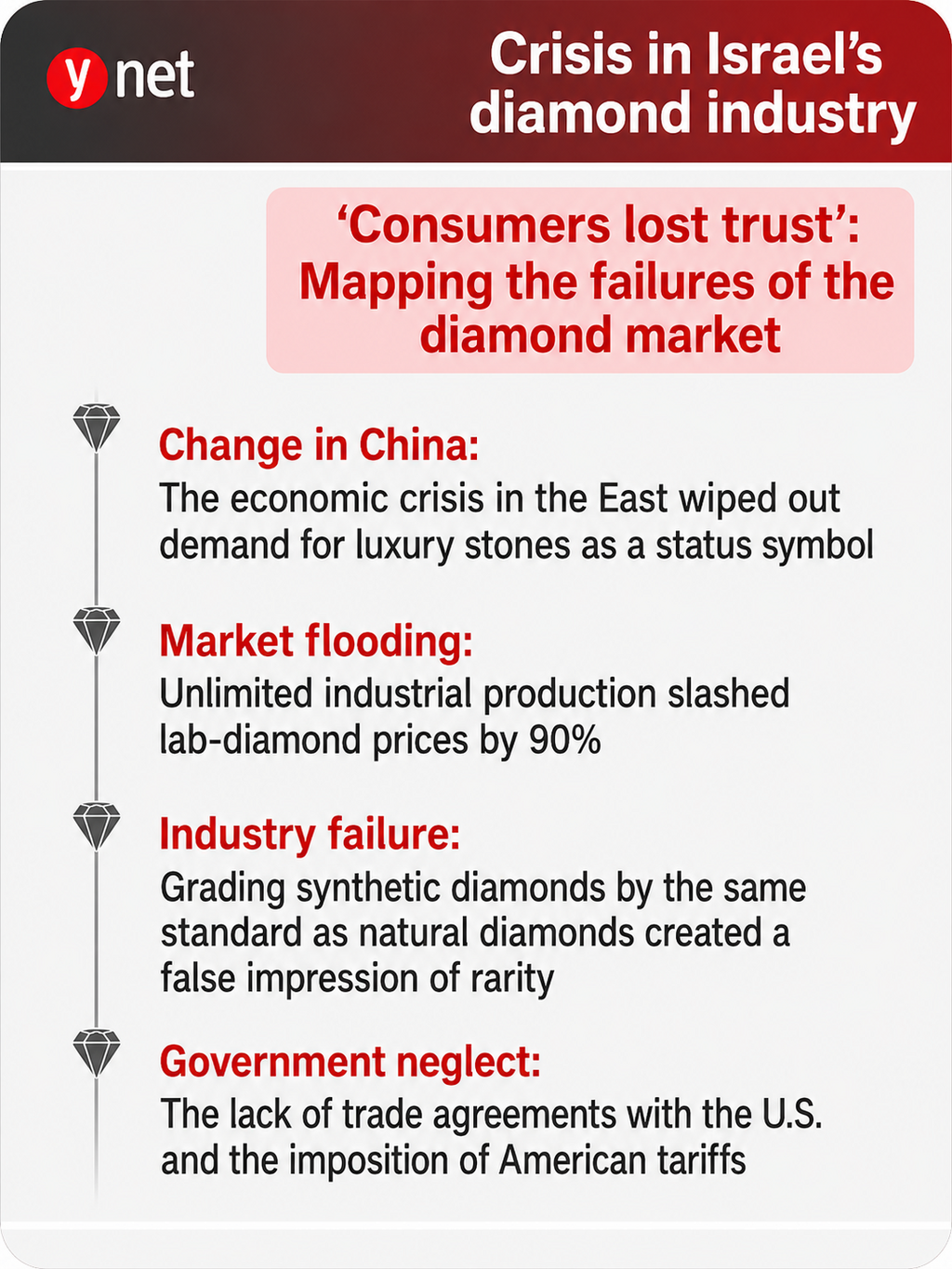
“Today, demand in the East has fallen almost to zero, and the industry is simply disappearing,” he said.
China’s slowdown and a flood of supply
According to the trader, the collapse is the result of a chain of global developments.
“In China, which is undergoing an economic crisis, buying a diamond was a symbol of status and financial security,” he said. “The public there lost confidence in the product because prices plunged.”
At the same time, he said, the expansion of Indian suppliers and years of inventory flooding the market beyond actual demand pushed prices further down.
But in his view, the industry’s gravest mistake was its embrace of synthetic, lab-grown diamonds without understanding the long-term consequences.
“About 15 years ago, they found a way to grow diamonds in a laboratory,” he said. “Had they honestly said from the beginning, ‘We have developed a diamond substitute,’ everything would have been fine. Calling this industrial product a ‘diamond’ was an enormous mistake.”
Consumers were suddenly offered what appeared to be the same product at dramatically different prices.
“They were told, ‘You can buy a one-carat natural diamond for $10,000 or a lab-grown diamond for $3,000,’” he said. “They also used the emotional narrative associated with our product: ‘Propose marriage with a lab-grown diamond engagement ring.’”
That created confusion, he said, and led consumers to ask why they should buy a natural diamond at all.
“I also failed to understand where this would lead us and underestimated the danger,” he said. “Anything that can be manufactured without limit will eventually fall in price. Lab-grown diamond prices have also collapsed sharply.
He now has no choice but to close, he said, although he must first sell the inventory he accumulated over the years.
‘The government abandoned the industry’
Alongside the global crisis, he also accuses the Israeli government of neglecting the sector.
“Belgium secured a 0% tariff on its exports to the United States because it has a government that works for the industry,” he said. “Here, the government abandoned us to our fate.”
About 60% of Israel’s diamonds are sold in the United States, he said, but tariffs imposed by the U.S. administration have made it harder for Israeli dealers to compete.
“No one pays attention to the diamond traders, even though this industry could have flourished here,” he said. “We have no one looking after us.”
The wider economy, he added, increasingly favors high-tech workers and people with academic degrees, qualifications he did not acquire while building his career in diamonds.
“The reality is that the industry in Israel is simply disappearing,” he said.
‘The great identity theft’
Another active diamond dealer, Ofir Naim-Doron, a longtime exchange member and arbitrator at the industry’s arbitration institute, says the roots of the catastrophe lie in the sector’s own decision to blur the line between natural diamonds and their technological imitation.
“To understand the scale of the drama, you need to understand what you are holding when you hold a natural diamond,” he said.
“It is not merely a sparkling piece of carbon. It is a stone formed beneath the earth’s surface under temperatures of thousands of degrees and enormous pressure, between 1 billion and 3.5 billion years ago.”
The stone existed before dinosaurs walked the earth, he said, and every natural diamond represents a unique fingerprint of nature.
“No two natural diamonds in the world are identical,” he said.
Then, just over a decade ago, modern technology introduced lab-grown diamonds: industrial furnaces capable of taking gas or carbon powder and producing a sparkling stone within two or three weeks.
“As a diamond dealer and arbitrator, this encounter was fascinating but also deeply unsettling,” Naim-Doron said. “Suddenly, you are looking at a product that is chemically composed of carbon atoms, but historically, emotionally, economically and narratively, it is the absolute opposite of the original.”
He describes what happened next as “the great identity theft,” blaming both industry colleagues and gemological institutes.
“Had they honestly said from day one, ‘We have developed a cheap, accessible industrial product,’ everything would have been fine,” he said.
“But our industry, driven by greed and a desire to make a quick profit, gave this synthetic product the name ‘diamond’ and used the same terminology.”
The gravest error, he said, was awarding synthetic stones quality grades based on the same 4Cs system used for natural diamonds: cut, clarity, color and carat weight.
“That scale was created to measure the rarity of nature,” Naim-Doron said. “When we grade a natural diamond, we are measuring a rare phenomenon formed against all odds.”
A laboratory product is fundamentally different, he argued, because manufacturers can control production conditions and create additional high-quality stones in large quantities.
“Using nature’s measurement system for an industrial product created a false impression,” he said. “It generated fatal confusion, and the public lost confidence in the entire product category.”
Prices plunge toward zero
The consequences of unlimited production quickly became evident.
“A resource that can be produced in unlimited quantities in a factory at the push of a button will eventually see its economic value eroded toward zero,” Naim-Doron said.
Within five years, he said, lab-grown diamond prices fell by between 80% and 95%.
A consumer who paid $5,000 for a lab-grown diamond four years ago may now discover that the same stone sells for just $50 at the wholesale level and has virtually no resale value.
The collapse has affected confidence across the wider market and has also weighed on natural diamond prices, he said.
Naim-Doron says the industry’s belated reckoning has now prompted an unprecedented wave of legislation around the world aimed at preventing consumers from being misled.
In France, he said, the law prohibits terms such as “lab-grown” or “cultivated” diamond and requires the product to be described as a “synthetic diamond.”
The World Jewellery Confederation, known as CIBJO, has also said synthetic is the only acceptable term and has called for banning the use of 4Cs grading for laboratory products.
India and Russia, according to Naim-Doron, have introduced criminal enforcement measures, restrictions on describing synthetic stones by carat weight rather than grams, and heavy fines for allegedly misleading terms such as “ecological” or “real.”
“The world is beginning to understand what happened,” he said.
A warning for the AI era
For Naim-Doron, the diamond industry is also a microcosm of a much wider transformation already unfolding in the age of artificial intelligence.
“When texts, images and voices can be created at the push of a button, they must be labeled by law to prevent the ultimate theft of identity,” he said.
People do not seek cheap industrial shortcuts when marking a once-in-a-lifetime occasion, he argued.
“They are looking for effort, depth and rarity,” he said. “If we call things by their proper name and preserve trust, the truth will prevail.”