

As in any war or military operation during which flights are delayed or canceled, the issue of compensation has come to the fore. The Transportation Ministry on Wednesday summoned Finance Ministry Director General Ilan Rom for a discussion on safeguarding passengers’ rights and formulating a compensation framework for the aviation sector following Operation Roaring Lion.
On the Finance Ministry’s table is a proposal submitted by Transport Minister Miri Regev to Finance Minister Bezalel Smotrich, under which responsibility would be divided equally: one-third borne by the state, one-third by the airline and one-third by the passenger stranded abroad. The proposal is based on the understanding that Operation Roaring Lion differs significantly from last year's Operation Rising Lion, which lasted 12 days, whereas the current operation has already lasted twice as long with no clear end in sight.
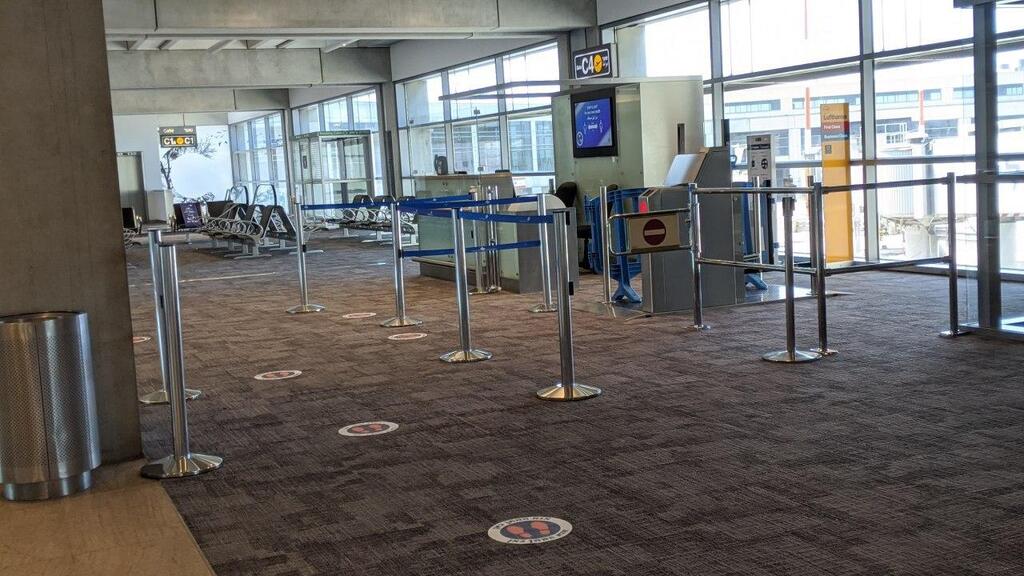
Ben Gurion Airport stands empty
(Photo: Gilad Yalon)
Transport Ministry Director General Moshe Ben Zaken told ynet: "We are aware of the complex problem. Israeli airlines are currently the only anchor of the aviation sector; foreign carriers are not operating here due to regulatory restrictions, both in Europe and North America, and we have no intention of harming Israeli airlines. Therefore, we understand the urgent need to hold immediate discussions with the Finance Ministry to find a solution that addresses both the affected passengers — who have been hit once again — and the airlines, which are also operating under a reduced framework and are being harmed."
What does the law currently stipulate if a flight is canceled?
According to attorney Ehud Pai: "The Aviation Services Law (the Tibi Law) regulates passengers’ rights in cases of flight cancellations. Under normal circumstances, when an airline cancels a flight, passengers are entitled to three things:
- Assistance services, including food and beverages and hotel accommodation until the alternative flight.
- A ticket for an alternative flight or a refund (at the passenger’s choice).
- Monetary compensation without proof of damage, the amount depending on flight distance, ranging from 1,530 shekels to 3,670 shekels.
If a flight is canceled due to circumstances beyond the airline’s control, as in the current war, the airline is exempt from paying monetary compensation without proof of damage, but is still required to provide assistance services as well as an alternative flight or a refund.
For example, if my flight from New York to Tel Aviv is canceled and the alternative flight is four days later, the airline must provide hotel accommodation and meals until departure. If I am required to cover these costs myself, I am entitled to reimbursement from the airline."
What happens if the transport minister issues an order?
Attorney Ehud Pai said: "Following the Swords of Iron war, an amendment to the law came into effect on Feb. 11, 2025, allowing the transport minister to issue an order (after consulting the economy minister and with approval from the Knesset Economics Committee), provided a special home front emergency has been declared for more than 14 days and there is significant disruption to flight schedules to Israel.
Such an order would temporarily, for up to 60 days, modify passengers’ rights regarding assistance services and alternative flights.
Regarding accommodation, the minister may limit the number of nights airlines are required to provide, as long as it is not fewer than two nights, compared with the original law, under which airlines must provide accommodation until the alternative flight without limitation.
Regarding alternative flights, airlines would be allowed to offer tickets to a different destination or departure point — such as nearby hubs like Larnaca or Athens — unlike the original law, which requires offering a ticket to the original destination. In the case of Tel Aviv, this is currently not feasible due to the near-total closure of Ben Gurion Airport."
It should be noted that passengers stranded abroad during Operation Rising Lion have yet to receive compensation or reimbursements from airlines — a situation that also applies to Operation Roaring Lion, which still has no defined end date, now in its 26th day.