

Israeli defense company UVision Air, controlled by businessman Aaron Frankel, is moving to the next stage of its planned initial public offering on Nasdaq, with a target valuation of $3.5 billion to $4 billion.
The company is expected to publish a prospectus in the second week of July, followed by a roadshow that could last several weeks before the IPO itself, which is planned for July or August.
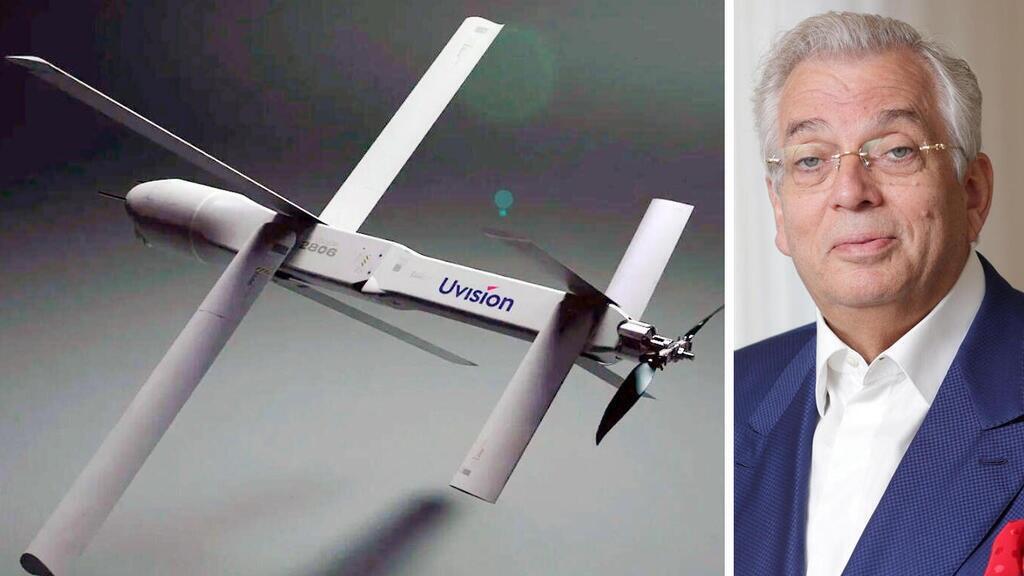
UVision drone, Aaron Frankel
(Photo: Orel Cohen)
The move comes after Frankel failed to reach understandings with Israeli institutional investors over UVision’s valuation in a planned pre-IPO investment round. Frankel had sought to bring in three or four institutional investors before the listing, but talks collapsed over price.
UVision develops and manufactures loitering munitions, also known as suicide drones, capable of locating, locking onto and accurately striking targets. Talks were held mainly with Clal Insurance, Migdal Insurance, Meitav and Mor Provident and Pension Funds, while Leumi Partners and Phoenix were considered the closest to investing.
According to proposals submitted during the talks, the institutions were prepared to invest at a company valuation of about $2.9 billion. Frankel refused to compromise on the valuation and decided to move directly toward a Nasdaq offering.
UVision is aiming to raise between $500 million and $1 billion, depending on demand. A significant portion of the proceeds is expected to be used to repay shareholder loans that Frankel has provided to the company over the years. The IPO is also expected to include a substantial secondary offering, through which Frankel will sell part of his stake to the public.
The offering is being led by U.S. investment bank JPMorgan. It is moving ahead at a time when many defense stocks have corrected downward after sharp gains triggered by wars around the world, partly against the backdrop of emerging understandings between the U.S. and Iran.
Next Vision, which trades on the Tel Aviv Stock Exchange and produces camera systems for drones, has lost about 28% of its value over the past three months. Elbit Systems has also shed about 20% of its market value since March. Still, over a longer time horizon, Next Vision’s shares have surged by about 1,700% over the past three years, reflecting the enormous demand created in military technology and unmanned systems.
In Israel, the offering is being accompanied by Barak-Leumi Underwriting, led by Zvika Mansen. Meetings with institutional investors are expected to begin in the second week of July, shortly after the prospectus is published.
The aim of those meetings will be to persuade the same institutions to participate in the IPO, even though the requested valuation is now higher than the level at which they were prepared to invest in the pre-IPO process. The question now is whether institutions that effectively rejected Frankel’s valuation about three months ago will be willing to participate in the public offering at an even higher price.
JPMorgan appears to believe that a higher valuation can be achieved for an Israeli defense company by turning to the global market. Accordingly, the roadshow is expected to begin in Israel and then continue in the U.S. and Europe.
During the pre-IPO process, Frankel sought to sell 5% to 10% of the company’s shares to institutions. To make the investment more attractive, he agreed to provide downside protection mechanisms. If a future IPO had taken place at a lower valuation than the pre-IPO round, the institutions would have received compensation through options, narrowing the gap and effectively lowering their entry price.
As part of their due diligence, representatives of most of the institutions visited the company’s headquarters and plant in Emek Hefer, where they met CEO Ran Gozali and received a detailed review of the company’s operations.
One of the key assets UVision is presenting to investors is a major contract it recently signed. The agreement, signed in October 2025 between UVision and U.S.-based Mistral for the U.S. Army, is worth up to $982 million over five years.
Geopolitical tailwind
Frankel acquired UVision in 2010 through his private company Magnus. In its current form, the company has operated since 2011. For the past year and a half, it has been led by Gozali, who had previously been considered a candidate for CEO of Rafael after a three-decade career at the Israeli defense company.
At Rafael, Gozali served as a senior vice president and management board member, leading, among other areas, research and development, engineering and global business activity in land, naval and multidomain warfare. He replaced Avi Mizrachi, who served as UVision CEO for five years.
The company’s chairman is Ilan Gipman, a longtime associate of Frankel who also represented him as a director at Gav-Yam and Alony Hetz. Other board members include Yedidia Yaari, former commander of the Israeli Navy and former CEO of Rafael, as well as Yair Ramati and Yair Dubester.
Over the past decade, UVision has become a significant global player in loitering munitions, partly through the development of its HERO family of products, a line of attack drones designed for a wide range of tactical and strategic missions.
The system combines features of a drone and a guided missile. It can remain above a target area for an extended period, collect real-time visual intelligence, identify targets and carry out a precise strike once an operational decision is made. One of its advantages is the ability to abort a strike even after launch and return the system for safe landing and reuse, a capability absent from most traditional munitions.
Wars in Ukraine, the Middle East and other arenas since 2022 have demonstrated the importance of drone systems and loitering munitions on the modern battlefield, leading to a sharp rise in global demand for both offensive systems and defensive measures against them.
UVision is now seeking to translate that trend into one of the largest defense IPOs by an Israeli company in recent years.
An IPO that could boost Frankel’s liquidity
UVision differs from many companies seeking to go public because it is wholly owned by Frankel. As a result, the IPO is expected to significantly increase liquidity for the controlling shareholder, who has become a familiar figure in the Israeli capital market thanks to several major deals that generated billions of shekels in profit over relatively short periods.
In December 2021, Frankel sold his 37% stake in income-producing real estate company Gav-Yam to Property & Building, part of the Discount Investment group, whose major shareholders are the Zalkind brothers through Elco and Tzachi Nahmias through Mega Or. The deal generated a profit of about 1.25 billion shekels for Frankel and a return of about 100% within roughly a year and a half.
Earlier, in 2019, he recorded a profit of about 80 million shekels, also a 100% return, from an investment in Aeronautics after buying shares in the market and selling them nine months later when the company was acquired by Avihai Stolero and Rafael.
In early 2025, he also exited his investment in Bank Leumi, generating a profit of about 612 million shekels after holding the stake for around two and a half years, a return of about 65%.
Frankel currently holds 16.3% of real estate company Alony Hetz, worth about 1.2 billion shekels, as well as 24.92% of Tamar Petroleum, one of the shareholders in the Tamar gas reservoir, worth about 540 million shekels.
Tamar Petroleum shares, however, have lost nearly half their value since October 2025, when the company traded at a record valuation of about 4 billion shekels amid a control battle between Frankel and Eli Azur.