

A massive fireball illuminated the skies near Beit Shemesh, a powerful blast-like sound carried across central Israel and dozens of videos flooded social media.
For many Israelis watching that Saturday night two months ago, in the middle of the war with Iran, it appeared that something had gone badly wrong at one of the country’s sensitive defense facilities. Online speculation escalated rapidly, with some users even invoking Chernobyl.
Gallery
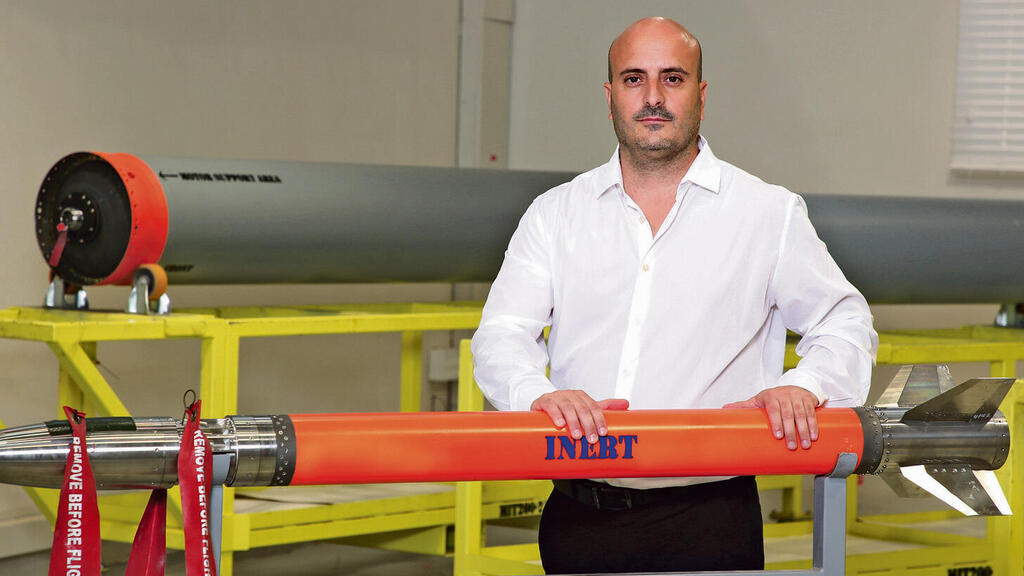
Tomer CEO Dotan Gabai: ‘There is an unprecedented global ammunition shortage. I conduct seven times more tests than before’
(Photo: Ryan Frois)
There had been no accident, however, and no explosion.
What the public had witnessed was a planned stationary rocket-engine test conducted by Tomer, one of the most secretive and strategically important companies in Israel’s defense industry.
The government-owned company is defined as a classified national asset and center of expertise for rocket propulsion. It develops and manufactures engines used in some of Israel’s most important strategic weapons systems, including Arrow interceptors, Barak 8, Romach, Extra and David’s Sling, as well as the Shavit launcher that carries Ofek intelligence satellites into space.
The nighttime test inadvertently gave the Israeli public a rare and spectacular glimpse of a company that has operated largely outside public view.
In his first media interview, Tomer CEO Dotan Gabai explained what happened that night, described the company’s role in Israel’s missile arsenal and revealed how unprecedented global demand is forcing its factories and testing facilities to operate around the clock.
“We are the taxi driver of the missile,” Gabai said. “During tests, I always joke with the missile developers at Israel Aerospace Industries and Rafael: ‘Without our engine, the missile would not clear the height of the building.’”
‘We are operating at a frantic pace’
Gabai, 41, has served as Tomer’s CEO for the past year after holding a series of senior positions at the company over the previous decade.
Tomer employs about 1,000 people at its headquarters and production complex, which covers roughly 1,000 dunams, or 247 acres, near Matzliah in central Israel. Its test range extends across some 12,000 dunams, from the community of Tal Shahar to the Tirosh area near Kiryat Malakhi.
The company serves as a subcontractor for Israeli defense firms developing missiles, but its own growth now mirrors the rapid expansion seen across the wider defense industry.
Tomer expects annual sales of 840 million shekels ($275 million), up from 648 million shekels ($212 million) the previous year. Net profit reached 55.8 million shekels ($18.3 million), compared with 41 million shekels ($13.4 million), while its order backlog surpassed 3 billion shekels ($984 million) for the first time. The dollar equivalents are based on the Bank of Israel’s July 17 representative rate of 3.05 shekels to the dollar.
According to the Government Companies Authority’s report, Tomer paid the state a dividend of 18 million shekels ($5.9 million) in 2025.
Gabai said the company would also raise 300 million shekels ($98 million) from Israeli institutional investors through a bond offering for the first time.
His five-year expansion plan calls for annual sales of 1.5 billion shekels ($492 million) by 2030 and an increase in the workforce to 1,500 employees. Tomer has invested approximately 1 billion shekels ($328 million) in infrastructure and technology in recent years and recruits between 20 and 30 employees every month.
What caused the fireball?
The test that alarmed residents involved a stationary rocket engine, Gabai said.
“A motor that is effectively used for a satellite launcher can reach the height of a nine-story building, and the burn corresponds to that scale,” he said.
“What people saw that Saturday night was the combustion of a stationary rocket motor used for testing. There was no explosion. Had there been one, anyone working with civilian satellites would already have published images of the black crater it created.”

The explosion back in May
Tomer had conducted similar tests before, he said. Engineers use cameras to document the behavior of the company’s solid propellant under different conditions.
The test had been reported in advance to all relevant authorities, including municipal officials and emergency services.
“No fire crews, ambulances or other emergency forces came to the site because there was no need,” Gabai said. “The difference this time was that we conducted the test at night, and against the dark sky, the effect was enormous.”
The choice of timing reflected the extraordinary pressure facing the company.
“We are operating at a frantic pace,” he said. “There is a global shortage of missiles, which have become the most sought-after weapons, and an unprecedented worldwide shortage of ammunition.”
Gabai estimated that production is lagging approximately 30% behind demand.
“I conduct seven times as many tests today as I did in the past,” he said.
Tomer’s production lines even operated in two shifts on the first night of Passover.
“To keep up, we divided the employees between those who had to celebrate an early Seder and then come to the factory, and those who had to celebrate later,” Gabai said. “Even veterans of Israel Military Industries, which owned Tomer’s predecessor, could not remember a Passover like it.”
“That is why we began fitting tests into Saturday nights. Night has become day for us.”
Although the test was neither an accident nor an exceptional technical event, Tomer reviewed its procedures afterward.
The company will return to conducting such tests during daylight hours and plans to issue public notices beforehand, similar to notifications distributed by Rafael because of the proximity of its facilities to communities in northern Israel.
Israel triples production
Gabai said Israel’s ammunition position is now substantially stronger than it was on October 7, 2023.
“If war breaks out tomorrow, our situation is infinitely better than it was on October 7,” he said.
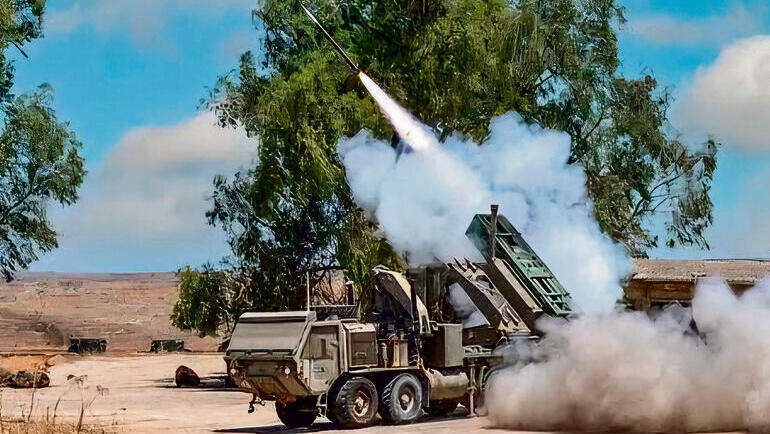
Tomer and Elbit’s Bar rocket, first used operationally during the Swords of Iron war
(Photo: Tomer)
“Unlike the worldwide shortage, in Israel we are closing the gap. We have dramatically increased production, tripling it since the massacre, based on IDF demand and the defense establishment’s conclusion that Israel must achieve independence in ammunition production.”
Tomer relies on imported composite materials and explosives. Under Defense Ministry instructions, the company has built up extensive reserves of those raw materials.
Even so, Gabai warned that Israel must plan years ahead rather than respond only to immediate wartime requirements.
He said Defense Ministry Director-General Amir Baram was working to secure continuous production budgets for defense companies, ensuring they could retain employees, manufacturing lines and specialized knowledge even when immediate military demand declines.
“We cannot return to the old system in which, during prolonged periods without fighting, defense suppliers and industries were forced to shrink and some disappeared,” Gabai said.
He cited the long contraction of ammunition production at Israel Military Industries during years of limited IDF demand, which left stockpiles dangerously depleted when the October 7 war began.
Modern wars in Ukraine, Russia, Iran and Gaza have become longer, he said, making industrial endurance as decisive as battlefield capability.
“The winner will be the one with staying power, expressed through the amount of ammunition available and the ability to manufacture it independently,” Gabai said.
“Who imagined that Arrow would become a consumable product? For years, the attitude toward the Arrow project in defense discussions was: ‘In case something happens and we need it.’”
The engineering behind a missile launch
Tomer employs approximately 80 researchers in what Gabai describes simply as missile engineering.
Almost all hold doctorates, many are Technion graduates and each specializes in a narrow field within rocket propulsion.
A small rocket-engine model sits on Gabai’s desk. From the outside it resembles a simple metal cylinder, but inside is one of the defense industry’s most complex technologies: a pressure vessel containing a narrow channel surrounded by solid propellant.
When activated, temperatures inside the engine reach thousands of degrees. The energy created by the burning propellant is directed through the nozzle, generating the thrust required to accelerate the missile toward its target.
In simple terms, every successful missile launch depends on an engine that produces the necessary energy, speed and controlled propulsion. Without it, the missile never leaves the launcher.
Tomer manufactures engines across a broad spectrum, from propulsion systems for interceptors, including the Arrow 4 now under development, to enormous engines used in satellite launchers.
“We are at the technological forefront of our field,” Gabai said.
He described Arrow as one of the world’s leading interception systems and the first designed to intercept threats outside the atmosphere.
The system also offers a cost advantage, according to Gabai. A single interception by the American THAAD system is estimated at $11 million to $15 million, while an Arrow interception costs approximately $3 million to $4 million.
Tomer’s engines achieve reliability of approximately 99% and can remain operational for up to 25 years, he said.
That longevity was demonstrated during recent fighting, when Arrow 2 interceptors manufactured years earlier remained operational.
Preserving propulsion technology under state control
Tomer was established as an independent government company following the 2018 privatization of Israel Military Industries.
When the loss-making IMI was sold to businessman Mickey Federmann’s Elbit Systems, defense officials feared that Israel’s critical rocket-propulsion technology, previously housed at IMI’s Givon plant, could leave direct state control.
The government excluded the propulsion operation from the privatization and transferred it into Tomer, a dedicated company owned entirely by the state.
Its roots date to 1939, when the Haganah operated an underground foundry at Kvutzat Schiller that produced mortar bombs and hand-grenade bodies.
After Israel’s establishment, the operation expanded, later became part of IMI and developed expertise in advanced rocket propulsion.
Decades later, those capabilities faced their most significant operational test during Iran’s missile attacks on Israel.
Gabai recalled sitting with his wife and five children in the protected room of their Rehovot home during Iran’s April 14 attack.
“I knew this was the moment of truth we had prepared for all those years,” he said. “Would the Arrow system, which until then had been examined in tests, be able to withstand such a broad threat involving dozens of ballistic missiles?”
He trusted the development teams at Israel Aerospace Industries, Tomer and the other participating companies, but the scale of the attack remained daunting.
“The next day, we saw the data and understood that we had been part of a historic event on a global scale,” he said. “The system we had played an important role in building had saved the State of Israel.”
By the second Iranian attack in October, the system’s effectiveness already appeared less surprising.
“For me, every interceptor we help produce represents lives saved and buildings and critical infrastructure that were not hit,” Gabai said. “That is the equation.”
Engines for Israel’s eyes in space
Tomer also manufactures propulsion systems for Israel’s Ofek observation satellites.
The latest war demonstrated the strategic importance of expanding Israel’s intelligence satellite constellation, Gabai said, particularly during operations conducted about 2,000 kilometers from Israeli territory.
The satellites provided a major advantage in detection and intelligence collection.
“We are working on a next-generation satellite launcher,” he said.
The company’s products are also attracting increasing international demand.
Gabai recently returned from Eurosatory in Paris, one of the world’s largest defense exhibitions, where Israeli participation was subject to extensive scrutiny.
“The French went from booth to booth like kosher supervisors,” he said.
Some exhibitors presenting dual-use systems with both defensive and offensive applications were disqualified. Several responded by placing yellow-star symbols on their booths.
Business demand nevertheless remained intense.
“My schedule was packed, with a meeting every 15 minutes,” Gabai said. “There is enormous interest in Israeli systems that have sweated on the battlefield, not only stood in exhibition halls.”
Foreign customers, he said, are impressed by Israel’s ability to increase production quickly while fighting for three years across six fronts.
“I saw countries at the exhibition that would not buy Israeli wine because it might have been produced in the West Bank, but they buy Israeli missiles without hesitation,” he said.
Since the war began, exports have accounted for approximately 30% of Tomer’s production.
International demand may also create an opportunity for the company to establish production lines abroad.
‘Every battlefield understands the importance of ammunition’
Gabai said the scale of recent air operations had reinforced the central importance of weapons inventories and production capacity.
At the same time, Israel’s adversaries have increasingly turned to cheaper weapons such as drones, which do not always require precision to shut down an area, disrupt activity or inflict casualties.
The global arms race has therefore become both technological and industrial: nations need sophisticated systems, but they also need the capacity to manufacture them continuously and in large numbers.
Tomer’s growth has intensified its search for workers.
The company now employs about 70 Haredi workers recruited through an intermediary familiar with the community.
“Without them, we would have been in trouble,” Gabai said. “Before recruiting them, I sent requests for production-floor workers to 12 employment agencies and received barely 13 résumés.”
He praised their work ethic and said Tomer provides appropriate working conditions, including meals that meet their kashrut requirements.
The company has also expanded employee welfare programs and signed a new collective bargaining agreement.
A production worker who previously earned 7,000 shekels ($2,300) a month now receives between 10,000 and 12,000 shekels ($3,300 to $3,900). Ten percent of company profits are distributed among employees, including production workers.
Half of Tomer’s workforce consists of engineers and development personnel, but Gabai stressed that sophisticated research cannot replace skilled manufacturing.
“Even the most brilliant engineers cannot move a meter without Michael, who tightens the screw for them,” he said.
Defense Ministry debt strains suppliers
Like other Israeli defense companies, Tomer is also owed a substantial sum by the Defense Ministry amid budget disputes with the Finance Ministry.
“We, too, are carrying an unreasonable debt,” Gabai said.
Government-owned companies facing delayed payments must still preserve their own supplier networks, he added.
“I fight tooth and nail to pay my suppliers on time and comply with the payment ethics law,” he said. “I will not harm a supplier whom I may need tomorrow morning.”
Gabai argued that the government and Finance Ministry should regard defense spending not only as an expense but as an investment in Israel’s economy.
Since the beginning of the year, Tomer has purchased approximately 1.2 billion shekels ($393 million) in goods and services from Israeli suppliers.
“When you strengthen the defense industries, you strengthen not only security,” he said. “You also strengthen the economy.”