

A bill aimed at combating what it defines as “renewed forms of antisemitism” has been introduced in the French parliament. The proposal is a private legislative initiative by National Assembly member Caroline Yadan and has undergone preliminary constitutional review. It was drafted in line with recommendations from France’s top court.
The bill seeks to address contemporary expressions of antisemitism that no longer necessarily appear as direct incitement or overt violence, but rather through more sophisticated ideological discourse. This includes comparisons of Israel to the Nazi regime, denial of the legitimacy of Israel’s existence, apologetics for terrorism and public calls for its destruction.
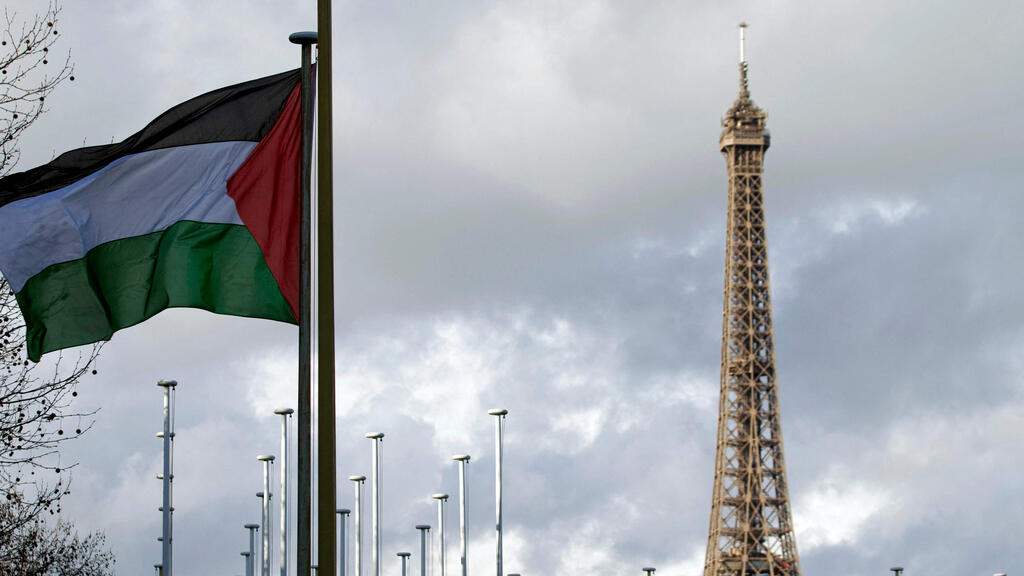
Palestinian flag in Paris
(Photo: JOEL SAGET / AFP)
According to the bill’s sponsor, recent years have seen a growing trend in France of delegitimizing the fight against antisemitism itself. Legal and political arguments increasingly portray efforts to confront hatred of Jews as violations of free speech or as political defense of a foreign state.
At the same time, expressions of hatred directed at Jews via Israel have multiplied at demonstrations, on social media and in public spaces. In many cases, the discourse does not include an explicit threat, but serves to justify, normalize or soften violence, placing it outside the scope of existing criminal enforcement. Against this backdrop, the sponsor argues, there is a need to update legal tools to address modern antisemitism.
Freedom of expression is enshrined in Article 11 of the 1789 Declaration of the Rights of Man and of the Citizen and is a cornerstone of French constitutional law. However, case law has long held that the right is not absolute. The bill seeks to operate within the tension between broad protection for critical speech and the need to prevent freedom of expression from being used as a cover for legitimizing violence and terrorism.
 Attorney Julie Daniel
In this context, the proposal calls for expanding the offense of incitement to terrorism to include indirect incitement and public apologetics. The intent is not to criminalize political opinion or critical analysis, but expressions that portray terrorist acts as legitimate, understandable or justified, or that downplay their severity and grant moral legitimacy to their perpetrators.
The line between criticism and incitement
The bill would also establish an offense for publicly calling for the destruction of a state recognized by the French Republic, by means that contradict the principles of the UN Charter. According to the sponsor, calls to destroy the State of Israel do not constitute legitimate political criticism, but rather create a hostile and dangerous climate for Jews in France.
The proposal stresses that criticism of Israeli policy, support for Palestinian rights or calls for a ceasefire will remain protected speech. The line is drawn where expression ceases to be a political position and becomes a tool for justifying violence or collective destruction.
Anticipated criticism of the bill centers on potential harm to freedom of expression. For that reason, the sponsor consulted the high court in advance, adopted its recommendations and chose to anchor the provisions within the 1881 Law on Freedom of the Press, while avoiding vague terminology. The move is intended to reduce constitutional risks and preserve legal balance.
According to the bill’s sponsor, calls for Israel’s destruction constitute a collective threat to Jews, even when not directed at them explicitly. The legislation seeks to send a clear normative message that such discourse is not legitimate in a democratic public sphere.
• This article was produced in cooperation with the Israeli legal website PsakDin
• Attorney Julie Daniel specializes in French law
• The PsakDin editorial team contributed to the preparation of this article
• ynet is a partner of the PsakDin website