

France has escalated restrictions on Israeli defense companies at Eurosatory 2026, the international arms exhibition in Paris, with several Israeli firms told their booths will be permanently closed starting Tuesday.
Representatives of some companies whose access routes had already been blocked were informed Monday evening that entry to their booths would be prohibited. The companies will only be allowed to dismantle equipment from the booths on Wednesday.
The affected company representatives also had their exhibitor badges revoked and replaced with “visitor” passes.
Despite the restrictions, Israeli exhibitors said they would continue operating as much as possible. “We will keep coming as usual and hold our meetings. Nothing will stop us,” one company representative said.
The exhibition opened this week after Israel’s flag was removed from the event’s official guide. Part of the area where the Israeli pavilion was supposed to stand was turned, as happened two years ago, into a cafeteria or storage space.
Israeli booths blocked at French arms exhibition
(Video: Defense Ministry)


On Sunday evening, a delegation of French experts inspected the booths and approved which items could remain on display and which had to be covered. But when the exhibition officially opened Monday morning, some exhibitors found that items approved the night before had nevertheless been covered.
At the booth of Avnon Group, fair workers painted over part of a photograph in black paint.
“At 2 a.m., inspectors came and painted over an image of a surveillance camera, even though a competing version is displayed in nearby booths,” said Stacey Dagan, the company’s spokesperson.
The censored image was not of the camera itself, but of the barbed-wire fence around it, which showed that it was a border-control product, meaning a defensive system, as the French government had required of Israeli companies.
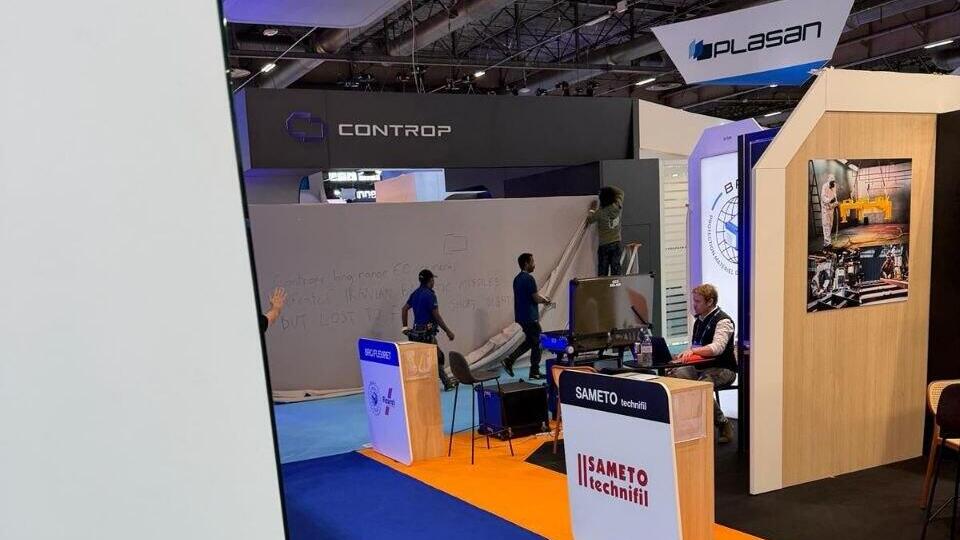
Controp’s closed booth
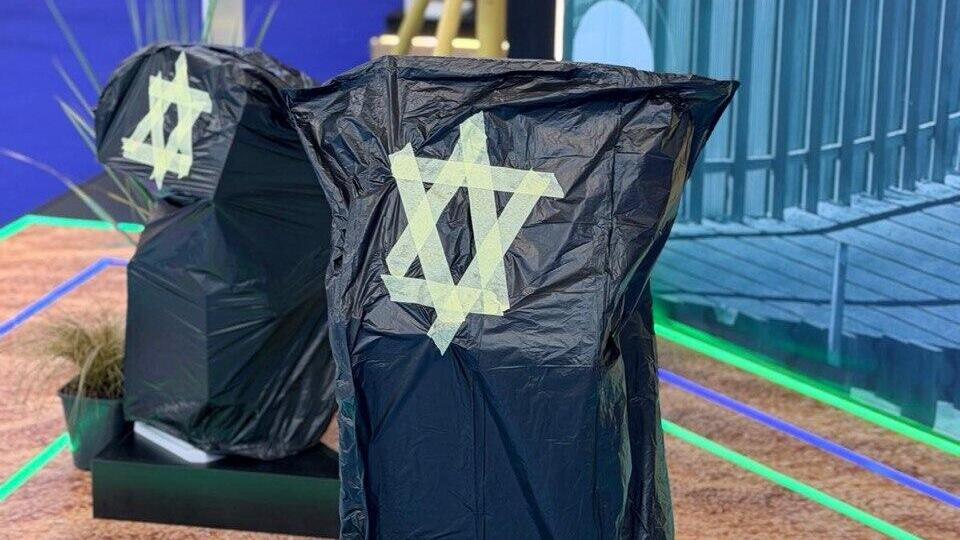
Avnon responded by placing a giant sculpture of a monster made from machine parts in its booth, drawing visitors to stop for photos with the company logo in the background. At the same time, it was forced to cover two interceptors in black plastic, even though they had been approved the previous night. Company CEO Tomer Avnon placed two Stars of David on the covers, but was ordered by organizers to remove them as well.
Doron Zalts, CEO of Controp, described a similar situation.
“In recent days, inspectors came through and told us, ‘take this down, take that down,’” he said. “We agreed to all the demands and were left only with defensive products and presentations. At midnight yesterday, we received a letter saying the booth was closed. They covered it overnight, when no one was here. We were forbidden from hosting foreign delegations. They even cut our electricity, but we somehow managed to reconnect.”
For now, the booths remain covered, though some can still be entered through curtains covering their entrances.
Out of roughly 35 Israeli companies participating in the exhibition, access was blocked to the booths of Aeronautics, Orbit, Controp, Gilat, Marom Dolphin, Smart Shooter, Amicell, Epsilor, Source/SOS, Paxis and OSG.
Still, Israeli exhibitors said they were not giving up. Hebrew could be heard throughout the exhibition halls, and many regular customers continued closing deals with Israeli firms. Even in the cafeteria set up where the Israeli national pavilion had been planned for the second year in a row, business conversations in Hebrew continued.
Israeli Ambassador to France Joshua Zarka visited the exhibition to support the companies and sharply criticized the French government’s conduct.
“The conduct of the French government regarding Israel’s participation is a disgrace,” Zarka said. “It has one main motive: unfair competition against Israeli industries that are far superior to its own. France is losing markets around the world, and its way of dealing with that is not to improve its technology, but to damage our ability to participate and close deals.”
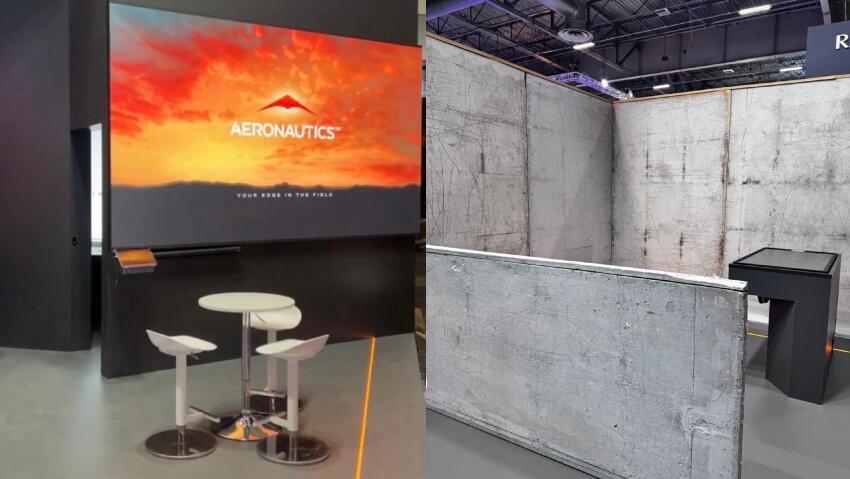
Aeronautics booth before and after closure
(Photo: Tamar Sebok)
Dani Selsky, CEO of Aeronautics, said larger Israeli companies whose booths remained open, including Elbit Systems, Rafael and Israel Aerospace Industries, were showing solidarity by hosting smaller firms.
“They are hosting us,” he said.
Selsky said his company had complied fully with all instructions.
“We followed every directive and more,” he said. “Our drones are completely defensive, and we did not even bring models. Our booth had chairs, a table and screens with only a screen saver. On Sunday at 11 p.m., they dismantled our screens and closed the booth. Since then, we have been chasing them by phone and no one answers.”
“We think our drones are comparable to French ones,” he added. “There is a political dimension here, but also an economic one. We will come here again at the next fair. The customers want to meet us, and we have a moral and business right to be here. If we cancel, they get exactly what they want.”
There were also some gains for Israeli companies. Rafael is displaying a laser target designator that locks onto a target, a product it was not allowed to show at the exhibition two years ago.