

Paramount announced overnight Friday that it has agreed to acquire Warner Bros. Discovery for $110 billion, after defeating Netflix in a five-month bidding war.
The combined company would bring together CNN, CBS, HBO and Nickelodeon under one roof, along with franchises including Harry Potter, “Game of Thrones,” the DC universe, “Mission: Impossible” and “SpongeBob SquarePants.”
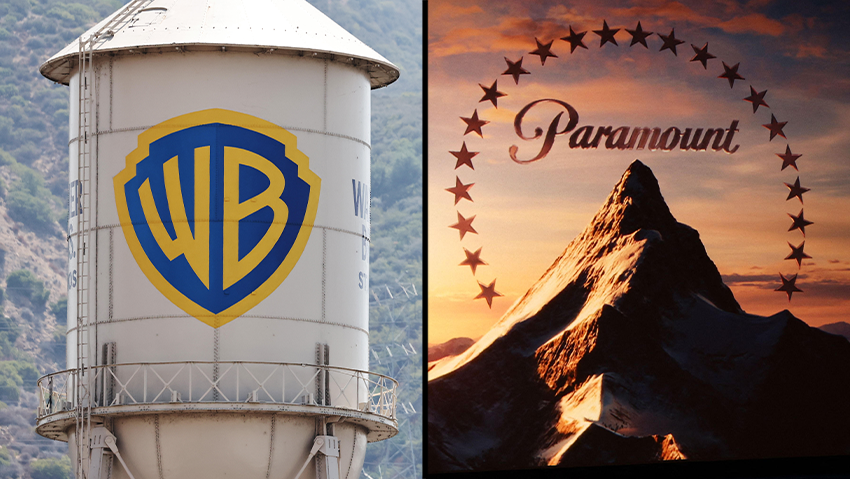
Paramount, Warner Bros.
(Photos: VALERIE MACON / AFP, Mario Tama/Getty Images)
Under the terms of the deal, Paramount will pay $31 in cash for each Warner share, valuing the equity at about $81 billion, and will assume roughly $30 billion in debt.
To bolster confidence in the transaction, Paramount offered Warner a $7 billion breakup fee if the deal collapses and agreed to cover the $2.8 billion penalty Warner owed Netflix after withdrawing from their agreement.
Netflix was central to the drama surrounding the sale. At one point, the streaming giant was prepared to pay about $83 billion, but when Warner’s board recently asked for a revised counteroffer, Netflix co-CEO Ted Sarandos declined. “We don’t have to do the deal at any price,” Sarandos said.
Wall Street reacted positively. Paramount shares surged more than 20% on the day of the announcement, while Netflix stock rose nearly 14%, suggesting investors believed the bidding war was not worth the cost for the streaming company.
Attention now turns to the Ellison family, which would control a vast global media empire while taking on significant debt. If regulators approve the deal, David Ellison is expected to undertake substantial cost-cutting measures to ease the financial burden. His father, Oracle billionaire Larry Ellison, was a key backer of the transaction and provided financial guarantees that ultimately helped sway Warner’s board to favor Paramount over Netflix.
The deal still faces significant regulatory hurdles. The European Commission is reviewing the merger, as are several U.S. states, including California.
“Paramount/Warner is not a done deal,” California Attorney General Rob Bonta said.
Another potential flashpoint is the deal’s financing, which includes three sovereign wealth funds from the Middle East — Saudi Arabia, Qatar and Abu Dhabi — a factor that could trigger federal national security concerns.
Movie theater chains have also voiced opposition to the merger, and Democratic members of Congress have expressed deep skepticism about concentrating so much media power in a single company.