

The Israel Tax Authority, Transportation Ministry and Environmental Protection Ministry recently published the formula that will determine purchase-tax benefits for new cars. The changes come as Chinese automakers gain an increasingly large share of Israel’s fleet market and sales of fully electric vehicles continue to weaken.
Together, the measures offer an early indication of what Israeli car buyers and company-car users can expect next year.
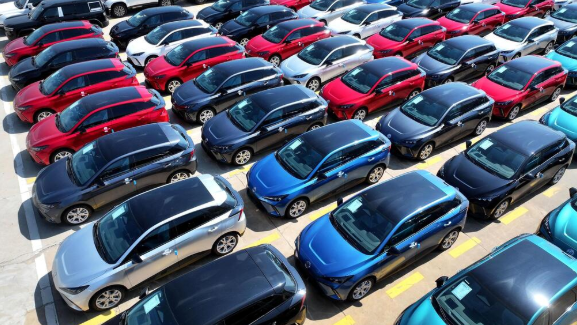
New electric vehicles at a port in China ahead of export
(Photo: Oriental Image via Reuters)
Company-car benefit: No immediate changes
Employees who receive a company car are taxed on its use through a monthly benefit known in Israel as the “use value.” The taxable amount is calculated at 2.48% of the vehicle’s value and added to the employee’s gross salary for tax purposes.
Drivers who choose lower-emission vehicles receive monthly reductions. The current benefit is about 550 shekels for a hybrid, roughly 1,200 shekels for a plug-in hybrid and around 1,300 shekels for a fully electric vehicle.
Tax officials have acknowledged that the system has shortcomings. A plug-in hybrid, for example, delivers its environmental benefit only if the driver regularly charges it and uses its electric motor. In practice, that does not always happen.
There are also major differences between models: Some plug-in hybrids can travel only about 30 kilometers on electric power, while others can cover roughly 80 kilometers, yet both currently receive the same tax treatment. The Tax Authority has said that it would reconsider the rules if the phenomenon became more widespread.
For now, however, the existing company-car tax framework is effectively locked in until late 2028 under a temporary provision. The Tax Authority says the arrangement is intended to allow the continued gradual adoption of vehicles with advanced propulsion technologies while leaving room to update the rules as the market and technology evolve.
That means the present system is likely to remain in place for several more years, although future revisions could distinguish between plug-in hybrids according to their actual electric driving range.
Electric-car purchase tax likely to rise
The biggest question for 2027 is the purchase tax on fully electric vehicles. Israel’s current policy allows the tax on EVs to rise gradually, but the pace depends partly on how widely electric cars are adopted. In other words, if electric cars are not selling, why raise the tax? And the tax rate is only part of the equation: There is also a cap on the purchase-tax benefit, meaning a maximum amount that can be deducted from the tax bill.
In 2025, the purchase tax on electric cars stood at 45%. The Tax Authority later proposed raising it to 52%, but the Knesset Finance Committee intervened and the rate was ultimately set at 48%. At the same time, the maximum tax benefit was capped at 22,000 shekels, a level that significantly reduced the practical advantage for many electric models.
The rate for 2027 has not yet been finalized, nor has the benefit ceiling. Under the existing framework, if no new rate is approved, the purchase tax on electric cars would jump to 83%. That scenario, however, is considered unlikely.
Similar warnings emerge almost every year toward November and December, only for the government to adopt a last-minute compromise. With electric-car sales currently weak, sources familiar with Finance Ministry discussions estimate that the eventual rate will probably return to the 52% level originally planned.
Will that push prices higher? Probably not. Demand is currently weak, and even if taxes rise slightly, early-year sales promotions are expected to offset most of the increase.
Green tax formula: Changes approved, but competition could keep prices down
With the green-tax formula (which determines tax credits according to a vehicle’s emissions), the rules are already largely set. A few weeks ago, the Transportation Ministry sent importers the formula that will determine purchase tax on new cars in Israel.
Under the current system, most cars are subject to an 83% purchase tax, while fully electric vehicles are taxed at 48%. But the original formula drawn up by the Environmental Protection Ministry was far stricter. It was supposed to factor in pollution from tire and brake wear, which would have reduced the tax advantage not only for gasoline-powered cars but also for electric and plug-in hybrid vehicles.
The formula ultimately published did not include those pollutants. Instead, it amounts to an update of the existing emissions-based system. Calcalist later revealed why those pollutants were left out of the new formula: car importers simply do not have the data regulators would need to include them.
European Union Euro 7 rules, due to introduce new requirements for manufacturers, are expected to make more of that information available. But the timing means Israel’s January 2027 changes will rely only on an updated version of the existing emissions formula.
According to vehicle importers, the main effect will be a reduction in tax credits for conventional hybrids, while plug-in hybrids will be affected much less.
The green-tax formula is designed to gradually phase out tax benefits for cars using older technologies, and conventional hybrids have now been on the market for more than a decade. Does that mean hybrid prices will rise? Not necessarily.
When an older technology is gradually phased out of preferential tax treatment, there is usually a transition period in which exchange-rate movements, last-minute vehicle shipments and other market factors soften the impact. That means a sharp rise in hybrid prices is unlikely. Israel’s green-tax formula is reviewed every two years, so tire-emission rules are not expected to return to the agenda before summer 2028.
Mileage tax remains a long way off
Recent weeks have also brought renewed speculation that Israel could begin imposing a mileage tax on owners of electric and plug-in hybrid cars from January. That is not expected to happen.
The proposal, which has resurfaced repeatedly in Finance Ministry discussions over the years, would charge drivers according to the number of kilometers they travel.
The rationale is that as motorists switch from gasoline-powered cars to electric vehicles, the government collects less revenue from fuel taxes.
Implementing such a system, however, presents both legislative and practical problems. First, the measure would require approval by the Knesset. With elections approaching, there is currently no guarantee that the legislation will advance.
The Finance Ministry told Calcalist that the mileage tax requires parliamentary approval and that this has not yet occurred, meaning no implementation date can currently be given.
There is also a major technical challenge: The government would need a reliable way to measure how far each vehicle travels. One option would be direct access to vehicle computer systems, which is not currently feasible. Another would require owners to estimate their annual mileage and make advance tax payments, followed by a year-end reconciliation. Drivers who traveled less than expected would receive refunds, while those who exceeded their estimate would have to pay additional tax.
A similar system is planned in Britain, but even there authorities are allowing an extended preparation period to build the necessary payment and administrative infrastructure.
For Israel, the chances of approving a mileage tax within the next few months appear low. The prospect of putting the entire system into operation in less than a year is even more remote.