

Six years ago, Moti Richter was a little-known 34-year-old franchisee taking an enormous gamble on Papa Johns. The American pizza chain had entered Israel, struggled and was looking for someone who could make the business work. Richter, who had started in the pizza industry as a teenager at Pizza Hut, agreed to take over, promising rapid expansion and a $1 million investment.
The gamble paid off far beyond expectations. Papa Johns now has 44 stores in Israel, well above the original target of 25, and the Israeli operation has become one of the chain's strongest international performers. That success eventually produced an offer that Richter and his wife and business partner, Chen, found difficult to refuse: take the formula abroad and rescue another struggling Papa Johns market.
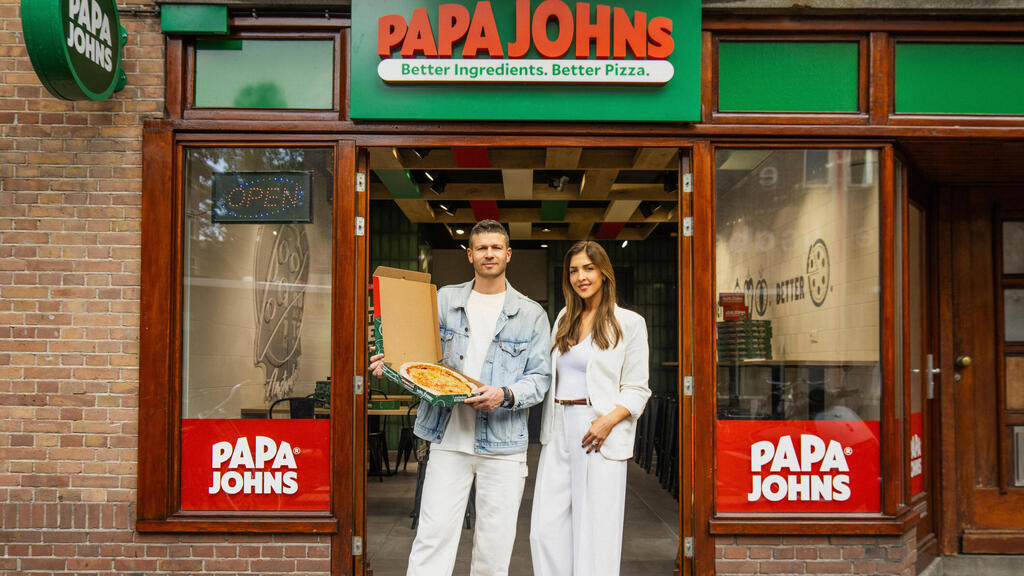
When the chain's British franchisee in the Netherlands failed and the Dutch operation slid into losses, Papa Johns' global management turned to the Richters. A year and a half ago, in the middle of the war and as Iranian missiles were flying over Israel, the couple packed up their lives and moved with their children to Amsterdam.
They now oversee Papa Johns in both Israel and the Netherlands, where 10 stores are currently operating. Combined annual revenue from the two markets has reached NIS 195 million. Richter's next target is considerably more ambitious: 100 stores in the Netherlands within five years, expansion into Belgium, the addition of another investor and, eventually, a public offering.
“We arrived here like aliens landing in an unknown place,” the couple told ynet during an interview in Amsterdam. “But it was also clear to us that the creativity and energy we bring from Israel were exactly what was missing here. That became our advantage. We bring our crazy ideas with us.”
‘F***, what was I thinking?’
For Chen, the move initially felt less like an international business triumph than a collision between ambition, parenthood and financial risk.
“In the first few months, the only thing I kept thinking was, ‘F***, what was I thinking? I'm only 30, I have two children, what have I done to myself?’” she said. “I was exhausted. I was the boss, a mother, driving the kids to activities, and there was the financial risk too. We invested NIS 10 million in developing the business in the Netherlands.”
“We had succeeded in Israel. We weren't missing anything. We had built a strong brand, and I'd reached the point where I could finally breathe a little and take my foot off the gas. So why are we always looking for the next challenge?” she said. “But that is also the answer: the ambition and the constant need for the next challenge. We're already dreaming about opening Belgium too. It's included in our franchise.”
They took over the Dutch operation with little knowledge of the language or local culture. The realization hit home recently when their children, who attend Jewish schools and kindergartens, began speaking Dutch to each other while their parents could not understand them.
“That was the last straw,” Moti said. “Chen and I decided that next week we're signing up for Dutch lessons.”
Language, however, has not been their biggest workplace obstacle. At a Papa Johns branch in Amsterdam Oost, Richter said virtually none of the staff are Dutch.
“You hardly find Dutch people here doing manual jobs, working in pizzerias or as waiters, or becoming franchisees,” he said. “Our employees and franchisees are Syrian refugees and Turks. Let's put it this way: Arabic would be more useful to me than Dutch.”
One Syrian manager he hired spoke neither English nor reliable Dutch. After struggling to understand WhatsApp messages written phonetically in Latin letters, Richter found a solution.
“I finally told him, send it to me in Arabic. I don't speak Arabic, but I translate it with Google and send the reply back in Arabic,” he said. “In the end, you overcome all the obstacles. I think part of the courage comes from our hunger to take on the world, and also a kind of naivety that you only discover afterward.”
Their Israeli identity, they say, has not created friction with their Syrian and Turkish employees.
“These are immigrants who want to succeed,” Richter said. “They came from difficult places, and ultimately they want to live, earn a living and build a future for their families. We haven't encountered a single problem with them because of who we are.”
What they did encounter was a business in severe distress.
A business in collapse
Papa Johns' previous franchisee in the Netherlands had managed the operation remotely from Britain. By the time the Richters arrived, local franchisees were frustrated, stores were in poor condition and the economics of the business had deteriorated.
Eventually, the British franchisee went bankrupt and Papa Johns' global operation took control, but Richter said little was invested in marketing or rebuilding the business. Ingredients came through an expensive local warehouse, while dough was shipped from Britain at high cost as sales remained weak.
“The most serious thing we discovered was theft from the business,” Richter said. “I have more than 20 years of experience in the field. I went into a store anonymously with cash, ordered a pizza and gave the franchisee the money. He took it and put it in his pocket instead of the register.”
Richter said he also found payment terminals that were not connected to the official system, meaning some transactions never appeared in the central records.
“When I left the store, I asked the representative from the international chain who was with us, ‘You're not managing this business?’ He answered, ‘This is what there is.’ That was the operation we inherited.”
One of their first moves was to connect ordering and payment systems to the company's app so transactions would pass through central systems.
They also found a market very different from Israel. A family-size Papa Johns pizza in the Netherlands is about 20% cheaper than in Israel, Richter said, despite the Israeli business not necessarily generating higher margins. One reason, he said, is taxation: value-added tax on food is 9% in the Netherlands compared with 18% in Israel, while Israeli ingredients are also more expensive.
The Dutch consumer is also more conservative and price-conscious, Chen said.
“At work they bring crackers and food from home. They mainly order pizza on Friday nights because they don't have a Friday dinner like we do in Israel,” she said.
Their response has been to reposition Papa Johns in the Netherlands around younger consumers and students, tying the brand to music, festivals, clubs and entertainment. The company sponsors festivals and performances, hands out pizza at clubs and has sponsored a Netflix film featuring Dutch actors.
They are also adapting the menu to local demographics. Just as the Richters pushed Papa Johns to offer kosher options in Israel, they see an opportunity in the Netherlands' large Muslim population. In some neighborhoods, stores will offer “halal-friendly” pizzas, with pepperoni and other meat toppings made exclusively from beef rather than pork.
“It will open us up to additional audiences,” Chen said.
From Pizza Hut teenager to franchise operator
Richter's pizza career began at 17. He had immigrated with his parents at age 3 from Tashkent, the capital of Uzbekistan, where his grandparents had fled from Poland and Russia during World War II.
His father, Igor, was a fencing coach who found work as a physical education teacher in Israel and raised his son with what Richter describes as a Soviet work ethic.
“We work hard. If you want to go out and have fun, go work and earn the money for it,” his father told him as a teenager.
Igor arranged a job for Moti at a Pizza Hut branch in Kiryat Ono. The manager initially did not want to hire an inexperienced teenager, but his father persisted.
“She worked me like crazy,” Richter recalled. “So I worked very hard, but I learned a huge amount and was promoted to shift manager.”
At 18, he joined the Israeli Navy and served aboard Dabur patrol boats. After his military service, his former Pizza Hut boss, by then an area manager, recruited him to work at a Holon branch near a Kentucky Fried Chicken outlet owned by the same franchisee.
The KFC store was plagued by management turnover, and at just 21 Richter was offered the job of running it. Within two years, he said, he had stabilized the operation.

(Photo: seven)
“The secret was that I interviewed 20 employees every day and chose only the ones who could handle the pressure,” he said. One of those recruits, he noted, later became a senior operations executive at Wolt Israel.
By 25, Richter had become a vice president at Pizza Hut Israel while completing bachelor's and master's degrees specializing in logistics and supply-chain management. Four years later, he left to advise pizza businesses.
Another turning point came when Israeli billionaire Teddy Sagi, after acquiring London's Camden Market, recruited Richter to develop its food operations and establish Camden Pizza. Newly married, Richter began flying to London each Sunday and returning to Israel on Thursday.
After two years and the birth of his first son, he left.
“I thought about leaving everything and moving into high tech,” he said. “My father told me, ‘You're good at pizza. You've already accumulated knowledge. Stay in the field.’”
Not long afterward, Assaf Greenberg, founder of Israeli sushi chain Hasushia and holder of the Papa Johns franchise in Israel, approached Richter about buying the business.
The chain had only three Israeli stores. Moti and Chen sat in a cafe opposite its Dizengoff Street branch and watched customers come and go.
“We were surprised that people were coming from all over the country,” they said. “I got the impression that this was a premium pizza that Israelis liked.”
Richter applied for approval from Papa Johns' global headquarters and received it just days before the COVID pandemic erupted.
Turning three stores into 44
Richter concluded that food costs were too high and supplier terms needed improvement. Chen, then a senior advertising executive, joined the business and took charge of branding and marketing.
They changed suppliers, renegotiated commercial terms and strengthened delivery operations just as demand for pizza deliveries exploded during COVID.
Chen redesigned packaging, developed children's meals and began reaching out to influencers. In the early days, Moti sometimes delivered the pizzas himself. One recipient was Israeli television personality Ofira Asayag, who did not recognize him and insisted on giving him a tip.
Papa Johns' global executives quickly realized, Richter joked, that they were dealing with “a crazy person,” but one who was producing results.
One of his biggest battles involved kosher certification. Richter insisted that some Israeli locations needed to be kosher to suit their local customer base. He proposed three models: kosher branches, non-kosher branches and vegetarian locations using meat substitutes.
The international chain initially struggled to understand why Israel needed different formats, particularly because kosher certification required dedicated production lines for some of the company's sauces overseas.
Eventually, Richter said, the company concluded that refusing the changes could threaten the Israeli operation. It agreed.
Today, 14 Papa Johns branches in Israel are kosher, with some recently upgraded to stricter mehadrin certification as demand increases in more religious areas. The Israeli chain now has 44 stores.
“Before we committed to the franchise in Israel, we were young and afraid of the financial risk,” Chen said. “We approached everyone we knew and asked them to invest with us. Everyone refused. Some laughed at us.”
“Today, when they see where we've gotten, especially after receiving the Dutch franchise, they tell us, ‘We can't believe we were stupid enough not to invest in you.’”
Success in Israel opens the door to Europe
The Dutch opportunity emerged because of the Israeli operation's performance.
In 2023, Papa Johns Israel ranked first in the global chain for average weekly sales per store, according to the couple. In 2024, Moti and Chen received a franchisee-of-the-year award and again ranked first in sales.
Executives at Papa Johns' international operation were sufficiently intrigued that they sent a delegation to Israel to study what the Richters were doing.
“They were especially impressed by our marketing language, which Chen is responsible for,” Moti said. “When they left Israel, their suitcase was full of packaging and branded products we had developed.”
In mid-2024, the company's Israeli operations chief attended a Papa Johns conference in Dubai, where executives asked whether the Israeli team might be interested in expanding into additional countries.
The Netherlands soon emerged as the opportunity.
“We saw that the Dutch market was good for competing chains and decided to go for it,” Richter said. “It challenged us.”
Taking over a failing operation was hardly straightforward. Richter pushed Papa Johns to cancel an expensive arrangement with an outside logistics center and decided to establish a local dough factory instead of importing dough from Britain.
As he dug into the Dutch operation, he also found problems in supplier contracts previously signed by the company. Disputes followed over who would absorb the costs.
Eventually, Richter decided to invest 200,000 euros himself in a factory and logistics center in Utrecht.
Then the war intervened.
From Iranian missile fire to a factory in Utrecht
Richter needed to be physically present when goods were transferred to the new Utrecht facility. At the time, his family was still in Israel and Ben Gurion Airport had closed amid Iranian missile attacks.
“The logistics center told us, ‘We're transferring the goods to the Utrecht factory. If you're not there, that's your problem,’” Richter recalled. “They were just waiting to see me fail.”
He made a snap decision.
Richter arranged for a driver and learned that flights were leaving from Aqaba in Jordan to Cyprus. He took Chen and the children with him because he did not want to leave them behind during the attacks.
They drove three and a half hours toward the Jordanian border while Chen searched for flights. “The children were paralyzed with fear from the missiles,” he said.

(Photo: Amit Tzuk)
At the border, Richter said, a Jordanian inspector objected to a Book of Psalms, a travel prayer and business stamps found in his luggage. After arguments and giving up the items, the family crossed.
They then waited for hours surrounded by Jordanian soldiers, with little information about when their flight would depart.
At midnight they flew to Cyprus, landed at 2 a.m. at friends' home and continued to Amsterdam the following morning.
Richter reached the Utrecht facility in time for its opening and the incoming shipment. Later, his operations executive arrived from Israel and trained workers to produce the dough.
Learning to slow down
For all the pressure of the move, the Richters say the Netherlands has proved attractive for family life.
Most people speak English, they found larger Israeli communities than expected and eventually moved from their initial rental to an area with a substantial Jewish and Israeli population. Their children attend Jewish schools and childcare programs.
“The Netherlands is expensive. Rent is more expensive than in Israel, and childcare and food aren't cheap,” Chen said. “But the quality of life is good.”
The Dutch approach to work also required an adjustment.
“They care about wellness. They won't stay an hour past their working hours,” she said. “At first it annoyed us. What do you mean, they're getting up and leaving when there's still work to do? Later, we also learned to take our foot off the gas and breathe.”
Moti concluded that succeeding in the Netherlands required understanding more than the balance sheet.
“I realized that to succeed here I have to be part of the local conversation,” he said. He now asks to receive a daily evening summary of the main Dutch news and events so he can better understand the country rather than remain “just an Israeli managing a business from outside.”
The next bet: 100 stores and an IPO
Dutch labor and franchise law has required another adjustment.
Employees generally begin with defined contracts, Richter said, and after three years can gain permanent status, making dismissal considerably more difficult. Employers therefore tend to use shorter contracts before deciding whether to extend them.
Franchisees also receive substantial legal protections. Prospective franchisees must be shown details about the proposed property and the company's financial profile, and after receiving a franchise agreement are given a 30-day cooling-off period during which they cannot be pressured into signing.
The Richters inherited 15 Dutch stores. Six were closed, and they acquired most of the remainder, leaving only three independently operated franchise locations.
Initially they focused on recruiting franchisees, but changed course after learning more about the market. Their first phase of expansion will now rely largely on company-owned stores, allowing them to establish operating standards before returning to a broader franchise model.
Richter says sales are steadily improving. One informal sign, Chen added, is that influencers who once ignored offers of free pizza now respond.
The ambitions have grown with the business.
The Richters' franchise rights also cover Belgium and Luxembourg. Moti says the plan is to expand further across Europe, bring another investor into the company and potentially acquire other food businesses.
And then, if the expansion works, there is the bigger goal.
“To expand in Europe,” he said. “To bring an investor into the company, grow through acquisitions of additional food businesses and eventually take it public, while always continuing to reinvent ourselves.”