

Three years after October 7, rebuilding border communities also requires addressing the question of how to strengthen the economic resilience of farmers and residents in the Gaza border region and along Israel’s northern border. A farmer returning to his land needs buildings in good repair, reliable electricity infrastructure and the ability to finance the next growing season. As livelihoods come under pressure, the decision to remain in the community becomes increasingly difficult. Solar energy has a practical role to play in this discussion and deserves greater consideration.
As someone who lives in Kibbutz Karmia and works with farmers, I believe strengthening these communities begins with ensuring that families can continue earning a living where they have chosen to make their homes. In the Gaza border region and communities along the northern border, active farms provide local jobs and keep the land under cultivation. An additional source of farm income can help farmers continue working the land, even as it becomes increasingly difficult to rely on agricultural production alone.

Farmers incur expenses long before they receive any income. They must pay for workers, water, equipment and other inputs, while their earnings depend on yields, market prices and their ability to access and work their land. Rental income from a rooftop solar system provides a revenue stream with different characteristics. It is not tied to tomato prices or poultry production, nor is it exposed to the same health and sanitation risks. It can help cover operating costs and finance investment in the farm. This income complements agricultural earnings, and its value is greatest when it helps farmers continue farming.
At EDI Energy, we use a leasing model that allows property owners to generate income from land and other available space. The company finances and installs the solar system and is responsible for its operation and maintenance. The property owner receives rental payments under a 25-year agreement. Where appropriate, the arrangement may also include replacing an old roof, reinforcing a building and upgrading the electrical infrastructure. In other cases, the solar installation is integrated with agricultural activity through an agrivoltaic system, allowing solar power generation to take place alongside crop cultivation rather than replacing it.
One of the projects we have publicized illustrates this connection well. An egg producer approached us with a permit to build a poultry house covering approximately 6,000 square meters. As part of the project, we financed the construction of a suitable roof, installed a solar system with a capacity of approximately 1.1 megawatts and upgraded the farm’s electricity connection. The work was carried out at no cost to the farmer. We are now also adding an energy storage system and paying additional rent for it.
One of our projects, a dairy cattle shed covering approximately 4,000 square meters was built for a female farmer in the Shfela region, without requiring any investment on her part. For a farm owner, the opportunity to construct a building under such an arrangement can affect how she invests in dairy equipment and the technology she introduces, because the company covers the cost of the structure in exchange for the right to use the roof.
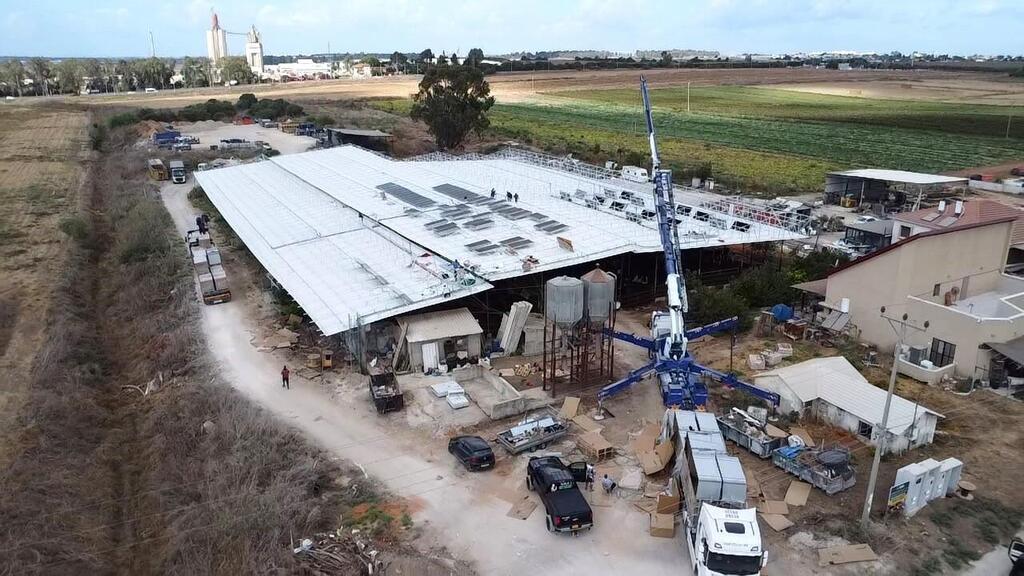
Construction of a solar roof over a dairy barn
(Photo: EDI Energy)
When assessing the contribution of a solar project, we must also take into account the buildings and infrastructure it makes possible, as well as the money that remains available to the farmer for the farm’s needs.
The benefits can also extend to the community. An early example is the project we built in Moshav Tzrufa, a farming community in the Hof HaCarmel region. The solar installation was built on a canopy over a sports court, which the company financed and constructed. The community thereby gained a shaded space for residents to use without having to rely on donations or public funds to build the canopy. The company also helped finance the construction of a skatepark, and revenue from the project was intended to support the development of additional facilities and services.
This model is also relevant to border communities, which need sources of income that will enable them to sustain community services over time.
Expanding the use of solar energy must safeguard agriculture. Installing panels on the roofs of poultry houses, dairy barns and packing houses makes use of built space while leaving cultivated land available for agricultural use. Agrivoltaic projects, with panels installed above crops, require agricultural planning and an assessment of their effects on crop growth, light availability and access for equipment. A project’s success must also be measured by whether it allows food production to continue. Revenue from electricity generation is no reason to abandon the agricultural use of the land.
A standard grid-connected solar system does not guarantee an electricity supply during a power outage. Combining energy storage with equipment that enables the system to operate independently of the grid can provide backup power for essential needs, subject to the power capacity and backup duration specified in the design. On a farm, the ability to maintain refrigeration for produce or ventilation in a poultry house can help reduce damage. It is therefore worth assessing the farm’s needs alongside the economic viability of electricity generation.
The connection between energy and reconstruction is already reflected in public programs. A September 2026 update from the Tkuma Directorate stated that approximately 33 million shekels had been allocated by the end of 2025 to projects aimed at strengthening energy independence in the communities. This acknowledges the importance of such infrastructure to community life. At the same time, farmers and communities must be able to advance suitable projects through clear permitting procedures, coordination among authorities and solutions for connecting to the grid.
I believe we need to prioritize projects that strengthen active farms in border communities and assess in advance what they leave in the hands of the farmer and the community: income, a useful building and infrastructure that will serve them for years. This has clear economic significance, with implications for the long-term sustainability of these communities as well. A farmer who can finance the next season and maintain the farm has a practical reason to continue working and living there. That outcome should be central to decisions about rebuilding the Gaza border region and the north.