

Agricultural technology giant Syngenta and Israeli bioagriculture company Groundwork BioAg announced Tuesday a strategic partnership to market biological products designed to improve crop performance, strengthen soil health and generate carbon credit revenue for farmers.
Under the agreement, Syngenta will commercialize products based on Groundwork BioAg’s mycorrhizal fungi technology, alongside soil carbon solutions, under its own label.
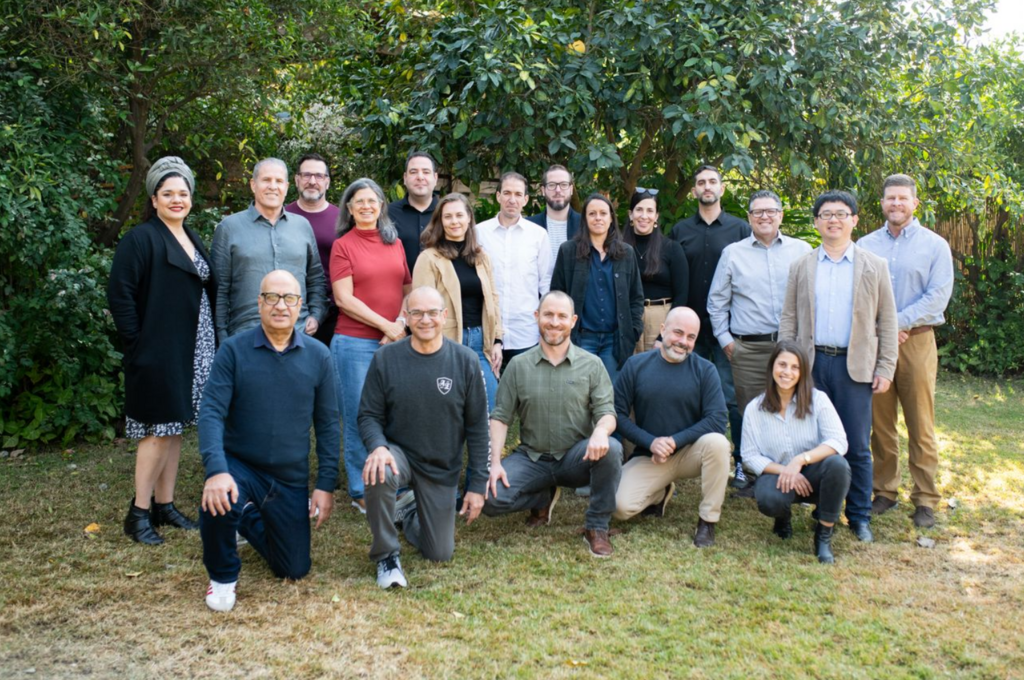
Groundwork BioAg founders and team
(Photo: Groundwork BioAg)
The program will initially target corn, soy, cereal and sunflower growers in Latin America and Europe, while the companies said distribution of the biological products would later extend to additional markets.
Groundwork BioAg will be responsible for manufacturing and supplying the products, providing the necessary digital tools and managing the development of the carbon program.
The partnership combines Syngenta’s international distribution network with Groundwork BioAg’s technology, which uses fungi that form symbiotic relationships with plant roots.
These fungi can improve crops’ ability to absorb nutrients and water, potentially producing higher and more resilient yields while supporting long-term soil health. They can also contribute to the formation of stable organic matter in the soil, allowing carbon to remain stored for extended periods.
The companies said farmers participating in the program could receive an additional source of income through carbon credits generated by the carbon stored in their soil.
“The model we've built with Groundwork BioAg goes beyond farming carbon. It builds resilience, restores soil health and accumulates long-term carbon stocks at a remarkable pace, while generating carbon credits from which farmers directly benefit,” Syngenta Group Chief Sustainability Officer Petra Laux said.
“We see this as a natural evolution of what carbon programs can achieve,” she added.
Soil carbon sequestration occurs when plants draw carbon dioxide from the atmosphere through photosynthesis and biological processes transfer and store some of that carbon in the soil.
Soils containing more stored carbon are generally more fertile, retain water more effectively and are more resilient to drought and erosion, according to the companies.
Groundwork BioAg CEO Alon Werber said the agreement provided commercial validation for the company’s technology and was expected to generate substantial revenue for farmers and Groundwork over the coming years.
“By combining Syngenta's market access with our proven mycorrhizal capabilities, we are positioning mycorrhizal fungi as both a valuable agronomic input and a significant pathway for agricultural climate mitigation through our end-to-end carbon program,” Werber said.
Syngenta Global Head of Seedcare and Biologicals Emilhano Lima said the agreement reflected the growing role of biological technologies in agriculture.
“Nature-inspired solutions give farmers effective, reliable tools, while also providing concrete agronomical returns,” he said.
Groundwork BioAg’s flagship Rootella product line is a mycorrhizal inoculant used across millions of acres of commercial farmland worldwide, according to the company. Its Rootella Carbon program operates across more than 280,000 hectares and is designed to produce durable, nature-based carbon dioxide removal at an agricultural scale.
Groundwork BioAg operates offices in Israel, the United States, Brazil, Canada, India and China. Syngenta, headquartered through its crop protection division in Basel, Switzerland, operates in more than 90 countries.
First published: 09:00, 07.14.26