


A few years ago, investors on the Tel Aviv Stock Exchange were enthusiastic about companies promising to save the world. Ecoppia, which developed robots for cleaning solar panels, was one of them. In 2020, it went public in Tel Aviv at a valuation of NIS 1.3 billion. But shortly afterward, its share price plunged by more than 90%, and the company sold its operations. In 2024, it became a publicly traded shell company. Two years later, in early 2026, that shell was given a new lease on life, this time under the name Stark Power. Within six months, its shares had surged by about 440%.
Where investors once sought companies directly involved in reducing environmental damage, such as building solar farms, recycling wastewater or cleaning solar panels, today everyone is talking about data centers and the enormous amounts of electricity they require. The real winners are companies that can develop deals and projects that ultimately deliver electricity, and know how to turn real estate into power. That is precisely the business Stark Power wants to be in.
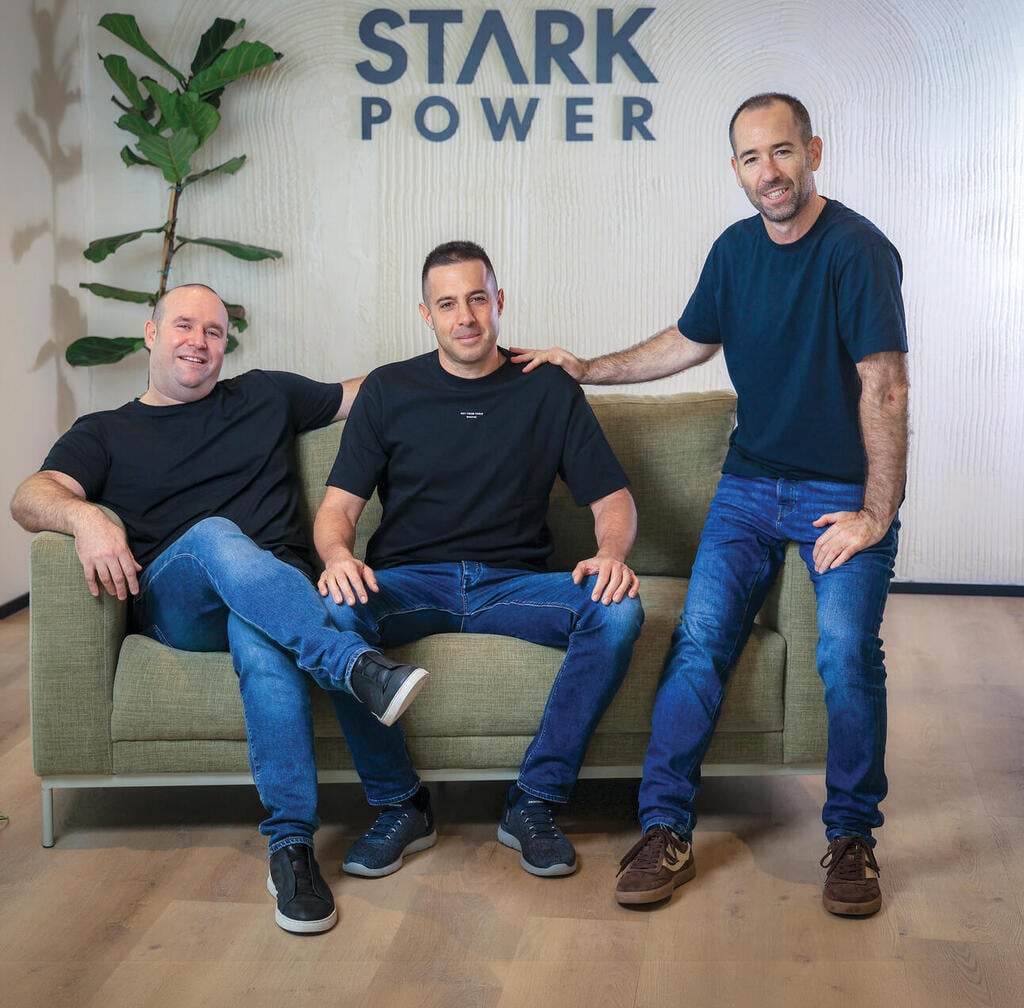
With a market capitalization of NIS 713 million, Stark Power has become one of the best-performing stocks of 2026 so far. The combination of a booming global energy market and five entrepreneurs with extensive experience and an ability to excite investors has attracted a long list of institutional backers, including Phoenix, Harel, Yelin Lapidot, Mor, Migdal and many others, which have invested NIS 665 million. Adding to the enthusiasm is the fact that the founders themselves have committed about NIS 90 million of their own money. Recently, the company held a competitive bidding process among banks and easily secured an $85 million credit facility from Bank Hapoalim.
There is another reason for Stark Power's remarkable rise: the high-profile figures behind it. Vice Chairman Zafrir Yoeli, a co-founder of Enlight Renewable Energy, was responsible for some of that company's most impressive international deals. Chairman Nadav Tena and his deputy, Shahar Gershon, ran Nofar Energy alongside Ofer Yannay, demonstrating a talent for turning real estate into money in the Israeli market. CEO Michael Avidan and CFO Yosef Levkovich, both former senior executives at Enlight, know the U.S. market inside out and have extensive experience closing deals there.
In their first media interview since the company was established, Yoeli, Tena and Gershon explain how they intend to turn soaring electricity demand into an engine of growth, respond to rumors surrounding their split with Ofer Yannay and explain why they are confident their new business will become a multibillion-shekel company as early as next year.
"We're a commando team," Yoeli says. "We picked out the stars and brought them over to us. The three of us are the controlling shareholders, but we also provide extensive support in dealing with funding sources, financiers, institutional investors, banks and even retail investors. We know how to devote a great deal of time to talking and explaining things, and for a company like ours, that's extremely important."
Tena adds: "We bring a tremendous amount of experience in establishing and managing companies worth billions. Each of us is involved in the working teams on a daily basis. We came here to work, to get things done and to succeed in building a company worth billions."
The first deal: 'It was over in 45 minutes'
Yoeli, Tena and Gershon have known each other for years. Yoeli and Gershon grew up on the same kibbutz, while Tena was Gershon's boss for many years. They shared mutual respect and a common view of the new opportunities emerging in the energy market. When Tena and Gershon left Nofar Energy in a turbulent departure, which we will return to later, they joined forces with Yoeli, who brought Avidan and Levkovich into the group. Stark Power was born.
Their first realization was that the market was heating up rapidly and there was no time to waste. Rather than establish a private company, raise initial capital and move forward slowly, they decided to acquire an available publicly traded shell company in April of this year. They also invested about NIS 40 million of their own money, with another NIS 50 million to follow, accumulated through their departures from their previous companies, to demonstrate just how strongly they believed in their business plan.
"We began receiving proactive approaches from major players in the capital market, and within a month of taking over the shell company, we had already brought in several leading institutional investors, including Mor, Phoenix, Yelin Lapidot, Harel, Noked, Alpha, Arkin and others," Gershon says.
What makes serious institutional investors put money into a company that has no operations?
Yoeli: "First, they knew us personally. Second, there was an alignment of interests. We didn't just come in and talk. We put our own money on the table, and that creates a very strong alignment of interests, unlike someone who comes with nothing more than an idea and a presentation, however good or impressive it might be. And third, most importantly, they genuinely believed in what we planned to do, in what we presented."
According to market rumors, it was a share offering without a presentation or a roadshow. The entrepreneurs named their price, and investors reached into their pockets. Within 45 minutes, it was over.
A month later, the company had already completed its first deal: the acquisition of American company SAGE, which develops data center projects and natural gas-fired power plants, for $50 million in cash. At that stage, Migdal became a major shareholder, investing NIS 90 million as part of a NIS 145 million financing round. That brought total investment commitments to NIS 665 million, of which NIS 320 million actually entered the company's treasury as cash available for project investments.
About a month ago, the company added an $85 million credit facility from Bank Hapoalim. "We secured it on extraordinary terms that allow us to acquire projects," Gershon says.
Yoeli adds: "When we set out to build the company, we had the luxury of establishing it in a way that was optimally suited to market conditions. We understand the energy business very well. We've previously built companies that operate as independent power producers (IPPs), and we looked at what was happening in the market and how to structure a company to achieve the greatest business success, fastest growth and best returns for shareholders."
And what did you discover? How do you generate the fastest growth?
"We saw that the IPP model is a good one because it allows companies to own numerous assets, including power plants that sell electricity, whether conventional or renewable. But it also has several problems. It requires enormous amounts of capital raising, meaning significant dilution for shareholders, as well as substantial overhead costs for development. It also takes a long time and involves considerable risk."
Yoeli's comments recall a deal associated with him during his time at Enlight. In 2021, he led the acquisition of American company Clenera for approximately $400 million. Its pipeline of energy generation projects enabled Enlight to enter the U.S. market and list its shares on Nasdaq.
The difference between that transaction and Stark Power's current deals lies in the timelines. Clenera's projects were still far from becoming operational and required years of development and substantial investment before they could begin generating revenue. Stark Power is looking for projects that are already producing income.
It sounds like a supermarket of projects, where you walk around picking whatever suits you without having to develop anything from scratch.
"We can do both. We have the expertise to develop and build projects at every level. We've done it on some of the largest projects in the world. So we know how to identify where it makes the most sense to get involved.
"For example, in Minnesota we bought an operating power plant, but we'll build an energy storage project there from scratch. Development work is already underway, and that's one of the reasons for the deal's enormous potential. The idea is to know how to acquire operating power plants or projects approaching construction, which can generate revenue much more quickly.
"Because the market is already well developed and there are many types of transactions, we know how to find the good deals, whether in renewables or conventional energy, anything that can generate electricity at the right time and in the right way."
Yoeli is referring to the company's second business arm, or sometimes what he calls its second leg. Either way, it represents a potentially substantial revenue stream from the data center industry, which is currently taking the world by storm.
Data center operators in the United States work on a scale that is difficult to imagine in Israel. A single data center can require 1,000 megawatts of electricity, sometimes much more. Technology giants such as Google, Meta and Amazon have plans to build nuclear reactors. In the meantime, however, they are desperately searching for electricity supplies.
"This creates enormous demand for expertise in how to bring electricity to a particular location, to a specific piece of land," Yoeli says. "Now think about what we know how to do. Exactly that. We know how to identify where power plants or storage facilities we develop will generate the maximum amount of energy on a particular site.
"When we realized that, we said, 'We'll take our expertise in developing electricity projects and use it to develop land for major energy consumers.'"
The term Stark Power uses is "power land." The company acquires land and secures construction permits for electricity generation facilities, along with approvals to connect those facilities to the power grid. It is a complicated process, whether in Israel or the United States, but one that can send the value of the land soaring.
"To get there, you need tremendous expertise in power land," Yoeli says. "If you're a real estate player or some kind of broker, that's not enough. You have to understand power." Perhaps that explains the company's name, Stark Power.
"Now listen to something incredible. With this kind of power land, on the best projects, within a year to a year and a half you can secure grid connections for hundreds of megawatts or more. You can sell that asset for hundreds of millions of dollars before you've even laid the cornerstone.
"That's an extraordinary return. Imagine investing tens of millions of dollars and then selling the asset for $200 million to $300 million within a year and a half. This is something that simply didn't exist in the energy market before."
It seems like an entirely new market economy.
"It has emerged because there's enormous demand from giant companies with huge amounts of money, such as Google and Amazon. They desperately need those megawatts and are searching everywhere for them. That's why our expertise in the power sector, together with the team we've assembled in the United States, has tremendous value."
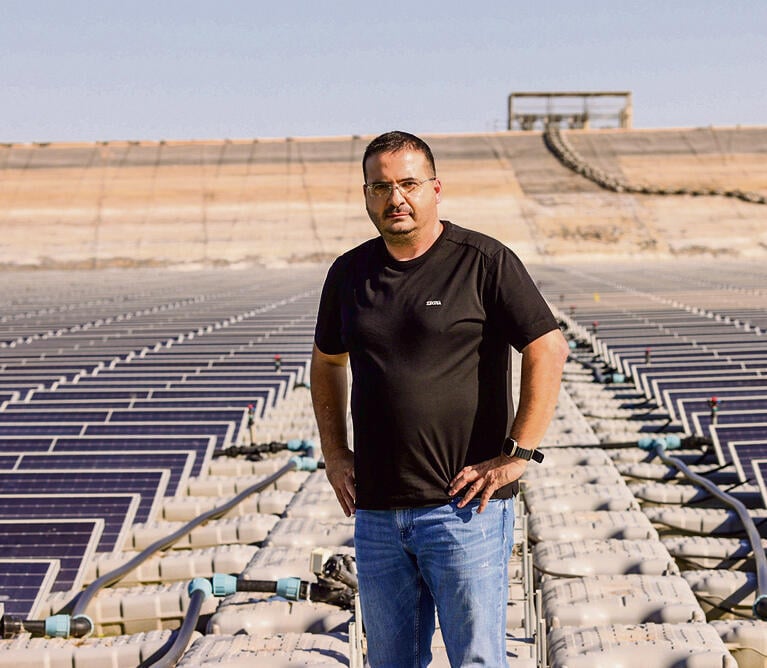
Ofer Yannay
(Photo: Orel Cohen)
The rift with Ofer Yannay: 'There were disagreements over who was at the helm'
Zafrir Yoeli was born on Kibbutz Eilon, near the Lebanese border. He served in the military's elite Unit 8200 intelligence unit and is still regarded as someone with a keen eye for the potential of emerging technologies. But his career took him far from the high-tech industry.
In 2008, he joined Gilad Yavetz and Amit Paz in founding Enlight, a company that helped pave the way for many other renewable energy businesses operating as independent power producers. It was a pioneer in developing projects overseas and listing shares on the stock exchange. Yoeli led its international business development.
"I think what we're doing here at Stark is taking the knowledge and experience we've accumulated at Enlight and Nofar and applying them to a business model that reflects what we believe should be the next stage for energy companies," he says.
In 2022, he left Enlight to establish the Gravity venture capital fund.
Nadav Tena was born at the opposite end of Israel's periphery, in Moshav Avigdor near Kiryat Malakhi. He describes himself as "the son of a dairy farmer." His professional career began managing the Azrieli Group's renewable energy operations, which were sold in 2014. He later joined Ofer Yannay in establishing Nofar Energy, where he served as CEO for 11 years, overseeing its Israeli operations, stock market flotation and international expansion.
Shahar Gershon was also born on Kibbutz Eilon. He began his career in energy at Enlight, managing business development in Israel under Yoeli. He later moved to Nofar Energy under Tena and eventually became the company's co-CEO.
Michael Avidan and Yosef Levkovich are also Enlight veterans. Avidan's last position there was CEO of Enlight USA, while Levkovich served as vice president of mergers and acquisitions. They subsequently left to establish SunSpear, a company investing in U.S. energy projects.
Then came the upheaval that ultimately led to Stark Power's creation: Tena and Gershon's departure from Nofar Energy, a story that dominated headlines for months.
The two had joined Nofar's controlling shareholder, Ofer Yannay, during the company's earliest days, when it consisted of just five people working in a small office in Jerusalem. Together, they led Nofar through a major initial public offering in 2020 and transformed it into a global player handling projects worth billions. The relationship between Tena, Gershon and Yannay was considered almost symbiotic, with each contributing to the company's success.
In June 2025, Tena and Gershon unexpectedly announced their departure. The move followed two years of disagreements over how the company should be managed, responsibility for projects and the allocation of resources. It had become clear that the arrangement could not continue.
Their departure was made easier by the financial resources they already had at their disposal. They left holding shares worth NIS 350 million, representing a 9.99% stake in Nofar that Yannay had granted them before the company's Tel Aviv Stock Exchange flotation. That gave them a substantial financial cushion for a new beginning.
But the market was buzzing with rumors and speculation. Some claimed that Yannay's involvement with the Hapoel Tel Aviv basketball club had created tensions. Others said the two executives had demanded that Yannay relinquish the chairman's position to Tena and appoint Gershon as CEO. There were also opposing claims that Yannay wanted to return to a more active and dominant role in management.
It was a turbulent separation. Yannay sent a strongly worded warning letter to the publicly traded shell company A.M.A.A.A., demanding that it cancel its merger agreement with Stark on the grounds that the transaction violated noncompete and confidentiality provisions. Tena and Gershon rejected the allegations outright, describing them as baseless. Ultimately, the dispute never reached the courts.
Yannay addressed the matter in February 2026, saying: "A long-term relationship sometimes runs into problems. At some point, the relationship among the three of us became problematic, and changes were necessary. When you make changes, you have to take the reins, and I decided I would become CEO. There was a dilemma about whether to look for another CEO or handle things personally. You know me and my style. I make a decision and act."
Now, for the first time, Tena and Gershon are addressing the affair, offering a somewhat less dramatic account of what happened.
"We were very close friends, a very strong trio that built the company from scratch, including tremendous successes in the Israeli market," Gershon says. "But during the two years before we left, we didn't see eye to eye on many issues, including how to manage the company and which decisions to make."
Tena adds: "We joined Ofer when Nofar was really just getting started, and together we built Nofar into a uniquely successful company, one that had no financial backing. But after more than a decade, I think something happens even in the best partnerships and relationships. There comes a point when you no longer see eye to eye, and the right thing to do is go your separate ways. It's not good for an organization when there are disagreements over who's at the wheel."
There were claims that you opposed the purchase of Hapoel Tel Aviv or wanted senior leadership positions at the company.
Gershon: "There are a lot of people who try to stir up conflict and spread stories. The reality was exactly as we described it. Everything else is just stories and fairy tales."
Are you now competing with Nofar Energy?
Gershon: "There's no competition at all. The energy market is enormous, especially when we're focused on the American market and areas Nofar isn't operating in. There's no real competition. There's room for everyone to operate and work, each in their own markets and areas of interest."
Could you see yourselves cooperating with Nofar someday?
"We're not looking for that kind of cooperation right now, but you know, we don't rule anything out. We'll consider anything that makes sense and is right for Stark's development and its shareholders."
You said earlier that you're on your way to becoming a company worth billions. Are you tempted to grow beyond Nofar's valuation?
"We're focused on ourselves, and we can already see and understand how we're going to become a company worth many billions. And we genuinely, wholeheartedly wish Nofar success."
Choosing the US: 'In Israel, everything is complicated and slow'
Stark Power's latest project, disclosed to the stock exchange, is the acquisition of the Cottage Grove complex in Minnesota, near Minneapolis. It includes an operating natural gas power plant generating 262 megawatts, along with an energy storage project under development that will provide an additional 320 megawatts. The investment in the project totals $43 million, while the projected value of the operation is $229 million.
That's not all. The companies operating the power plant purchase the natural gas and bear the risk associated with fluctuations in fuel costs. Stark, meanwhile, receives a fixed, stable payment for 15 years, ranging from $43 million to $48 million annually. Pretax profit is estimated at $30 million to $33 million.
The acquisition was financed through Stark's loan from Bank Hapoalim, and the expected return on net equity is 33%.
The company's first signed transaction was in the power land sector. Stark acquired SAGE, an American company developing data centers and natural gas-fired power plants, for $50 million in cash.
"They're a very talented group of entrepreneurs who previously developed large-scale solar and storage projects," Yoeli says. "About a year and a half ago, they shifted direction and began developing land for data centers on behalf of customers.
"We acquired them when they already had a portfolio of very interesting projects, although they weren't yet ready as power land because they didn't have signed grid connection agreements. But the process looked promising."
SAGE's portfolio includes data center projects totaling 5,550 megawatts, approximately four times the maximum capacity allocated by Israel's Electricity Authority for the entire country, along with the development of an additional 1,550 megawatts of natural gas-fired power generation in a colocation model, meaning power plants located alongside data centers.
According to the company's estimates, the portfolio represents potential revenue of $310 million to $620 million during the initial stages of project realization.
One of the transactions in that portfolio involves a 4,000-dunam site containing an old tire recycling plant, with two power stations nearby. During Joe Biden's presidency, the site benefited from numerous incentives that made upgrading it attractive. But under Donald Trump, those incentives disappeared, forcing the developers to sell it at almost any price.
Stark sees an opportunity in what remains: electricity generation infrastructure capable of supplying 700 megawatts of actual power. The company now plans to transform the site into a massive data center campus equipped with its own electricity supply.
"The whole world is looking for data centers. Everyone wants to develop them, sell them or buy them," Gershon says. "The key question is how to create value, and how to position yourself in the right segment of the market without wasting money.
"In this project, we have the potential to secure grid connection approvals for hundreds of megawatts as early as next year. Our strategy is simple. We acquired the entire portfolio for $50 million, and we estimate that developing it will cost another $30 million. That involves securing permits and approvals, submitting numerous applications to local utilities, a tremendous amount of paperwork, legwork and persuasion. Almost every week, we hold public consultation meetings.
"Our goal, beginning next year, is to bring these properties to the power land stage and begin selling them in phases, with the aim of generating hundreds of millions of dollars in revenue."
It's easy to understand why you chose to operate in the United States. There are plenty of opportunities there that simply don't exist in Israel.
Yoeli: "We know the Israeli market extremely well. We've developed some of the largest renewable energy projects in the country to date, including wind turbines in the Golan Heights and large solar farms. We have extensive experience developing complex projects from scratch in Israel.
"But from the outset, we estimated that competition in Israel was very high, meaning that land prices and the costs of all the other components would be high compared with other markets.
"We also knew there would be restrictions, like those the Electricity Authority is imposing now, because the power grid simply cannot accommodate dozens upon dozens of data centers at the same time.
"That combination led us, at this stage, to focus on the American market, which is obviously much larger and includes enormous players. That makes it possible to reach deals worth hundreds of millions of dollars for power land, something that doesn't exist in Israel."
But the US is also the most crowded and competitive market.
"First of all, we've already completed very large and successful deals in the United States, so when you know what you're looking for, you can find it. Michael and Yosef are American executives, and the company we acquired also gives us a local presence.
"For all practical purposes, we're like any American player, but with one important advantage: the financing available to us through the Israeli capital market is extremely competitive.
"Does that mean that if we go head-to-head with BlackRock, we'll win? We're not even trying. We're going into places where the giants don't go, but where there are still plenty of deals to be made."
Why is Israel's electricity sector lagging behind its counterparts in the Western world? The regulation, the bureaucracy, the outdated power grid...
"I met a Polish entrepreneur who told me that every energy entrepreneur is convinced that developing projects in his own country is the hardest. I told him he was right, but that in Israel it's genuinely the hardest.
"At the end of the day, the electricity grid here is limited. Israel is an energy island. We don't have connections to other countries that would allow us to export or import electricity when needed. There are a lot of constraints here."
And does that make Israel less attractive to entrepreneurs? Is that why so many Israeli companies are operating in the United States, Europe and Eastern Europe?
"Israeli companies expand internationally because the Israeli market is both small and limited, and they want to grow quickly. Everything here moves relatively slowly because so many different bodies are involved in regulation, including the Electricity Authority, planning authorities and the Israel Land Authority.
"It's complicated, and it slows down the process. That's why entrepreneurs who want to grow quickly try to operate overseas."