

Israel’s next election is already on the horizon, but listening to the speeches of the country’s party leaders, one might think the economy had never been in better shape.
The so-called economic “deafening silence” spans the entire political spectrum. Benjamin Netanyahu, Yair Lapid, Gadi Eisenkot, Naftali Bennett, Avigdor Liberman, Yair Golan and Aryeh Deri are all taking part in an unusual conspiracy of silence. They talk about Iran. They talk about Lebanon and Gaza. But when it comes to the urgent measures that will have to be taken in Israel’s economy after the election, there is total silence.
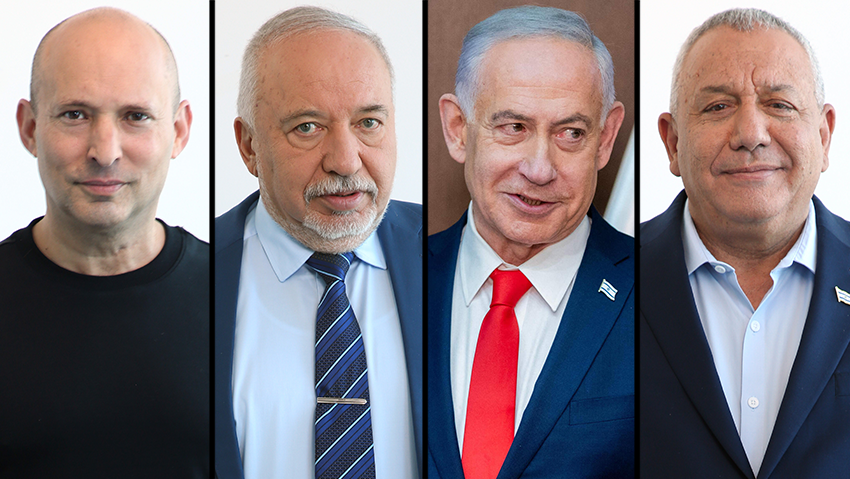
Naftali Bennett, Avigdor Liberman, Benjamin Netanyahu and Gadi Eisenkot
(Photos: Ryan Frois, Nathan Howard/AFP)
From the right of the political map to the left, including potential candidates for the next finance minister, virtually everyone is ignoring any serious discussion of the difficult economic situation facing both the state treasury and many Israeli households.
The reason is simple, cynical and, from their perspective, almost unavoidable: Israel’s economy is facing a deep fiscal hole, and anyone offering genuine solutions would have to talk about harsh measures, painful spending cuts and tax increases — proposals that do not win votes but drive them away.
Ahead of elections, politicians tend to follow a simple rule: Do not volunteer information about painful measures. A politician who stands up and tells the truth — that VAT must be raised, benefits and tax exemptions cut or public-sector wages frozen — would be committing political suicide on live television.
That is why they prefer to focus on security issues and declarations about “unity” or “governability,” while leaving the troubling reports and grim forecasts from the Bank of Israel and Finance Ministry buried deep in a drawer. They have no desire to tell voters just how directly the next round of measures could hit their wallets.
Economic reality, however, refuses to conform to the election campaign. Israel is carrying an enormous structural deficit, a direct result of the prolonged war and its associated costs. The war has already cost half a trillion shekels. Half a trillion, and the money has to come from somewhere. Where? There is little doubt: from the country’s citizens and the companies operating in it.
The challenges
This deficit is not a temporary problem that will disappear on its own. It is expected only to grow and deepen in light of the defense establishment’s continuing demands. The defense budgets of the coming years will require tens of billions of additional shekels for procurement, force buildup and the financing of extensive reserve duty.
That money has to come from somewhere, and in the absence of any magical source of funding, the ordinary citizen will end up paying the price.
The problem becomes even more severe when other macroeconomic indicators are taken into account. During the war years, Israel experienced a series of particularly painful cuts to major budgets alongside relatively weak economic growth, leaving the economy in a slowdown. When growth is weak, the state collects less in taxes, widening the budget hole even further.
At the same time, the threat of inflation continues to loom because of the prolonged fighting, disruptions to supply chains and fears of a global rise in energy and oil prices amid the continuing confrontation around the Strait of Hormuz.
Inflation means higher prices for basic goods, erosion of real wages and a direct blow to the public’s purchasing power. The implication is clear: the Bank of Israel could slow or even completely halt interest rate cuts as long as the new government fails to take the difficult measures required. And that is precisely what politicians do not want to discuss now.
As if that were not enough, the economy is also facing a long-term structural challenge: the risk of rising unemployment and people dropping out of the labor market as artificial intelligence makes major inroads into a wide range of professions. That process is expected to require massive spending on professional retraining and social support.
The direct result of this fiscal hole could be an intensification of what Israelis have already seen in recent years: across-the-board cuts to education, health care, welfare and infrastructure.
The education system is suffering from shortages of classrooms and staff as well as poor results on national standardized tests. Hospitals are buckling under the strain, while national infrastructure and transportation projects are stalled or being postponed.
The next government, regardless of who heads it, will have to perform what amounts to “surgery without anesthesia” on the state budget. It will have to make deep cuts to public services and impose new and painful taxes to prevent further financial deterioration and damage to Israel’s credit rating.
With this menu of options, it is easy to understand why Netanyahu prefers to talk about total victory, Lapid and Bennett about change and hope, Liberman about opposition to the ultra-Orthodox and Golan about a new security doctrine. They all know what awaits them the day after a government is formed, and they would all prefer the public to discover the scale of the painful measures only when voters no longer have alternatives at the ballot box.
The silence from potential finance ministers may be the worst of all because they are the ones who are supposed to offer an alternative economic vision, a rescue plan or structural reforms.
Instead, they have chosen to join the chorus of those avoiding responsibility. We have heard no plans for spending cuts or new taxes from Keren Terner Eyal, Shaul Meridor, Minister Eli Cohen, Avigdor Liberman, Yair Lapid, Orit Farkash-Hacohen or Naama Lazimi. The subject is apparently not to be mentioned.
Ultimately, this conspiracy of silence is a serious blow to democracy and to the Israeli voter’s ability to make an informed choice at the ballot box. The public deserves to know how the country intends to confront the biggest economic challenges of the current generation.
But as long as politicians continue to fear the economic truth, Israel will continue to get election campaigns filled with empty slogans — producing a government that begins its term with an economic shock and a mass breaking of campaign promises.