

The latest tariff threat comes as part of Trump’s broader pressure campaign against European taxation of U.S. tech firms. In a post on his social media platform Truth Social, he wrote that “many European countries are discussing the near-term implementation of a digital services tax on American companies, and some are close to actual implementation.”
“Please let this statement serve to represent that any country that imposes such a tax will immediately be met with a 100% tariff on any and all goods sent to the United States of America,” he wrote. Trump added that the new tax would supersede any previously negotiated trade deals. Trump said the penalty would apply to any country that moves forward with such a tax, but he singled out European nations in his post.
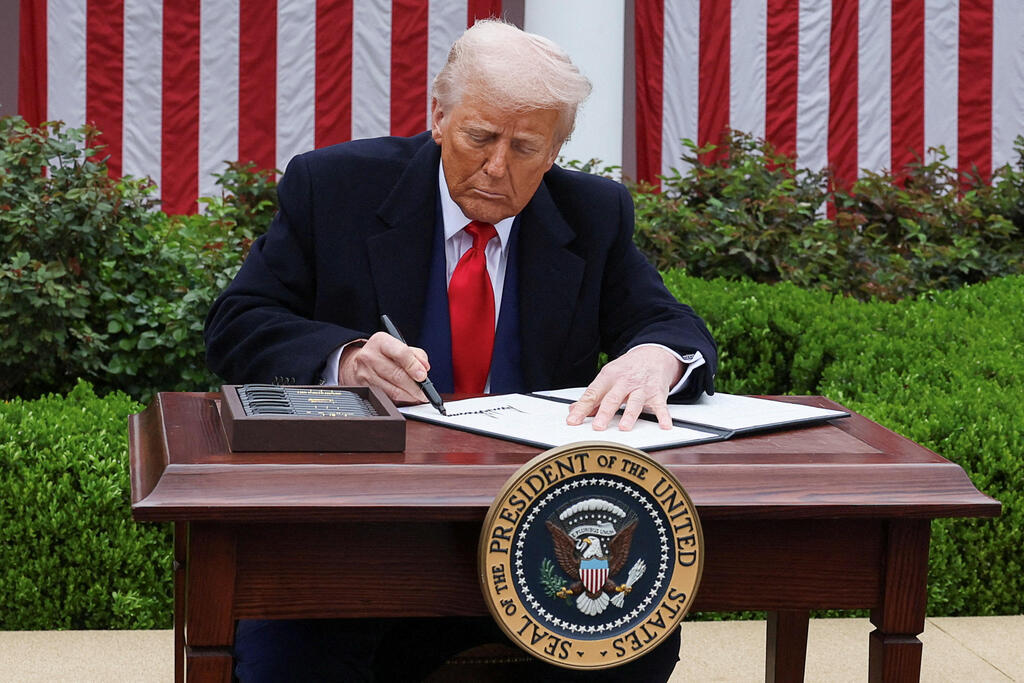
The latest tariff threat comes as part of Trump’s broader pressure campaign against European taxation of US tech firms
(Photo: REUTERS/Leah Millis/File Photo)
A digital services tax is levied on revenue generated by large technology companies from digital services within a given country, even if they have no significant physical presence there. Unlike corporate tax, which is based on profit, it is applied to gross revenue from sources such as online advertising, digital marketplaces, and user data sales.
Most countries that apply such taxes limit them to large corporations with hundreds of millions of dollars in global revenue, effectively targeting major U.S. tech firms such as Google, Meta, Amazon, and Apple.
Around 10 European countries currently impose such taxes, including the United Kingdom, France, Italy, Spain, and Portugal, with rates ranging from 1.5% to 7.5%. The UK, for example, charges a 2% tax on revenues from search engines, social networks, and online marketplaces, applying only to companies with more than £500 million in global revenue. France’s 2019 law imposes a 3% tax on digital services revenue generated in France.
Trump has opposed these taxes in principle since taking office, viewing them as direct discrimination against American tech companies. Nearly a year ago, he warned that countries refusing to repeal what Washington considers discriminatory digital taxes or regulations could face significant additional tariffs on exports to the U.S., as well as restrictions on exports of semiconductors and advanced technology.
More recently, ahead of the G7 summit, he threatened France with a 100% tariff on imports of French wine and champagne unless President Emmanuel Macron repealed the tax. Earlier in April, he also warned the United Kingdom that failure to abolish its digital tax would result in a additional tariff.
So far, most of these threats have not been implemented. Negotiations are ongoing within the OECD framework, which is attempting to reach a global agreement to replace unilateral digital services taxes, but consensus remains out of reach in the United States. Meanwhile, several countries have moved in the opposite direction, reconsidering or freezing such taxes under U.S. pressure, including Canada, which scrapped its digital services tax last year to preserve trade talks with Washington.