

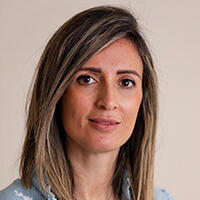
It is almost hard to believe, but in the West Bank, between greenhouses, fields and fish ponds, close cooperation is taking place between Palestinian farmers and Israel’s Civil Administration. Most Palestinian agricultural produce is marketed in Israel, under the coordination of Samir Moadi, a Druze from Yarka who lost his son, Corporal Yosef Moadi, in Operation Cast Lead and believes the land can connect people.
Between the moshav of Shaar Ephraim in the Sharon region and the Palestinian village of Jalama near Jenin, amid the most complex security reality the area has seen in decades, a daily and largely invisible cooperation continues, one that sustains thousands of families on both sides. This is not political cooperation, but work. Of land, water, sowing and harvest.
3 View gallery
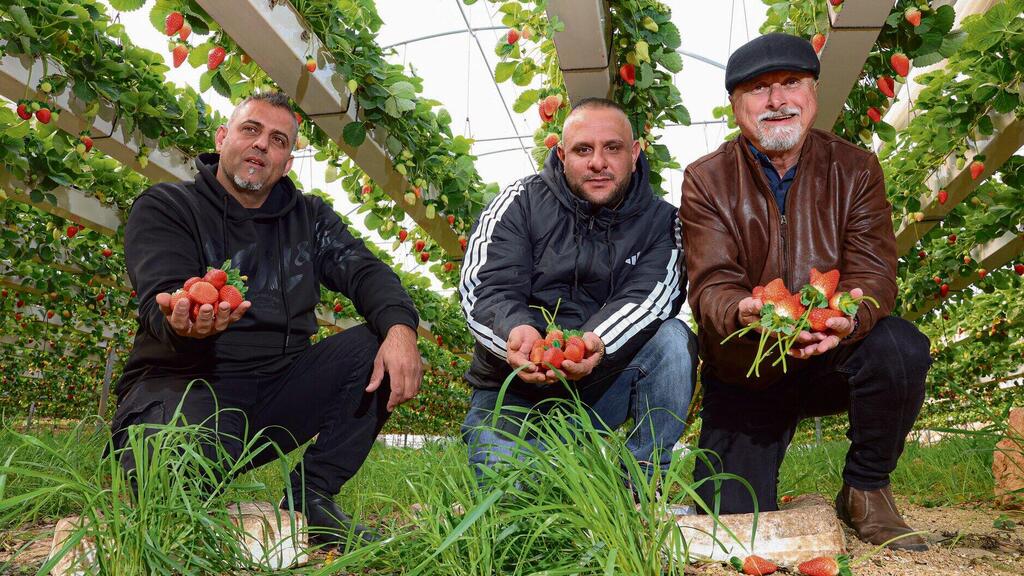
'This is a long-term project' From right: Tair Qader, Tarek Abu Safaka, Samir Moadi
(Photo: Shaul Golan)
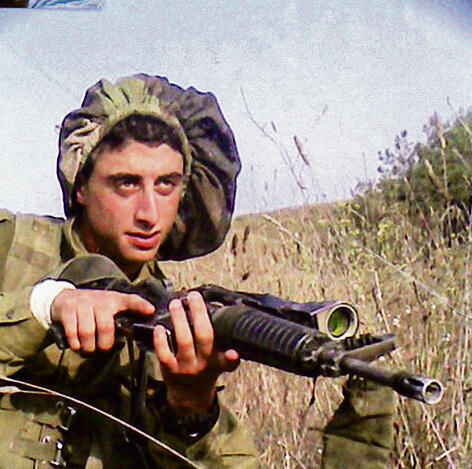
At the center of this activity stands Moadi, a Druze from Yarka and an agriculture staff officer in the Civil Administration. He lost what was dearest to him, his son, Cpl. Yosef Moadi, a Golani Brigade soldier who was killed in combat in the Gaza Strip in January 2009 during Operation Cast Lead, and chose to keep moving forward through the land.
“I continue to do my job faithfully because I understand that this is the only path to brotherhood and peace,” Moadi says quietly. “Someone who works, earns a living and lives with dignity does not seek wars.”
100,000 tons a year
Palestinian agriculture relies heavily on the Israeli market. About 65% of Palestinian agricultural produce is marketed in Israel. Annual production stands at roughly 150,000 tons, more than 100,000 of which reach the Israeli market, about 10% of Israel’s total consumption.
“If there is no market in Israel, there is no Palestinian agriculture,” Moadi says unequivocally. “It is that simple.” Agricultural marketing from the West Bank to Israel is estimated at about 1.2 billion shekels a year. Agriculture accounts for roughly 7% of Palestinian GDP and employs about 140,000 workers, about 16% of the workforce. Since the outbreak of the war on October 7, the number of workers in the sector has risen by about 25%, following the reduction of employment inside Israel.
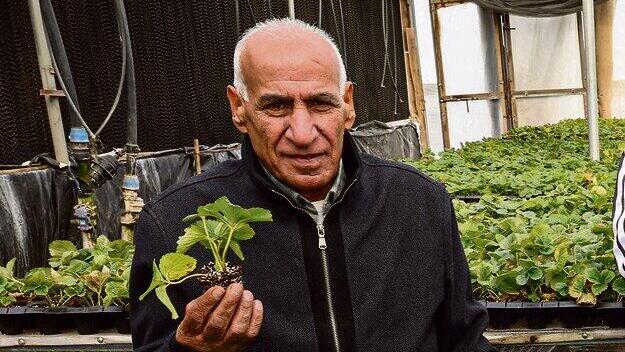
Abd al-Rahman, a resident of the Palestinian village of Talouza near Nablus, is an agricultural engineer and instructor who has worked alongside Moadi for more than 34 years. He is responsible for one of the most sensitive processes, inspecting Palestinian produce before it enters Israel.
“Every shipment that passes through the crossings, especially Shaar Ephraim and Jalama, undergoes organized sampling,” he explains. “These include pesticide residue tests and microbiological tests of irrigation quality. Everything is sent to the Agriculture Ministry in Beit El, and only then is it cleared for marketing. That is how we maintain quality and safety.”
According to him, even after October 7, professional work did not stop. “What was hurt was marketing. But Samir and I continued working without interruption. We did not stop.”
One of the major initiatives led by the agriculture staff officer is the shift to integrated and biological pest control. “Instead of dangerous chemical spraying, we moved to pest control using insects,” Abd al-Rahman says. “This reduces toxicity, improves fruit quality and allows Palestinian farmers to meet the standards of all markets, in Israel and abroad.”
‘Agriculture is a forward defense’
In the village of Jabara, not far from Tulkarm, agricultural engineer and farmer Tair Qader points to the water ponds. This is where a fish farming project was born, in cooperation with the Civil Administration.
“It started as an irrigation pond for greenhouses,” Qader says. “I said, why not also raise fish? Samir took the idea seriously.”
Israeli experts were brought in, oxygenation systems, filters and generators were installed. About 2,800 fish were raised in the first pond, and six additional ponds were later established. Today there are seven fish ponds in the Tulkarm and Jericho areas, with about 40,000 fish, mainly bass. “In March we will introduce no fewer than 30,000 new fish. This is a long-term project,” he says.
Tarek Abu Safaka, a trader and owner of a packing house, markets agricultural produce and employs more than 170 Palestinian farmers. His goods reach almost every home in Israel.
“The high quality did not start today,” he says. “Even 20 years ago we worked together, Israelis and Palestinians, according to the same standards. It is the same method, the same knowledge.”
On the Israeli side, agriculture is also seen as a strategic tool. Capt. Yuval Arviv, commander of the Shaar Ephraim liaison office in the Civil Administration, puts it simply: “Agriculture is a forward defense. Without an economy and without work, security collapses. There is a clear Israeli interest here.”
Since losing his son, Moadi has also led agricultural and landscape memorial projects in memory of fallen IDF soldiers.
“In the end,” he says, looking over the fields, “life wins. The land does not ask who you are. It asks that you care for it. And if we care for it together, maybe we will also heal.”
And between greenhouse and fish pond, between strawberry field and crossing gate, it seems that at least here, the land still knows how to connect.