

An appeal filed against the Israel Tax Authority's demand for an additional 132,000 shekels (around $43,000) in VAT from the owners of the well-known Jerusalem sabich stand Ha'Sabichiya has exposed an unusual tax dispute: how many hard-boiled eggs go into each pita, and how many pitas tear during the workday and should therefore be recognized as waste.
The appeal was filed on Sunday with the Jerusalem District Court by Sabich Yerushalayim Ltd., the company that operates the stand run by Yigal Patel on Shamai Street in downtown Jerusalem.
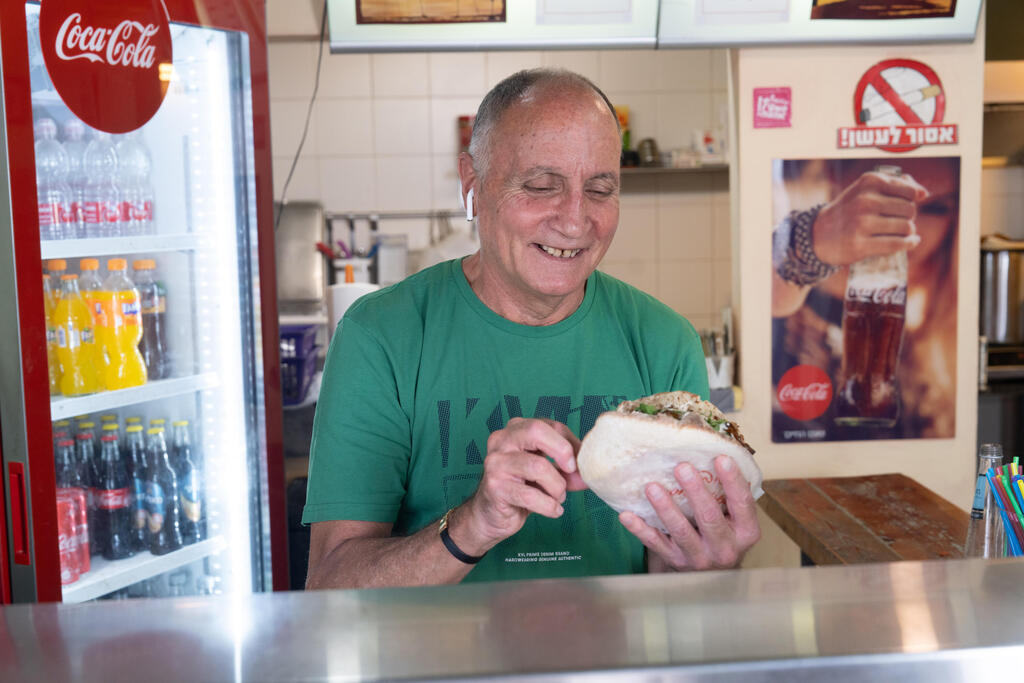
Yigal Patel
(Photo: Shalev Shalom)
According to the appeal, the company was established 23 years ago by another individual to provide a livelihood for Patel and his wife while they were undergoing bankruptcy proceedings. The filing states that the stand sells only sabich and soft drinks and does not even own a freezer, meaning no inventory is kept overnight.
In 2025, the Tax Authority conducted two observational audits at the cash-only stand, which operates for roughly six hours a day. Inspectors counted 134 customers on one day and 127 customers on another.
Based on those observations and the price of each sabich, the Tax Authority concluded that the stand had underreported its sales and initially assessed an additional VAT liability of approximately 160,000 shekels (around $52,000) covering four years.
"Yigal was struck with anxiety and uncontrollable crying while rejecting the figures," the appeal states, describing a meeting between Tax Authority representatives and the stand owner's representative.
Patel argues that the Tax Authority's calculations, based, according to documents attached to the appeal, on an assumption of 1.05 eggs per pita and a 20% waste rate, do not reflect reality. He argues that the additional VAT assessment should therefore be canceled in full because actual waste is significantly higher, particularly due to pitas that tear while being prepared.
"There are many conversations with Angel Bakery, the pita supplier, about the poor quality of the pitas," the appeal, filed by attorney Shmuel Deblinger, states.
"The stand cannot serve customers a pita that cannot hold its contents, and therefore many pitas were returned or thrown away."
According to the appeal, the stand orders 200 pitas each day from Angel Bakery, of which approximately 70 are never sold, representing 35% of the daily order, while at least another 20 are discarded because they tear during preparation.
The filing also notes that Patel has not changed pita suppliers over the years.
Angel Bakery did not respond to requests for comment.
According to the appeal, the Tax Authority agreed to increase the recognized waste rate from 20% to 25%, but maintained that, even after revising its calculations, the stand still owed additional VAT.
As a result, the authority reduced its demand to approximately 132,000 shekels (around $43,000), an assessment that Patel is now challenging in court.
At the center of the case is a surprisingly detailed accounting exercise.
The Tax Authority's assessment assumes a standard number of eggs per sabich and a limited amount of discarded bread. Patel argues that both assumptions are unrealistic for a busy street-food stand, where torn pitas, unsold bread and other unavoidable losses are part of daily operations.
The outcome of the case could help clarify how small food businesses can prove waste levels when tax authorities reconstruct sales based on observational audits rather than accounting records.