


Israeli companies are increasingly making their mark on Europe's energy market. Since the beginning of the year, a wave of Israeli investment in energy projects has gathered momentum, accelerating further in recent weeks.
The shortage of projects in Israel and the freeze on grid connection approvals for new data centers appear to be driving Israeli energy companies to expand their operations in Europe, where they benefit from government policies encouraging renewable energy investment and rapidly growing demand. Israeli energy companies are closing major deals, acquiring project portfolios and developing solar, wind and energy storage infrastructure across Europe.
Gallery
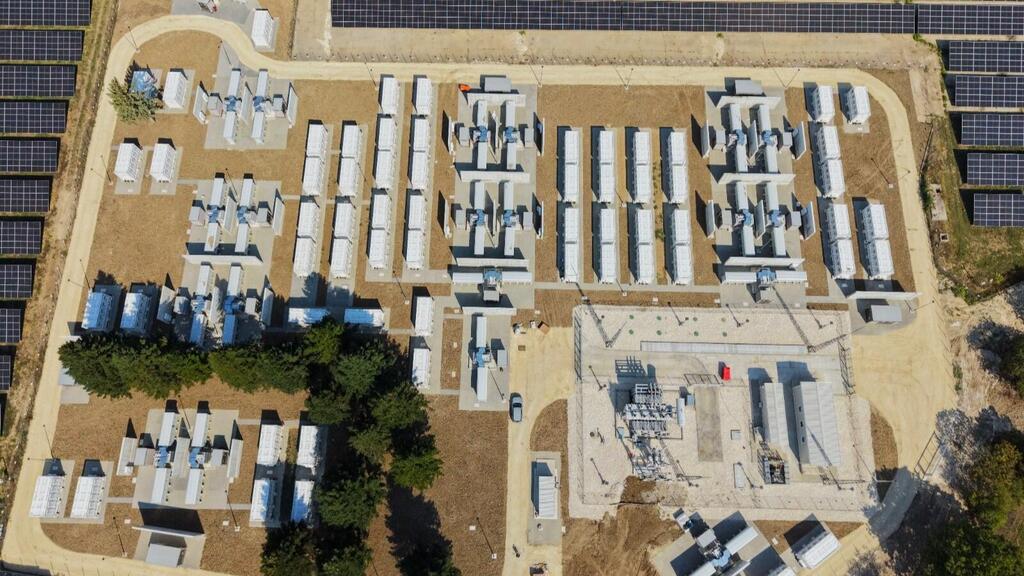
The project developed by Colmobil Energy and Timnat Energy Ltd. in Bulgaria
(Photo: Colmobil Energy)
One recent example is the investment by Colmobil Energy and Timnat Energy, which announced the start of commercial operations at an energy generation and storage project in Bulgaria. The companies invested 60 million euros in the project, which is expected to generate 12.8 million euros in revenue in its first year. The Lambrinovo project, located near the city of Silistra, includes a battery energy storage system (BESS) with a power rating of 150 megawatts and a storage capacity of 317 megawatt-hours. It covers approximately 4 acres on the site of the former Silistra airport.
Colmobil Energy, the renewable energy arm of the Colmobil Group, holds a 60% stake in the project, while Timnat Energy owns the remaining 40%. The two companies acquired land-use rights for 49 years. The project met the eligibility requirements for an 8 million euro grant under a European Union program. Its completion marks a significant milestone for Israeli companies operating in Bulgaria's energy market, following nearly a decade of efforts to promote and develop projects in the country.
Aviv Pfeffer, CEO of Colmobil Energy, said the launch of the Lambrinovo project demonstrates the company's international growth strategy.
"This involved the construction and commissioning of a large, significant energy storage facility on an exceptionally tight schedule, demonstrating our ability to identify opportunities, develop and build complex assets and bring them into commercial operation," he said.
Pfeffer added that the company intends to expand its operations in Bulgaria and across Europe.
Dan Naor, CEO of Timnat Energy, said: "This is an important milestone in establishing Timnat's position as a significant player in the European energy market."

Aviv Pfeffer, CEO of Colmobil Energy
(Photo: Colmobil Energy)
Significant opportunities
Why do Israeli companies prefer Europe?
Pfeffer explained: "Europe is undergoing a profound transformation of its energy system. Geopolitical developments have reinforced the need for energy independence and domestic production, while the electrification of transportation and industry, artificial intelligence and data centers are increasing demand for electricity."
According to Pfeffer, as the share of renewable energy grows, imbalances emerge, increasing the need for storage and infrastructure capable of ensuring electricity supplies around the clock.
"The convergence of these trends, together with the business and regulatory environment, creates significant opportunities for Israeli energy companies," he added.
Pfeffer said this is why Colmobil Energy is building a regional presence in Bulgaria, Romania and Serbia.
"In Bulgaria, we found a combination of demand for energy storage, support for developing the sector and a project opportunity that allowed us to move quickly. Our first project there provides a foundation for further expansion in the region and the establishment of a diversified platform."
Eitan Parnass, CEO of the Green Energy Association of Israel, said the rush by Israeli companies to expand overseas stems in part from regulatory restrictions in Israel.
"Naturally, the maturity of Israel's renewable energy sector, combined with the shortage of domestic projects resulting from misguided decisions by various Israeli regulators to delay and halt ground-mounted solar projects, has led to a boom in Israeli activity in Europe and the United States," Parnass said.
"What cannot be done here is being done there, quickly, with Israeli efficiency and plenty of chutzpah. The results speak for themselves, with Israeli companies at the forefront of the industry in several countries, holding project pipelines totaling thousands of megawatts."
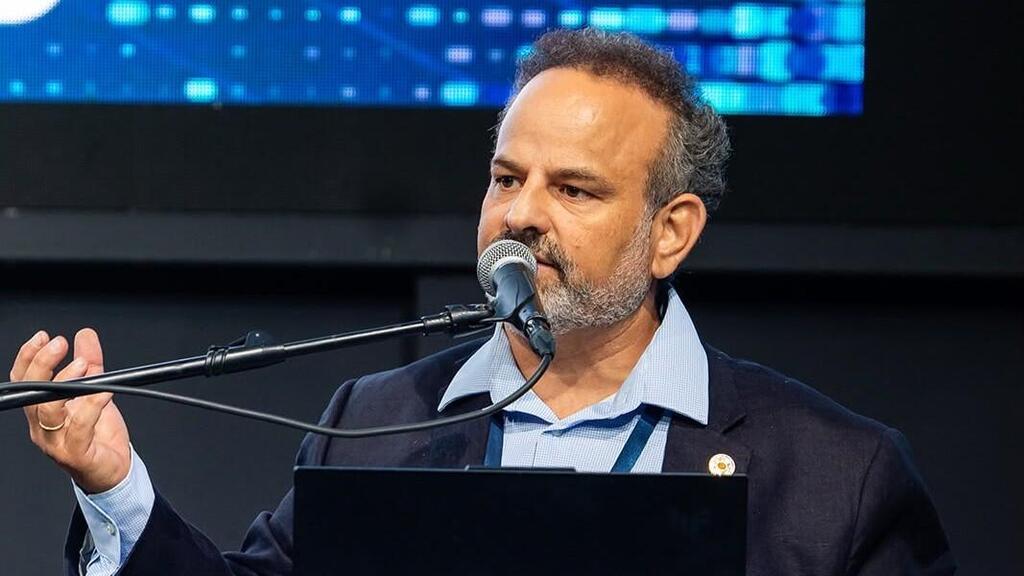
Eitan Parnass, CEO of the Green Energy Association of Israel
(Photo: Shauli Lendner, Art Studio)
Since the energy crisis that hit Europe, the European Union has pursued an aggressive policy of ending its dependence on Russian gas supplies. The EU has established binding renewable energy targets in law, creating enormous, stable and sustained demand for green electricity.
Unlike emerging markets, where regulation and payments carry greater risks, Europe offers developed markets in which companies can sign long-term contracts with major corporations and governments, providing investors with stable cash flow.
For Israeli companies, Europe is also geographically closer than the United States or Asia. This makes it easier for executives, engineers and professional teams to visit projects, oversee construction and manage assets efficiently.
In previous years, Israeli companies focused on developing solar farms and wind turbines. Today, because of congestion on European power grids, the dominant trend is to integrate energy storage solutions into new and existing projects to ensure a stable electricity supply.
Another emerging trend is the shift from developing new projects to acquiring existing, revenue-generating assets.
Israeli companies are leveraging their financial strength not only to build new projects but also to acquire portfolios of facilities that are already connected to the grid and selling electricity. The goal is to generate immediate cash flow and subsequently improve the assets' operational performance.
There has also been an increase in partnerships with Israeli insurance companies and investment firms to finance acquisitions of revenue-generating portfolios while providing ongoing returns to policyholders and savers in Israel.
Investments in foreign markets
As noted, the stream of announcements about European energy deals has reached a peak in recent weeks.
Solair recently reported several business developments, including conditional grid connection approval in Italy for energy storage projects totaling approximately 384 megawatts, up from the originally planned 320 megawatts. The company also announced another water supply agreement for ENAPAC, signed with an international mining company, and advanced negotiations to increase its holdings in projects in Spain, Italy and Chile.
Solair is negotiating with its Spanish partner, Himin Solar Energy Company SL, on a restructuring deal designed to allow Solair to focus its operations on revenue-generating assets with strong cash flow.
Under the proposed arrangement, projects in the planning and development stages in Spain, with a combined capacity of approximately 883 megawatts, would be transferred to Himin Solar. In return, Solair would receive an option, exercisable for up to 10 years, to acquire Himin's 49% stake in the Agua-Sol partnership.
The Matera Energia project in Brindisi, Italy, in which Solair holds a 47.4% stake, has received conditional grid connection approval (STMG) from TERNA, Italy's national transmission system operator.
The project consists of two standalone energy storage facilities with a combined installed power capacity of approximately 384 megawatts and storage capacity of up to 2,300 megawatt-hours, providing six hours of discharge. The approval secures the project's place on the transmission grid. Construction is expected to begin in the second half of 2027.
Solair also reported that it had secured exclusive rights to negotiate the acquisition of full ownership of an operating 50-megawatt solar project in Poland. The transaction, if completed, would be valued at 46.5 million euros. The project is expected to generate annual revenue of 7 million euros.
Following completion of the acquisition, Solair's portfolio of revenue-generating assets in Europe, including Poland, would have a combined capacity exceeding 700 megawatts.
Econergy reported that its Dalmarnock energy storage project in the United Kingdom had been connected to the national electricity grid and had begun supplying electricity on a partial basis.
The 40-megawatt project, with a storage capacity of 120 megawatt-hours, is wholly owned by the company's subsidiary, Econergy England. The company expects the facility to reach full commercial operation in December 2026.
Total investment in the project reached 29 million euros, with expected annual revenue of 4.7 million euros.
The company has another grid-connected storage project in the United Kingdom, Swangate, with a power capacity of 50 megawatts and storage capacity of 100 megawatt-hours, which was connected to the grid in 2024.
Additional projects are under construction or approaching the construction stage. These include the 80-megawatt Immingham storage project, with a capacity of 240 megawatt-hours, which is expected to connect to the grid in 2027, as well as three additional energy storage projects and a solar project scheduled for grid connection in 2027 and 2028.
Econergy also announced a business agreement between its subsidiary, Eco Italy Management, and Luxembourg-based EGD. Through the arrangement, the company will control, via project companies, photovoltaic projects in Italy with a combined capacity of approximately 390 megawatts. The projects are at various stages of operation, construction and development.
The company believes the transaction will strengthen its ability to influence EGD's management and advance its business operations and the renewable energy projects held through it.
Ellomay reported the start of grid connection work for an 87-megawatt solar project in Italy's Lazio region.
The first 30-megawatt section of the 87-megawatt solar facility, developed by Ellomay Solar Italy Five, in which Ellomay holds a 51% stake, has begun connecting to the grid. The remainder of the project is expected to connect to Italy's national electricity grid in the coming weeks.
Prime Energy reported signing a memorandum of understanding to acquire a portfolio of operating photovoltaic projects in Hungary with a combined capacity of approximately 70 megawatts.
The company plans to acquire two Hungarian holding companies that operate four revenue-generating photovoltaic facilities already connected to the electricity grid. The transaction is valued at approximately 68 million euros.
Sunflower Renewable Investments reported completing the signing of electricity sales agreements in Poland.
The company will sell the entire gross electricity output, known as "black power," from its wind farms in Poland to ENERGA during 2027 and 2028.
The sale will be structured on a pay-as-produced basis at a price of 495 Polish zlotys ($126/MWh) per megawatt-hour.
Sunflower expects revenue from the agreement to total approximately 121 million zlotys ($30.9 million), although the forecast remains uncertain and depends on actual electricity generation.
These deals represent only a partial and somewhat random selection of transactions that are part of a much broader trend.
Israel's energy expertise and the substantial Israeli capital being invested in European projects represent resources that are being diverted away from the domestic market.
With appropriate regulation, some of these resources could have been directed toward Israel's economy, preventing the continued migration of companies and investors to foreign markets.
This article was originally published by Energya, ynet's news website covering energy and technology.