

The International Monetary Fund (IMF) has issued a pessimistic outlook for the Israeli economy for 2025 and 2026, despite expectations that these years would mark a period of recovery following a year of war and sluggish growth in 2024, which saw declines in both GDP per capita and business output.
According to the IMF’s first World Economic Outlook (WEO) report for 2025, Israel’s economy is projected to grow by 3.2% this year and 3.6% next year—lower than the Bank of Israel’s most recent forecasts of 3.5% and 4%, respectively. The report does not provide country-specific explanations, except for the world’s largest economies, and includes only statistical tables. Israel’s central bank forecasts typically serve as a benchmark for both domestic and international economic projections.
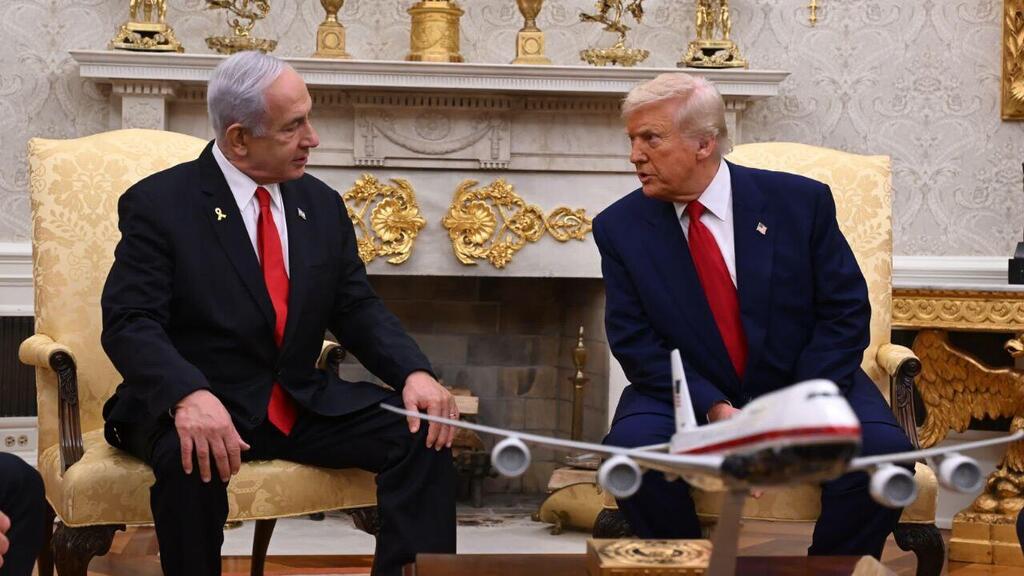
Benjamin Netanyahu and Donald Trump
(Photo: GPO)
The IMF also expects inflation in Israel to be slightly higher this year than the Bank of Israel’s estimate—2.7% versus 2.6%—but slightly lower in 2026, at 2% compared to the central bank’s 2.2% projection. Like the Bank of Israel, the IMF anticipates the unemployment rate will remain low over the next two years, around 3%, a modest increase from the current 2.6–2.7%.
One figure receiving unusual attention in the current report is the current account surplus in Israel’s balance of payments, which reflects the net flow of foreign currency. Israel has maintained a surplus in this account for two decades, driven largely by exports—particularly in services such as tech.
In its previous report from October 2024, the IMF projected a 4.4% of GDP surplus for 2025. That forecast has now been sharply downgraded to 2.8% of GDP—a reduction of about 32 billion shekels. The downgrade is likely tied to a decline in exports due to the escalating trade war launched by U.S. President Donald Trump.
Indeed, the standout message of the WEO report is the global disruption sparked by Trump’s sweeping tariffs. The global economy had begun to recover, with inflation subsiding, when Trump’s April 2 Rose Garden announcement of what the IMF describes as “the highest tariffs imposed in over a century” derailed projections.
The updated projections indicate a significant downgrade in global growth expectations
“The April 2 announcement forced us to throw out all of our forecasts,” wrote IMF Chief Economist Dr. Pierre-Olivier Gourinchas in the report’s preface, noting that the team had to condense a two-month forecasting process into just 10 days.
Gourinchas stated that the tariffs themselves represent a major blow to global growth, but the chaotic rollout of trade policy further compounded the damage and made economic forecasting more difficult. As a result, the updated projections in the report are based on various scenarios regarding future U.S. trade policy.
These forecasts are current as of April 4—before the White House froze tariffs on most countries for 90 days and raised duties on China.
The updated projections indicate a significant downgrade in global growth expectations: the IMF now anticipates global GDP growth of around 2.8% in 2025 and 3% in 2026, compared to 3.3% in the January 2025 update. This marks a cumulative downward revision of 0.8 percentage points over two years, with projected growth well below the 2000–2019 historical average of 3.7%.
For the United States, the IMF now forecasts a slowdown to 1.8% growth in 2025, down from 2.7% in the previous forecast, citing increased policy uncertainty, trade tensions, and expected cooling in demand. In the eurozone, the projected slowdown is milder—only 0.2 percentage points—with weak overall growth forecast at just 0.8%.
Get the Ynetnews app on your smartphone: Google Play: https://bit.ly/4eJ37pE | Apple App Store: https://bit.ly/3ZL7iNv
The report’s other major revision concerns inflation. The IMF expects global inflation to ease, but more slowly than previously thought, and to remain relatively high: 4.3% in 2025 and 3.6% in 2026. The most significant upward revisions were recorded in developed economies, particularly the United States, where 2025 inflation is now projected at 3%, up sharply from the 2% forecast in January.
Beyond the numbers, the IMF outlines a growing web of risks that could undermine both short- and long-term growth. “Escalating trade wars, combined with deepening uncertainty over trade policy itself, could further weigh on economic performance,” the report warns. Weakened fiscal buffers, it says, also leave countries more vulnerable to future shocks. “Hasty policy moves or actions that cause fragmentation and negative sentiment could trigger repricing of financial assets—beyond what we’ve seen since the broad U.S. tariff announcement on April 2.”
The IMF also notes sharp fluctuations in exchange rates and international capital flows, particularly affecting economies already facing debt distress. The report warns of potential broader financial instability, including a hit to the international monetary system—a veiled reference to the U.S. dollar’s status as a global reserve currency.
Perhaps most striking is the final warning: “The lasting impact of the current cost-of-living crisis, combined with limited policy space (referring to restricted capacity for fiscal deficits or major interest rate cuts) and weak medium-term growth forecasts, may reignite social unrest.”