

Investment in Israeli life sciences companies fell sharply in 2025, dropping 40% after a recovery the previous year, according to an annual report published Sunday by the Israel Advanced Technology Industries Association, the Israel Innovation Authority and PwC Israel.
The report, released ahead of the MIXiii Health-Tech.IL conference in Jerusalem, said private investment in the sector fell to its lowest level in five years, while the average deal size continued to decline, dropping below $10 million.
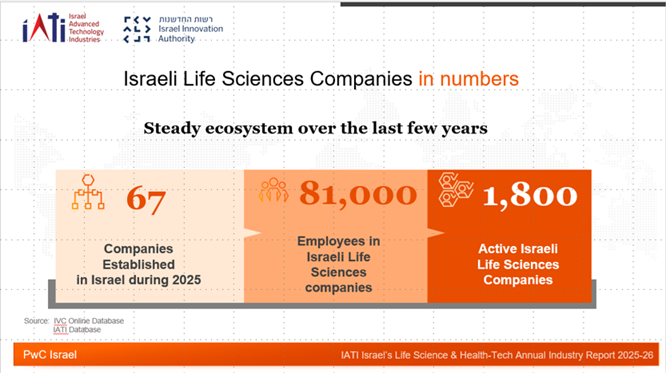
About $1.6 billion was invested in Israel’s life sciences sector in 2025, more than 90% of it private investment. The report found stability in biomed investment but a steep drop of more than 60% in medical device investment. It also found a significant increase in investment linked to artificial intelligence, similar to trends across other high-tech sectors.
IATI CEO and President Karin Mayer Rubinstein said Israeli high-tech is operating during “one of the most complex and challenging periods it has ever known,” citing the security situation, geopolitical uncertainty, prolonged military reserve duty and global competition for capital. She also said the weakening dollar has hurt Israeli companies whose revenues are often in dollars while expenses, especially salaries, are paid in shekels.
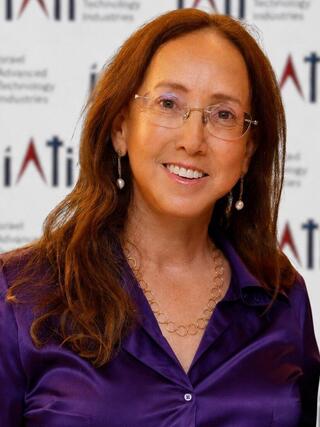 Karin Mayer Rubinstein Photo: Guy Yechiely
Despite the challenges, she said, the industry continues to show resilience, maintain business activity and serve as a central growth engine of the Israeli economy.
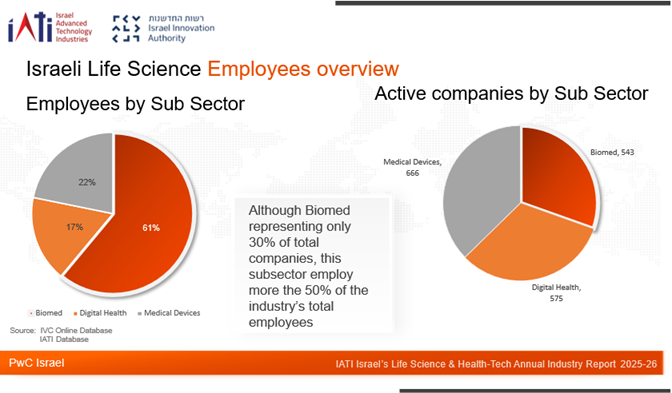
The report said the number of active life sciences companies in Israel remained stable, as did exports, mergers and acquisitions activity and international interest in Israeli technologies. Biomed companies account for about 30% of the sector’s companies but employ more than half of its 81,000 workers.
Tel Aviv remained the leading hub, with 310 companies, followed by Rehovot and Ness Ziona with 120, Jerusalem with 112 and Haifa with 83.
(Illustraion: PwC Israel)
The report said 2025 marked the sixth consecutive year in which at least one acquisition of an Israeli life sciences company exceeded $500 million.
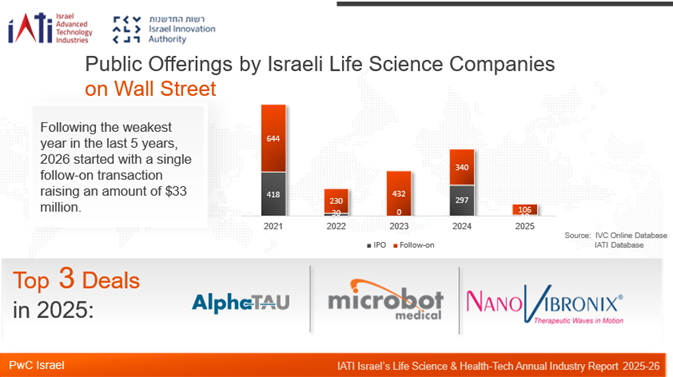
Public financing was weaker. Most public Israeli life sciences companies use U.S. markets as their main source of funding, and about 40% of those traded on the Tel Aviv Stock Exchange are also listed on Wall Street. But Israeli companies raised only about $115 million on U.S. exchanges in 2025, a drop of more than 80%. No new life sciences companies held IPOs on the Tel Aviv Stock Exchange, and total fundraising there was negligible.
The report highlighted AI in drug development as a growing field. About 30 Israeli companies operate at the intersection of AI and drug development, about 70% of them supported by the Israel Innovation Authority. Globally, about 12% of recent pharma-biotech collaborations are AI-driven, with combined deal value of about $30 billion, the report said.
(Illustraion: PwC Israel)
Israel Innovation Authority CEO Dror Bin said Israel is at the forefront of medical innovation because of its scientific base, entrepreneurs, health care system and AI capabilities.
“Israel today stands at the forefront of the global medical innovation revolution. The combination of scientific excellence, breakthrough entrepreneurship, a high-quality healthcare system, and advanced capabilities in artificial intelligence creates an exceptional opportunity to develop solutions that will change the way health is diagnosed, treated and managed," he said.
"The role of the Israel Innovation Authority is not only to invest in companies, but to build the conditions that will enable innovation to grow, through national infrastructures, supportive regulation, international collaborations, and pilot sites that make it possible to test technologies in real-world environments.
"Even during a period of geopolitical and economic challenges, we see the resilience of the Israeli ecosystem, with renewed entrepreneurship and an increase in companies’ activity. We will continue to identify the trends shaping the future and ensure that Israel is among the countries leading the next generation of medical innovation, for the benefit of patients in Israel and around the world.”
 Dror Bin Photo: Hanna Taieb
In 2025, the authority invested about 560 million shekels in health-tech, about 29% of its total investments. Its Startup Fund allocated more than 45% of its investments, about 250 million shekels, to health-tech. The authority also supported two venture capital funds specializing in life sciences through the Yozma Fund.
In 2026, the authority and Health Ministry launched a regulatory pilot to evaluate autonomous AI systems in health care.
The report said Israeli life sciences companies exported about $1.7 billion in pharmaceuticals and $3.3 billion in medical equipment in 2025, similar to 2024 and stable compared with recent years.
Omer Gavish, life sciences leader and partner at PwC Israel, said 2025 was “significantly challenging” for private fundraising, though merger activity showed continued international interest in Israeli innovation.
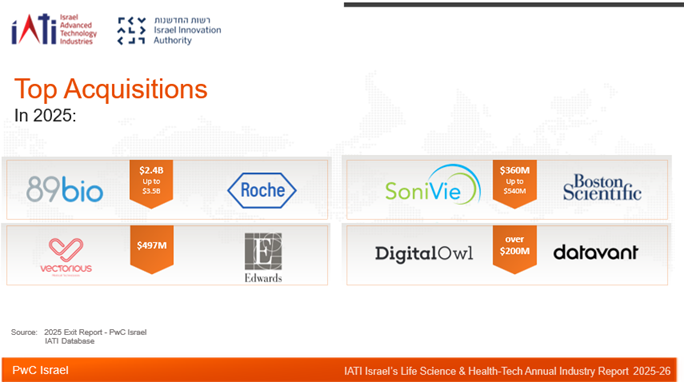
(Illustraion: PwC Israel)
“We saw a decline to levels we have not experienced in the past five years, and an average deal size that fell to below $10 million. However, this year as well, we saw several merger deals amounting to hundreds of millions of dollars, alongside many transactions at lower amounts, which validate the interest of international companies in the innovation of Israeli companies," he said.
"The survey we conducted among the funds indicates cautious optimism toward 2026, with expectations of recovery or a return to growth, and together with the maturation of the AI field and investments in national infrastructure, the foundation for continued growth exists.”
A survey of leading life sciences and health-tech venture capital funds found 74% cited fundraising as the industry’s main challenge in 2025, up from 52% in 2023. Looking ahead, 57% of funds expected cautious recovery in 2026, 22% expected renewed growth and 22% expected stagnation.