

The consumer price index fell 0.3% in January, exceeding analysts’ expectations for a decline of between 0.1% and 0.2%, according to data released by the Central Bureau of Statistics on Sunday.
Because January last year saw a sharp 0.6% increase, annual inflation slowed to 1.8%, well within the government’s 1% to 3% target range. It marks the lowest annual inflation rate since June 2021 and could pave the way for another interest rate cut later this month.

Season-end sales in clothing and footwear, brought forward this year due to unseasonably mild winter weather, contributed significantly to the decline. Prices for clothing and shoes dropped 3.9% in January.
Other notable decreases were recorded in transportation, down 2.8%, culture and entertainment, down 0.7%, and owner-occupied housing services, down 0.2%.
Price increases were seen in miscellaneous goods and services, up 2.4%, fresh fruits and vegetables, up 0.8%, health services, up 0.7%, home maintenance, up 0.6%, and rent, up 0.3%.
Looking ahead, February 2025 recorded a zero reading, and February this year is expected to post only a modest increase. However, March and April last year were elevated, with increases of 0.5% and 1.1%, respectively, raising expectations that the corresponding months in 2026 will show more moderate readings.
Separately, housing prices rose at the end of 2025 despite declines during much of the year.
The housing price index for November-December 2025, which is published alongside the January 2026 consumer price index but is not part of it, rose 0.8% compared with the previous two-month period, the sharpest increase since December 2024. It marked a second consecutive monthly rise following a 0.7% increase in the prior reading.
On an annual basis, housing prices rose 0.4% compared with November-December 2024.
By district, most regions recorded increases in November-December 2025. The Tel Aviv district led with a 2% jump, followed by the Southern district with a 1% rise. Jerusalem and the Northern district each rose 0.4%, and Haifa increased 0.3%. Prices in the Central district were unchanged.
Compared with the same period a year earlier, prices rose in Jerusalem, up 9.6%, the Northern district, up 4.8%, the Southern district, up 1.4%, and Haifa, up 0.7%. Annual declines were recorded in the Tel Aviv district, down 1.9%, and the Central district, down 3.1%.
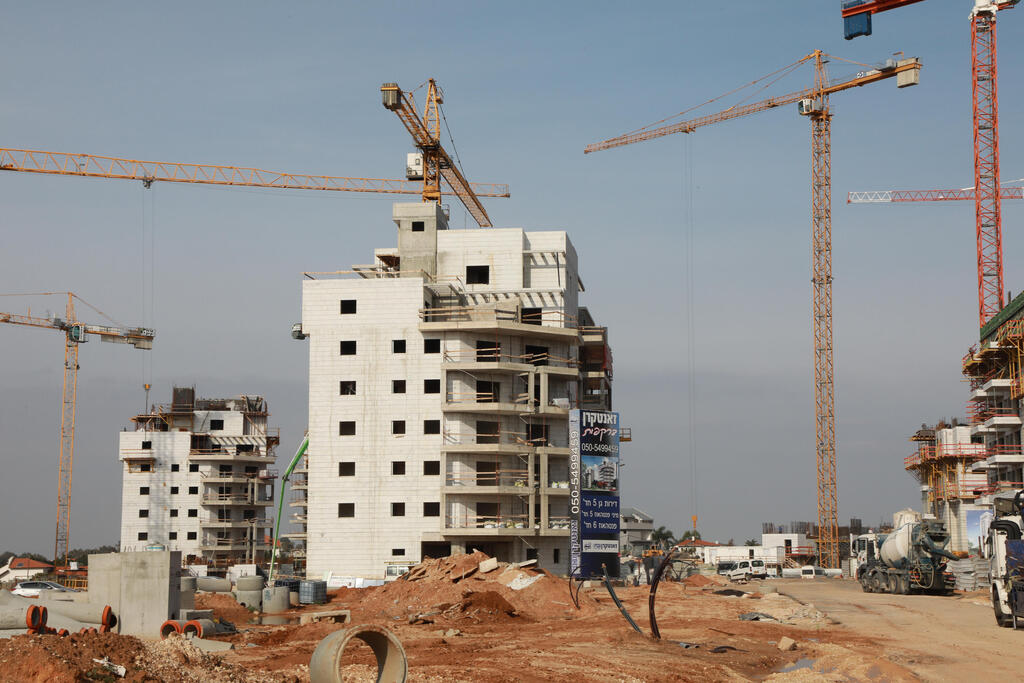
New home prices rose 0.9% in November-December 2025, driving the overall increase in the housing index. On an annual basis, however, new home prices fell 0.9%.
(Photo: Dana Kopel)
Government-subsidized transactions accounted for 36.7% of new home deals in November-December, down from 42.1% in the previous two-month period. Excluding government-supported transactions, the new home price index rose 0.7%.
Quarterly data show that the national average price of a home reached about 2.36 million shekels in the fourth quarter of 2025, up 1.8% from the previous quarter and 0.5% from a year earlier.
The Tel Aviv district recorded the highest average price at approximately 3.36 million shekels per home, while the Northern district posted the lowest at about 1.57 million shekels.
Among the 18 largest cities, each with more than 100,000 residents, average prices above 3 million shekels were recorded in Tel Aviv, about 4.16 million shekels, Herzliya, about 3.97 million shekels, Jerusalem, about 3.33 million shekels, and Ramat Gan, about 3.28 million shekels.
Prices below 2 million shekels were recorded in Beersheba, about 1.28 million shekels, Ashkelon, about 1.72 million shekels, and Haifa, about 1.83 million shekels.
Compared with the fourth quarter of 2024, notable increases in average home prices were recorded in Jerusalem, up 10%, Haifa, up 8.9%, Beit Shemesh, up 7.6%, and Rehovot, up 6%. Declines were seen in Rishon LeZion, down 7.8%, Netanya, down 4.2%, Kfar Saba, down 2.8%, and Herzliya, down 2.2%.