

The war between Israel and the United States and Iran, which began Saturday with a powerful opening strike by the Israel Defense Forces, will hover in the coming period — and beyond — over the Israeli capital market and the local economy.
Distant history shows that within a year after war's end, the local market tends to deliver excess returns compared with global markets. More recent history shows that the Tel Aviv Stock Exchange has been in a significant rally since the war that began on October 7, and since the previous exchange of blows with Iran about eight months ago, during Operation Rising Lion in June — when the local exchange actually posted gains during the operation, amid market assessments that it would ultimately bring about a dramatic reduction in the Iranian threat to Israel.
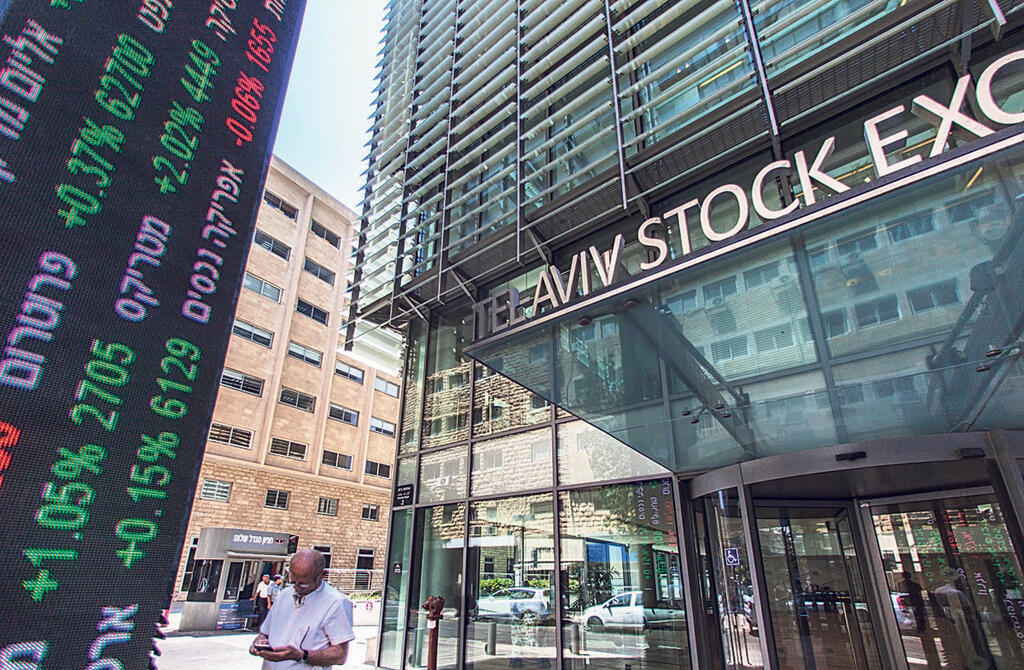
The Tel Aviv Stock Exchange on Ahad Ha’am Street
(Photo: Calcalist)
Investors are now asking themselves whether history will repeat itself this time as well, at least the economic history — or whether this war with Iran is an entirely different story.
Amit Attar, deputy CEO and chief investment officer at More Mutual Funds, who is soon to become the firm’s co-CEO, believes the rally on Ahad Ha’am Street — a metonym for the Tel Aviv Stock Exchange — which has intensified since the start of the year, reflects market expectations that a war with Iran will ultimately prove to be a positive event.
“Since the events of last June, we have been in a very impressive streak of gains on the local exchange, with January especially strong,” he said. “There is no doubt that part of the gains in recent months reflected market and investor expectations of progress in the campaign against Iran, whether in coordination with the United States or not. In a certain sense, the market has already priced in a scenario in which the Iranian risk is reduced, and now we are seeing something that is beginning to materialize.”
What is your assessment of what lies ahead? Are you optimistic about the war’s impact on the market?
Attar: “If we indeed see a dramatic change in Iran’s standing, this could significantly reduce Israel’s geopolitical risk. The economic implications could be substantial — less funding for Hezbollah and Hamas, greater regional stability and more foreign capital flowing here and supporting the stock market. Over the past year we have already seen foreign investors, including from Gulf states, enter Israel and the local exchange. If the risk declines, that process could intensify.”
So despite the war, is there still room for further gains on the TASE?
Attar: “There is room for additional gains, but investors need to be much more selective than they were six months ago. The local market is no longer priced as it was then — meaning that, following the gains, it has become more expensive. The path will not necessarily be a straight line, and we will see volatility.”
What do you think will happen on Monday when the Tel Aviv exchange opens for the trading week?
Attar: “In the next 48 hours all sorts of things could happen that affect sentiment. We are still at the beginning of the event. I am less focused on the next two or three days, and more on whether this represents a fundamental shift. If so, this move could reshape Israel’s economy for years to come.”
'Uncertainty has increased'
Aviel Azuelos, head of investments at Profound Investment House, added that the war’s impact on the market depends on several key parameters, including the duration of the fighting and its effect on Israel’s home front.
“There is no doubt that in the short term uncertainty has increased,” he said. “The airspace, and probably the maritime space as well, will be closed for an unknown period, and a possible missile impact could significantly slow business activity in the economy.”
That said, Azuelos stressed that “the fighting has only just begun, and at this stage it is not advisable to make dramatic decisions regarding risk management in investment portfolios. Various hedges should have been put in place before the strike. At this point, the risks will likely be reflected when trading opens on Monday."
"In a scenario in which the operation drags on or fails to achieve the desired results, we will see the market as a whole decline, and foreign investors will most likely reduce their holdings in the Israeli market," he explains. "The exchange will react negatively both because of the uncertainty and because of assessments that companies operating in the local market will be harmed, and also because the cost of the war could be high and negatively affect Israel’s credit rating and the government’s fiscal deficit.”
Rafael Gozlan, chief economist at IBI Investment House, said that “the strike in Iran in itself is not the objective. The question is whether it changes the strategic picture. If it turns out that there is an improvement in the situation, we will see continued capital flows into the market and optimism among investors. But the intensity will likely be more moderate compared with the moves we experienced on the local exchange in the months following the previous operation."
“In the past six months, the local market has posted excess performance, partly against the backdrop of a decline in the risk premium and a strengthening of the shekel. We have seen significant capital inflows into the local market," he said. "There is no doubt that much of the good news has already been reflected in prices. Beyond the short term, the main importance lies in the question of regime change in Iran, as this is a central factor that will affect the economy’s risk premium, including the attainment of additional diplomatic agreements, and from there also the economy’s growth potential."
“Since the end of the 12-day war with Iran last year, Israel’s risk premium has returned to its level on the eve of Oct. 7, 2023 — that is, a significant decline that translated into substantial outperformance by the local market. However, to see further positive effects from a decline in the risk premium, there would need to be an assessment that the probability of survival of the current regime in Iran is low.”
'Consumption could be hurt'
Tal Brookman, CEO and founder of Finnovest, a digital investment advisory platform, pointed to a negative scenario that must also be considered — one in which a prolonged and stubborn campaign unfolds against Iran.
“In a situation of fighting that lasts for many months, there will undoubtedly be damage to the Israeli economy,” he said. “Consumption is a very important pillar of the local economy, and disruption will certainly hurt us. That said, the economy here is strong and is entering this event in relatively good condition, even if not at its peak.”
War does not affect the market and the economy evenly. What are we likely to see?
Azuelos: “We will see differences among sectors. Retail companies may benefit from a rush by citizens to stock up on food and basic supplies, while El Al and Israir could suffer from the impact of the closure of Israeli airspace in the medium term. However, the airlines will also benefit from increased demand if other foreign carriers stop serving the Israeli aviation market. If foreign investors come under pressure, the stocks most likely to suffer will be insurance companies and banks, which are favored by foreign investors. Residential real estate companies are already facing difficulties, and their business has been affected by the situation, so their shares are also likely to weaken in the near term.”
Brookman added that “defense companies, which have already enjoyed strong momentum over the past year, will continue to see strong demand, as the global arms race has not yet reached its peak. Even if the campaign is short, the global arms race will intensify. If there is significant damage, infrastructure companies may encounter higher demand, but only over the longer term, as we have learned that rehabilitation mechanisms take time."
“On the other hand, all sectors related to leisure and tourism are unfortunately already going through a difficult period. Now, the more we remain at home and routine life is disrupted, consumption will of course decline. For fashion companies, this event comes after an almost dry winter and a drop in sales. In such situations household spending contracts, and they may suffer blow after blow.”
Brookman, who previously served as deputy CEO of the mutual fund arm of Excellence Investment House, now Phoenix Investment House, and before that at Psagot, said additional casualties include underwriting firms. “In any significant event — and we are certainly experiencing one now — the market almost completely shuts down for offerings. A period of uncertainty is very bad for the issuance market, certainly for the initial public offering market. On the one hand, I believe we will not see too many offerings soon. On the other hand, strong companies always have demand, so even in a difficult period there are offerings by good, strong companies. As for other sectors, we have known how to recover quickly in the past, and that will happen again. I believe that once calm is restored, the issuance market will return to normal.”
According to data from investment houses, tens of thousands of new retail investors have joined the local market following the rally. Could they see the current war with Iran as a good entry point and thereby provide additional fuel for gains?
Gozlan: “It is usually a mistake to think in terms of ‘I missed an opportunity.’ When entering the stock market, one must understand that it is volatile — sometimes strong and sometimes weak. Anyone who enters needs a long-term investment horizon and the ability to tolerate volatility. Searching for the perfect entry point and going in ‘with full force’ is a move that sometimes works, but often works against the investor. Investors must have breathing room in terms of time and understand that things can go wrong — not only because of local factors but also global ones. Investing in equities requires patience.”