

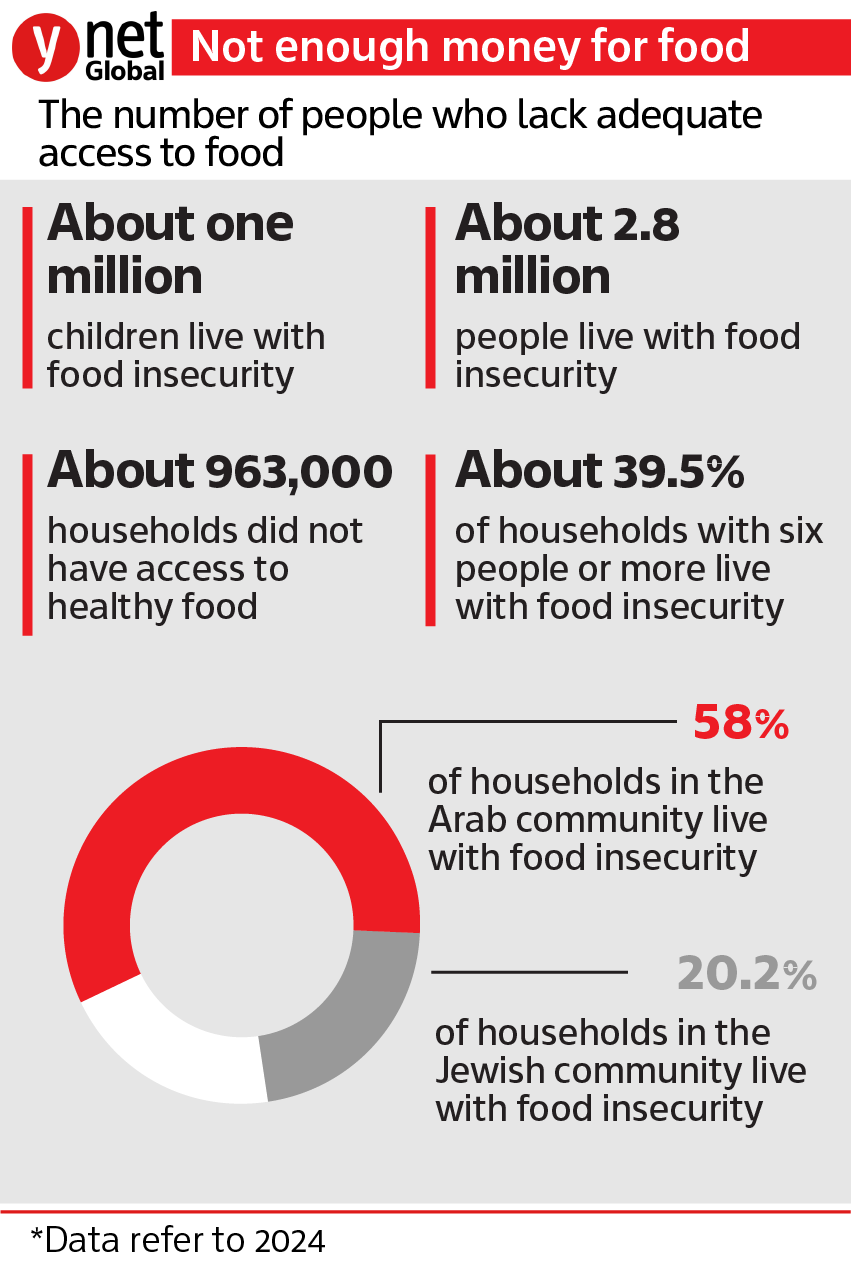
Twenty-seven percent of households in Israel lived with food insecurity in 2024, according to new data released Wednesday by the National Insurance Institute. The figures represent about 900,000 households that together include 2.6 million people. Roughly one million of them are children, who are more likely to experience food insecurity than adults.
Food insecurity means these households lack consistent access to food. As a result, the quality of their diet declines, eating habits are disrupted and their health and well-being may be threatened. The findings paint a troubling picture, although they reflect a slight improvement from 2023, when 30 percent of households were categorized as food insecure.
There is a clear link between poverty and food insecurity, although the correlation is not complete. For example, while the Haredi community experiences high poverty rates, its food insecurity rates are only slightly higher than those of the general Jewish population. The report found that 25 percent of Haredi households experience food insecurity compared with 19 percent of non-Haredi Jewish households. The researchers note that low income in the Haredi community often reflects a choice that prioritizes religious study over material income. They also describe strong traditions of mutual aid, including charitable funds, community credit systems and collective purchasing.
In Arab society, the findings are more alarming. Fifty-eight percent of households reported food insecurity, and 23 percent were categorized with very low food security. According to the authors, the results reflect the high poverty levels in the Arab community.
The report is based on a comprehensive survey representing all sectors of Israel’s population. It focuses on eating and purchasing habits to determine whether respondents were forced to forgo buying food, especially healthy food, due to financial constraints. Participants were asked questions such as whether they ate less than they felt they needed because they lacked money for food, or whether they were hungry but did not eat for the same reason. The answers place each household into one of three categories: high food security, low food security or very low food security. Ten percent of all Israeli households fell into the very low food security category.
(Photo: Illustration)
“The grim findings in the report highlight the need for a long-term social and economic policy that ensures all residents of Israel have regular access to adequate and healthy food,” the authors wrote. “Multi-year government programs, dedicated budgets and defined targets are required to reduce food insecurity.”
The report’s authors also recommend raising basic welfare benefits and expanding school meal programs, especially in communities where food insecurity is most widespread.
The data also examined access to healthy food. In 2024, about 963,000 Israeli households lacked access to healthy food. Together, they include roughly 2.6 million people, including an estimated 926,000 children.
First published: 09:48, 11.16.25