

Asian markets fell Tuesday as fighting involving Iran entered its fourth day, dampening investor sentiment, while oil prices extended gains amid reports that Tehran had closed the Strait of Hormuz.
Crude prices rose for a third straight session as the escalating conflict between the United States and Israel on one side and Iran on the other heightened fears of supply disruptions from the Middle East, a key oil-producing region. Brent crude futures climbed as much as 2% to $79.70 a barrel. On Monday, Brent touched $82.37 — its highest level since January 2025 — before settling up 6.7%.
(Photo: AP)
U.S. benchmark West Texas Intermediate crude rose 1.5% to $72.30 a barrel after surging 6.3% in the previous session to its highest level since June 2025.
The gains came after Iranian drones struck the largest oil refinery in Saudi Arabia and major gas facilities in Qatar, increasing pressure on the third day of the war. Iranian media also reported that a fuel tanker flying the Honduran flag caught fire in the strait after being hit by two drones.
More than 14 million barrels of oil per day passed through the Strait of Hormuz on average last year — nearly one-third of global seaborne oil exports — according to data from Kpler. The strait is a critical chokepoint for global energy supplies.
Japan and South Korea are among the countries most dependent on oil and gas shipments through the waterway. Japan imports more than 90% of its oil through the strait, while South Korea relies on it for roughly 70% to 80% of its oil imports, according to the U.S. Energy Information Administration and government data from both countries. Any prolonged closure would create an immediate supply shock and threaten steady energy flows to industry.
South Korea’s Kospi index plunged 4.9%, dragged down by losses of more than 6% in shares of Samsung Electronics and SK Hynix. Defense-related stocks, however, surged, with some rising more than 20%. Futures on the Kospi 200 fell more than 5%, triggering a temporary trading curb that halted futures trading for five minutes.
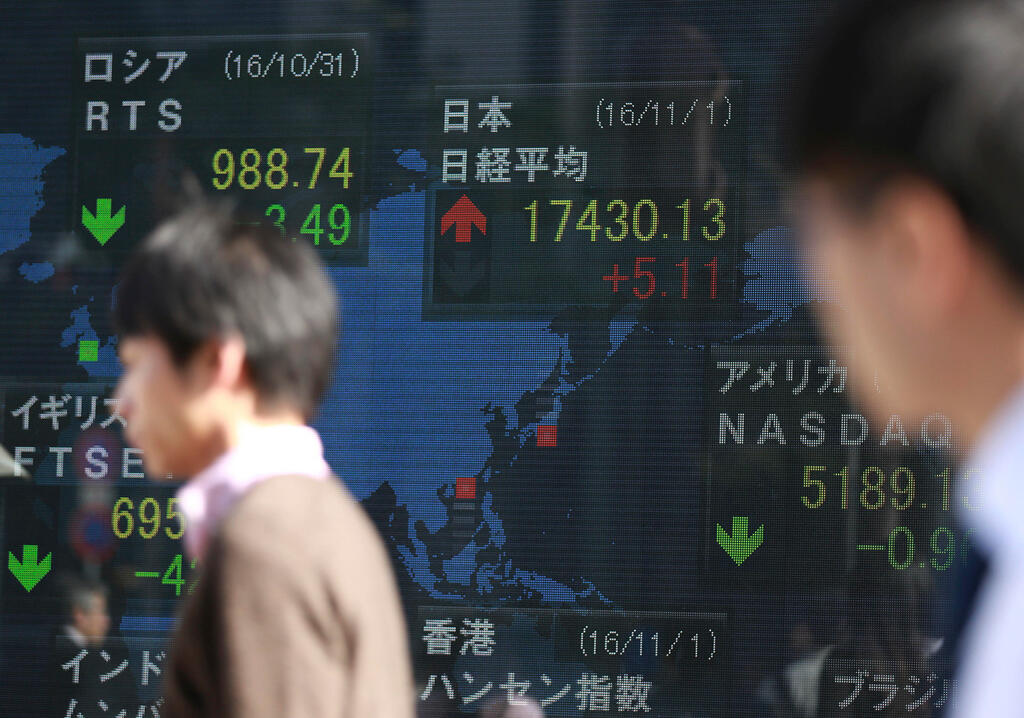
Japan’s Nikkei 225 dropped 2.3%, weighed by energy and cyclical consumer shares, while the broader Topix index fell 2.47%. In Australia, Sydney’s benchmark slid 1.4%, reversing modest gains from the previous day. In China, Hong Kong’s Hang Seng index edged down 0.3% and the Shanghai Composite slipped 0.1%.
On Wall Street, stock futures fell as much as 0.6%. On Monday, the S&P 500 eked out a 0.04% gain after a late rebound. The Nasdaq composite rose 0.36% after earlier falling 1.6%. The Dow Jones Industrial Average slipped 73.14 points, or 0.15%, to close at 48,904.78 after being down nearly 600 points at its session low.