

Elbit Systems’ latest reports were not simply another “good quarter” for a defense company. They signaled something much deeper: a shift in Elbit’s position in the new global defense market.
In the first quarter of 2026, the company reported revenue of about $2.19 billion, up roughly 15.5% from the same period last year. Adjusted net profit jumped about 59% to $186 million, while earnings per share reached $3.87, well above market expectations.
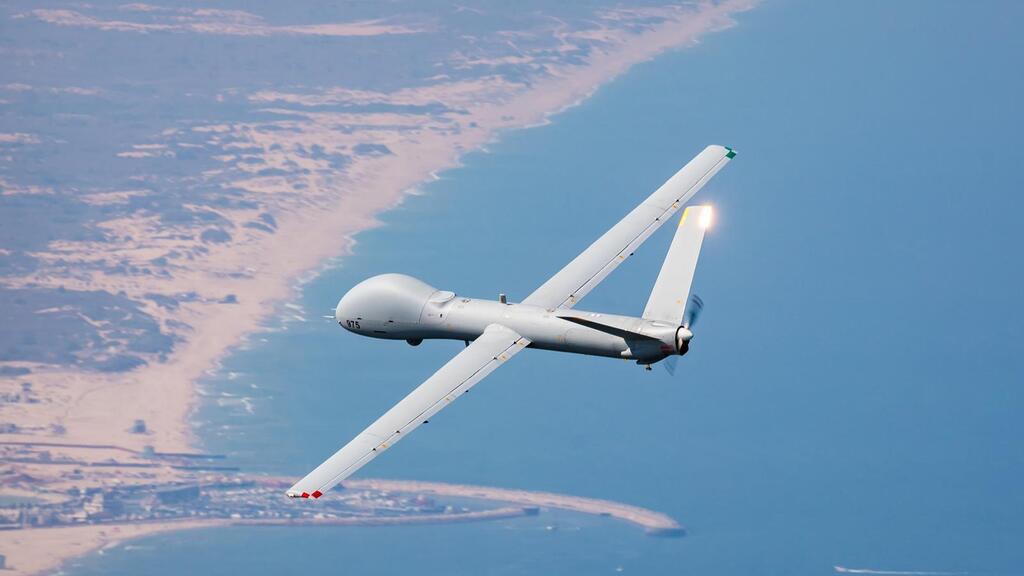
Hermes 900
(Photo: Elbit)
But perhaps the most important figure was cash flow. Elbit reported more than $280 million in operating cash flow for the quarter and about $210 million in free cash flow, a metric that has historically been a weak point for the company and is now becoming one of its sources of strength.
At the same time, the company’s backlog crossed the $30 billion threshold for the first time, reaching $30.2 billion, with about 71% of it designated for customers outside Israel. But the numbers themselves are only part of the story.
The truly important point is that Elbit is beginning to transform from a “classic” defense systems company into a broad defense tech company operating at the heart of the technological revolution reshaping the future battlefield.
The war in Ukraine, conflicts in the Middle East and tensions with China have completely changed the way countries think about security. The world is moving from heavy, slow militaries to forces built around drones, autonomous systems, AI, real-time communications, sensors, electronic warfare and human-machine integration. That is precisely where Elbit is positioned.
In the past, the company was identified mainly with electro-optical systems, pilot helmets or land systems. Today, it is building entire layers of what could be described as an “operating system” for the modern battlefield. It is no coincidence that AI and robotics appeared prominently in its latest reports for the first time.
The company also recently announced the acquisition of Bluewhite, which operates in the field of autonomous systems.
Elbit already holds a broad portfolio of unmanned systems, including tactical Skylark drones, Hermes UAVs, loitering munitions and more.
At the same time, the company’s land segment, which has benefited from strong demand for ammunition and combat systems, grew by about 27% in the quarter, while its cyber and communications segment grew by about 17%.
Elbit’s major advantage over flashier startups in the field is that everything is already connected to real armies, real systems and real battlefields. That is the crucial point: genuine battlefield proof. These are systems that operated in real wars, under real pressure, against real enemies, not just polished presentations.
On the other hand, the stock is far from cheap. Elbit is trading at an EBITDA multiple of about 39 based on 2026 results and at a price-to-earnings multiple above 50, relatively high valuation levels for the traditional defense industry.
But the market may still not have fully grasped the scale of the change. Elbit is no longer just “another Israeli defense company.” It is beginning to look like one of the central infrastructure companies of the autonomous warfare era.
Nir Maimon is the CEO and owner of NMM Capital, an investment advisory firm for family offices, investment companies and wealth clients