


Interest in green vehicles in Israel has steadily grown in recent years, driven by their promise as a more economical and environmentally friendly option. But the reality on the ground is leaving many drivers holding on to the gas pump. With the purchase tax expected to rise to 52%, inadequate infrastructure and unclear government policy, Israel’s electric vehicle revolution has stalled.
In 2023, the Energy Ministry set an ambitious target: By 2030, at least 90% of new vehicles would be electric, and by 2040, nearly 100% of new cars sold in Israel would be electric. A year later, 2024 marked a record for the green revolution on Israeli roads, with one in every four cars sold in the country — 25% — fully electric.
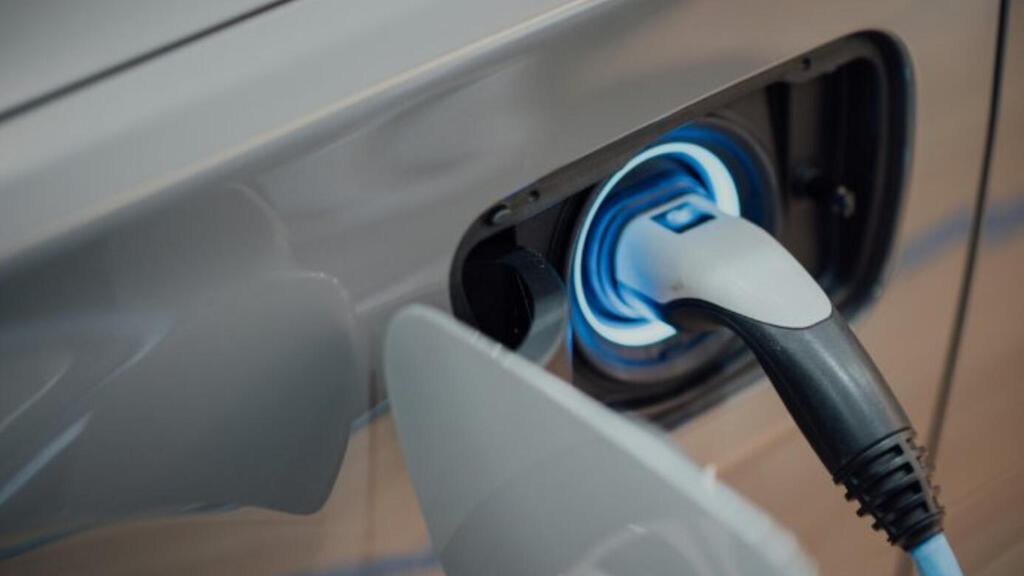
Electric vehicle charging; illustration
(Photo: iCar)
It looked like a promising start. But since then, the share of green vehicle purchases has only declined and now stands at about 11% of all new cars sold. Israel currently has only about 200,000 fully electric vehicles, another 120,000 plug-in hybrids and roughly 800,000 conventional hybrids.
Battles with the condo board
Despite savings on fuel costs, Israeli drivers seeking to switch to electric vehicles have encountered significant obstacles over the past year. The main reasons for the slowdown in sales include the erosion of tax incentives and higher vehicle prices, complicated bureaucracy surrounding the installation of charging stations in apartment buildings and concerns about the lack of accessible public charging infrastructure.
More than the fear of running out of power after a long trip or battling a condo board over installing a charger in a building parking lot, vehicle prices are a major factor — and they are expected to rise further in the coming months.
Under pressure from the Finance Ministry to reduce the state deficit and compensate for lost fuel-tax revenue, the government is expected to raise the purchase tax on electric vehicles to 52%, although the move will likely be postponed until after the upcoming election.
While the Knesset Finance Committee temporarily blocked the sharp increase and set an interim compromise rate of 48%, auto industry estimates suggest this is merely a political delay. Implementation of the Finance Ministry’s original plan will depend largely on the makeup of the next government, the pace at which green vehicles penetrate the Israeli market and whether a mileage-based road-use tax is approved at the same time.
“In recent years, even though the Energy Ministry has repeatedly sounded the alarm, taxation on electric vehicles has been decided at the last minute every time, and you cannot plan an economy that way. People want to know what the tax rate will be and where the mileage tax stands, and only then make a decision,” said Ron Eifer, head of the Sustainable Energy Division at the Energy and Infrastructure Ministry.
“Around the world, governments continue to encourage the shift to electric transportation through tax benefits and other measures, and Israel also has to maintain regulatory certainty. Ultimately, Israelis make decisions through their wallets, and when questions are raised about future taxation or a mileage tax, public concern creates uncertainty that drives buyers away.”
 Ron Eifer Photo: Shlomi Amsalem, GPO
According to Eifer, “There is no more significant step that can be taken in Israel’s energy sector to reduce the country’s energy consumption than moving to electric transportation. If we transition properly to electric vehicles, by 2040 we could save 14% of Israel’s total energy consumption. Today, nearly 40% of Israel’s energy consumption depends on imported oil. Moving to electric transportation would allow us to cut roughly two-thirds of that dependence.”
He said Israel’s characteristics make it an ideal candidate for electrification.
“Israel is an optimal place for this — it is a small country, daily driving distances are not long and Israelis are very fond of innovation. But while in 2024 we were among the world leaders in electric vehicle penetration, in the first half of 2026 we fell to a penetration rate of just 11%-12%. That is very disappointing for us, and we want Israel to get back on track,” he said.
‘Range anxiety’ on long trips
While owners of private homes can enjoy the savings, the electric revolution often grinds to a halt at the entrance to a shared parking garage. About 80% of Israelis live in apartment buildings, where installing a charging point can frequently become a bureaucratic and infrastructure nightmare.
Adding to that is “range anxiety” on longer trips. The public charging market is currently fragmented among dozens of apps and different operators, with no single information system showing in real time where an available, functioning charger can be found.
Under new Energy Ministry regulations set to take effect in 2027, all public charging operators will be required to provide real-time information on charger locations, availability and charging prices.
For now, Pango has stepped into that vacuum, offering a map covering most companies that operate public charging stations, along with details about each station, including price and charging time.
Pango data shows that while the deployment of public charging stations across Israel has advanced, it remains geographically uneven, with significant gaps in availability.
Another major obstacle comes from vehicle fleets and leasing companies, which play a dominant role in shaping Israel’s auto market. Company-car users currently have no financial incentive to switch to electric vehicles because their employers pay for their fuel.
The result is a market distortion: Many employees choose plug-in hybrid models to benefit from the tax break but use them in practice as ordinary gasoline-powered cars and never charge them.
Among Israel’s 40 largest cities, Or Yehuda leads the public charging accessibility index with one charging connector for every 378 residents. It is followed by Eilat, with one for every 387 residents, Herzliya with one for every 424, Ness Ziona with one for every 610, Givatayim with one for every 629 and Ra’anana with one for every 650.
The overall infrastructure map shows that 65% of charging infrastructure is concentrated in central Israel, while the north accounts for 19.7% and the south just 15.3%.
In the south, the main hubs are Beersheba, ranked 16th with 146 charging connectors, and Eilat, ranked second with 137. Together, the two cities account for 28% of the region’s charging connectors and help reduce “range anxiety” for travelers heading south on vacation.
The picture is more complicated in Israel’s three largest cities. Tel Aviv-Jaffa has the highest absolute number of connectors, with 665, placing it seventh in the accessibility index at one connector for every 714 residents.
Haifa, by contrast, drops to 19th place with 165 connectors, or one for every 1,770 residents. Jerusalem ranks 20th with 543 connectors, a low ratio of one for every 1,805 residents.
The gaps become even wider in ultra-Orthodox and Arab communities. Bnei Brak, ranked 32nd, and Beit Shemesh, ranked 33rd, have only a handful of public charging points, with roughly one connector for every 18,000 to 19,000 residents.
In Nazareth, ranked 34th, and Modi’in Illit, ranked 35th, public charging infrastructure is close to nonexistent. In Beitar Illit, Rahat, Umm al-Fahm, Tayibe and Shefa-Amr, ranked 36th through 40th, there are no public charging stations at all.
The data also shows that fast DC charging takes an average of about 45 minutes, with a median of 36.7 minutes, while standard AC charging takes an average of about 4.2 hours, allowing drivers using fast chargers to get back on the road relatively quickly.
“Pango recently added 298 charging stations and 1,400 new connectors, giving us more than 6,000 stations available through the app,” said Adi Hanegby, Pango’s vice president of marketing. “The data clearly shows that alongside growing demand for electric vehicles, actual access to charging infrastructure is the central issue. More and more electric vehicles are going onto the road, and they need infrastructure to support them.”
Ultimately, the electric revolution offers a wide range of benefits. While it is advancing rapidly in public transportation, it remains largely stalled in the private vehicle market.
The next government’s policy will determine whether Israel is left behind — or whether Israelis will be able to breathe cleaner, greener air while also saving money.