

As public confidence in elections declines in many democracies, an Israeli technology company is betting that mathematics, rather than trust alone, can help restore faith in the voting process.
Across countries and political systems, election results have increasingly been challenged, sometimes with allegations of fraud and, in other cases, despite little evidence of misconduct. The result has been growing skepticism among voters toward the institutions responsible for administering elections.
According to the International Institute for Democracy and Electoral Assistance, or International IDEA, about one in five elections held between 2020 and 2024 faced at least one legal challenge. In the United States, 37% of Americans said they had strong trust in election results in a 2024 survey conducted by the nonprofit Issue One.
Shai Bargil, an Israeli entrepreneur, said that loss of confidence inspired the creation of Sequent, a company he co-founded in 2021 with Chief Technology Officer Eduardo Robles and Head of Research David Ruescas.
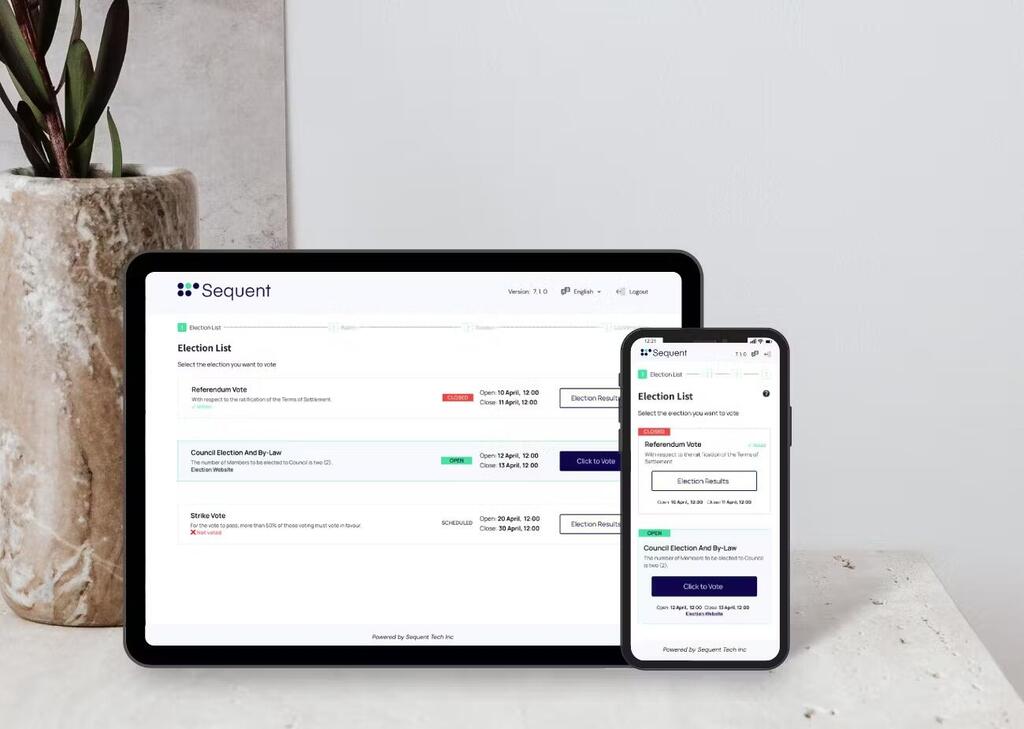
Rather than focusing primarily on making voting more accessible, the company says it has developed election software designed to allow independent verification that votes were recorded and counted correctly while preserving ballot secrecy.
"The trust challenge is bigger than election results alone," Bargil said. "It is trust in democratic institutions, trust in leadership and trust in the process itself. What we are showing is that election integrity can be proven."
Many election systems, including some digital platforms, require voters to trust election officials and independent auditors to certify the outcome. Although audits and recounts may be conducted, individual voters typically have no practical way to verify that their ballots were recorded exactly as cast and included in the final tally.
Sequent argues that advances in cryptography allow election systems to provide stronger evidence that votes have been handled correctly without compromising ballot privacy.
Under the company's system, ballots are encrypted on the voter's device before being transmitted. Decryption authority is divided among multiple independent trustees using threshold cryptography, preventing any single individual or organization, including Sequent itself, from accessing ballots independently.
Each ballot also includes cryptographic proof that it complies with election rules without revealing how the voter voted. Before counting begins, ballots pass through a cryptographic "mixnet," which shuffles and re-encrypts them to break any link between voter identities and ballot contents while generating mathematical proof that no ballots were added, removed or altered.
After that process, ballots are decrypted collectively and counted. Additional cryptographic proofs are published throughout the election, allowing outside auditors to verify each stage independently.

Sequent team
(Photo: Sequent)
The approach, known as end-to-end verifiable voting, is designed to allow election officials to authenticate voter eligibility, voters to confirm that their ballots were recorded correctly and independent auditors to verify that every recorded ballot was included in the final count.
"Digital voting is not only about making participation easier," Bargil said. "The real test is whether election officials can prove that every vote was recorded and counted correctly without asking the public to rely on blind trust."
According to the company, Sequent's technology has been used in more than 330 elections involving over 9.2 million voters across North America, Europe and Asia, including elections conducted by governments, municipalities, labor unions, universities and political organizations.
Among its largest deployments was the Philippines' 2025 midterm elections, where the Commission on Elections used Sequent's technology to support overseas voting for about 1.23 million eligible voters in 77 countries. For overseas voters, remote digital voting can expand access where in-person voting may be difficult or impractical.
The company also said 15 municipalities in Ontario are expected to use its platform in upcoming municipal elections representing more than 200,000 registered voters.
Election security experts broadly agree that cryptographic techniques can strengthen election auditing and transparency. However, digital voting remains the subject of ongoing debate, particularly for large-scale public elections, with many cybersecurity specialists cautioning that internet-based voting presents security risks that differ from those associated with traditional paper ballots.
For Bargil, however, the debate over election integrity is evolving beyond preventing fraud.
"The question is no longer only how elections prevent fraud," he said. "It is whether they can produce evidence that earns public trust."
As governments look for ways to strengthen confidence in democratic institutions while confronting increasingly sophisticated cyber threats, companies such as Sequent argue that independently verifiable election systems could become a larger part of future voting infrastructure.