

The script for “Widow’s Bay,” whose first season on Apple TV ended last week, was originally written nearly 20 years ago as a spec script by the show’s creator, Katie Dippold. She was trying to land a writing job on “Parks and Recreation,” and the version she submitted as a writing sample indeed got her the coveted job. Over the years, during which Dippold became one of the show’s key writers, she revised and rewrote the idea into a far more realistic and darker story, until it recently emerged as “Widow’s Bay,” a hybrid of workplace comedy, horror and moral drama, all in one package.
The plot of “Widow’s Bay” is the exact opposite of everything Apple TV is used to. It is not the kind of polished, prestigious and exquisitely shot series the platform is known for. It has a respectable cast, but not one so glittering that it draws viewers simply by existing. Instead, it fully serves the story. Tom Loftis, played by Matthew Rhys of “The Americans,” is the mayor of a remote island in New England who arrived there by marrying a local woman and dreams of turning it into a thriving tourist destination like the neighboring towns. But something stands in his way, and that something is apparently the island itself. Not as a metaphor, but literally, as a curse cast on the island since the days of its first settlers is slowly revealed.
From episode to episode, “Widow’s Bay” is pulled, almost against its will, into exposing the curse hanging over the island. At first, the focus is Tom’s struggle to sell cappuccino and Wi-Fi to tourists while residents cling to what appear to be superstitions. Gradually, however, the town descends through all the familiar stations of the genre: murderous clowns, possessions, sea witches, human sacrifices and spell books. At the same time, the characters gain depth. Wyck, played by Stephen Root, a former fisherman and conspiracy enthusiast, initially comes across as the village madman but is revealed to be the one who understood the situation correctly. Patricia, played by Kate O’Flynn, Tom’s personal assistant, who is grappling with past trauma and searching for belonging, turns out to be a brave and determined woman.
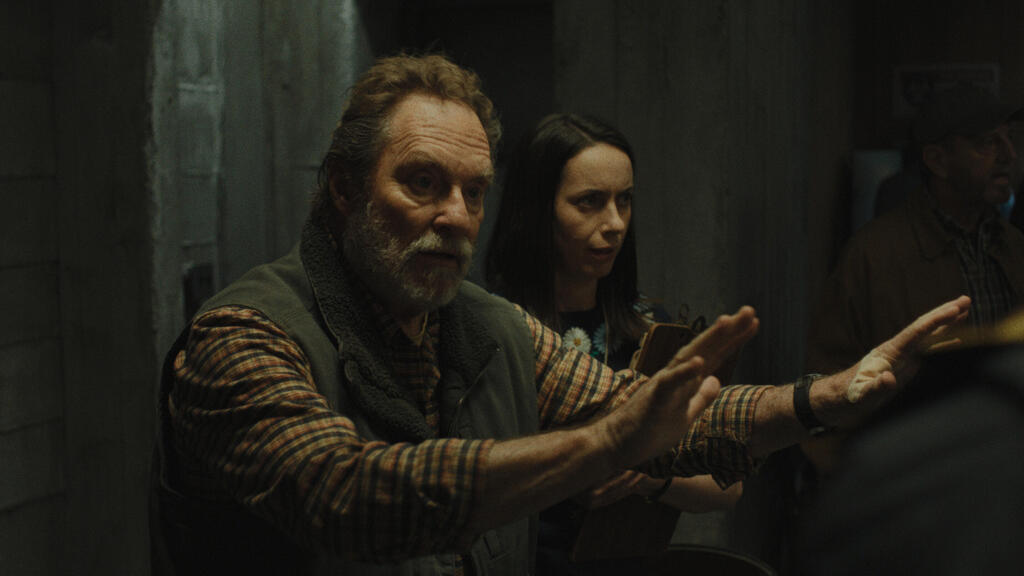
Presiding over all of them is Tom, with most of the comedy and drama resting on the internal contradiction between his attempt to impose administrative order, or any kind of logic at all, on an island where monsters are part of the DNA. He struggles to cling to reality every time he listens, with a horrified expression, to another fantastic theory from one of the residents, until he has no choice but to let go and be pulled in. The show’s dry humor comes from its unstable human interactions and from the impossible meeting points between horror and comedy.
In one scene, Tom sits in a room for a nerve-racking conversation with a man who is more or less defined as dead. In the middle of the conversation, Patricia walks in, apologizes for having forgotten her bag in the room, takes it and leaves. This blurring of the terrifying and the ridiculous repeats itself again and again, and it is funny every time. If that makes it sound as though “Widow’s Bay” mocks horror, that is not the case. It takes its horror very seriously, almost normalizing it. It even folds it into the drama in a way that forces people to treat it as part of their lives and even confronts them with moral decisions, especially the one that appears in the final episode and forces Tom to recalculate his entire approach to dealing with the curse.
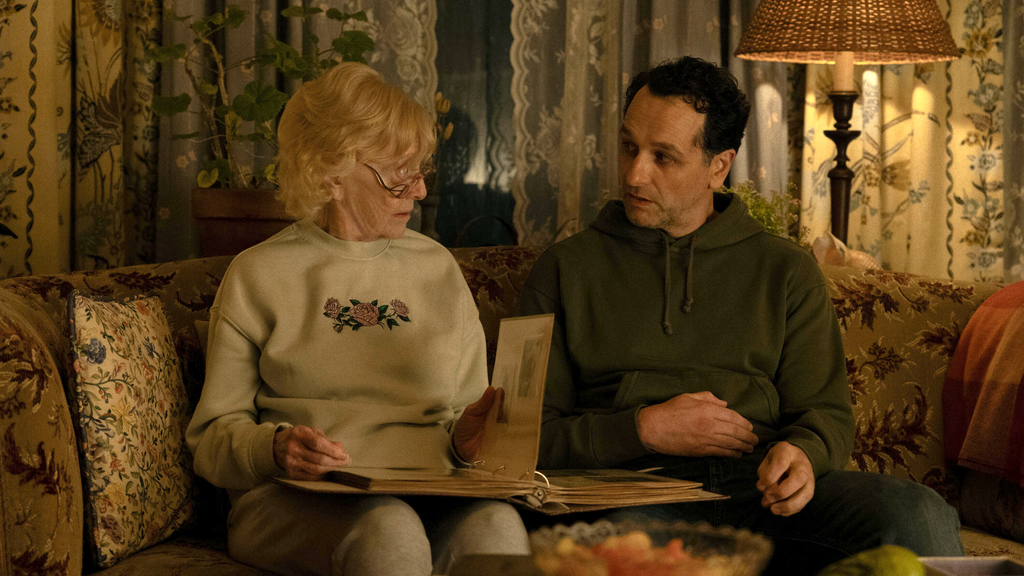
From ‘Widow’s Bay’
(Photo: Courtesy of Apple TV+)
“Widow’s Bay” has done the unbelievable, turning from a sleeper hit into a series entrenched at No. 1 on Apple TV and drawing an audience that grew from week to week. It earned recognition from figures such as Guillermo del Toro, who called it “an act of narrative magic,” and Stephen King, yes, Stephen King himself, showered it with praise, which is only fitting for a series filled with homages to his books. The combination of deadpan humor and classic horror worked so well that the series has already been renewed for a second season, with the first season’s ending certainly leaving room for it to develop and grow.
In an almost ironic way, “Widow’s Bay” may be the antithesis of the traditional image of Apple, its parent company, which is associated with cleanliness, elegance, an obsession with control and a smooth user experience, including in its series. “Widow’s Bay” carries chaos, fog, strange characters and genre instability, but it arrives precisely at a time when Apple itself is dealing with a retreat from its original reputation. The company is trying to persuade the world that it is a supreme, innovative brand, just as Tom tries to market a rotten and unresolved island as a futuristic premium experience. Perhaps the show does not reflect Apple itself, but rather the anxieties Apple is currently navigating. Either way, “Widow’s Bay” is an acquired taste that is worth your attention.