

British actress Kate Winslet turned 50 this year and says the milestone has pushed her to reflect on the past and the unexpected turn her career has taken — including stepping behind the camera to direct “Goodbye June,” a new family drama written by her 21-year-old son, Joe Anders.
In an interview conducted across time zones, Winslet said making the film deepened her connection to stories of grief and family. “It didn’t change my attitude toward death,” she said, “but it certainly made me feel more connected to other people’s experiences of loss… We don’t talk about our own experiences of loss or grief — and certainly not in that context.” The process, she added, “was very healing for me.”
Motherhood, guilt and the film’s themes
“Goodbye June,” set around a large family gathering as the matriarch nears the end of her life, touches on regrets, strain and reconciliation. Winslet said she immediately related to the emotional fabric of the story.
Playing Julia, a daughter juggling responsibilities while managing her own unresolved history, struck close to home. “That guilt she feels at being busy and the things she’s missed of her children’s lives… that terrible, terrible guilt because of work and being away — it’s extremely universal,” Winslet said. “There are so many working mothers the world over who carry that guilt all the time.”
But for Winslet, the story was never simply about illness. “It’s not so much a story about a woman with cancer,” she said, “it is about that family coming together because of that loss.”
She was especially moved by the screenplay’s treatment of the dying mother, June, played by Helen Mirren. “What’s so great about Helen’s performance,” Winslet said, “is that she never shied away from how imperfect June is and how brutally honest she is. Even in those last moments of her life, she’s still telling her daughter not to wear yellow because it looks horrible on her. Those are the things that make that character so human and so relatable.”
Directing for the first time — alongside her son
Though long admired for her discipline on set, Winslet said she had never planned to direct until this particular script arrived. “I never imagined I would direct it or produce it,” she said. But as Joe developed the screenplay, “I suddenly emotionally felt so attached to it that I didn’t want to let it go. And I thought, my God, I would really regret it if I didn’t do this now.”
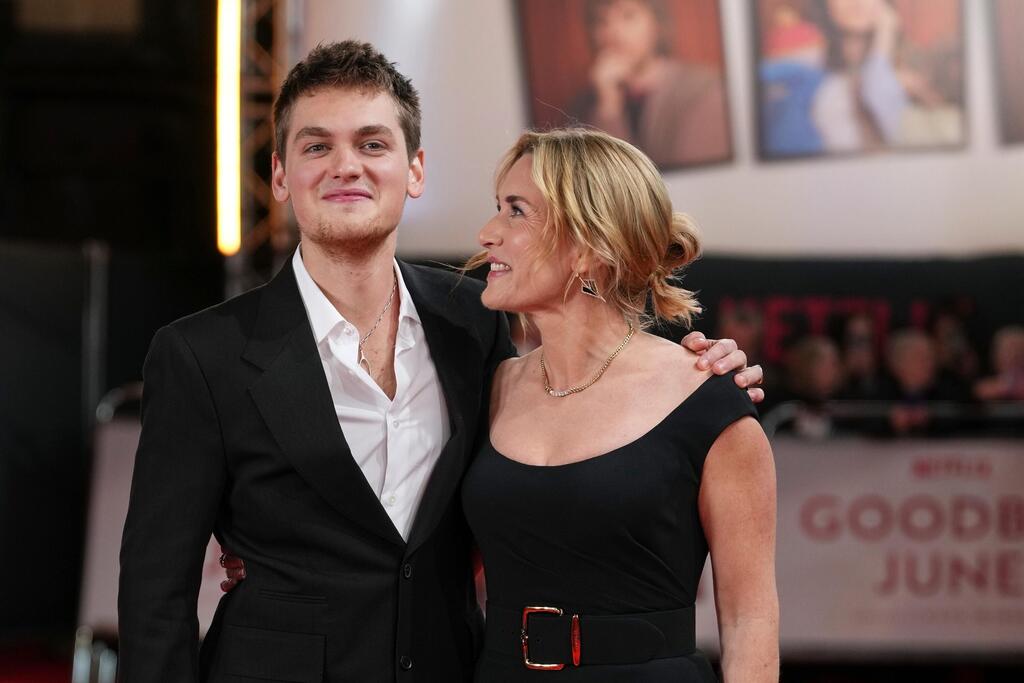
Working professionally with her son required a shift. “We both realized early on we had to get even better at listening to one another,” she said. Joe, she added, had to learn quickly how to detach emotionally from scenes during editing. “Sometimes you have to kill your favorite babies,” she told him, quoting director Francis Lee. “He just had to learn it super-fast — and he did really well.”
Their personal history shaped the script as well. Joe drew inspiration from the death of Winslet’s mother in 2017 and from witnessing how their “very vast family all came together under quite strange circumstances.” Winslet said reading his screenplay reminded her “how you can never hide anything from children… Joe has always been very observant of people.”
Guiding Mirren, Spall and Collette
As a first-time director, Winslet relied on decades of acting experience to navigate an ensemble cast that included Mirren, Timothy Spall and Toni Collette. She said she quickly learned how differently each performer worked.
“Helen needed very practical direction,” Winslet said. “She found it really hard to talk about the emotion of June because of her own experience of loss and my own experience of loss.” Early on, Mirren told her she would never play a character with dementia or dying of cancer — but eventually added, “I will break my rule. I will do it for you.”
Spall, meanwhile, wanted to talk through every emotional beat. “He needed someone to hold his hand,” Winslet said. Collette approached her role with openness, often discussing character choices in front of the entire cast.
A set built on intimacy and trust
Determined to create an unusually quiet and immersive environment, Winslet eliminated overhead booms, radio-mic’d every actor — including the children — and often locked cameras in place before having crew step out of the room entirely.

(Photo: Chris Pizzello/Invision/AP)
“It enabled the actors to feel unnerved by how real the space felt,” she said. Mirren told her she had “never had that before.”
Winslet also insisted on assembling a crew that included many first-time department heads. “It mattered to me to pay that forward,” she said, noting she had spent years advocating for women in an industry where they are historically underrepresented. Ultimately, she said, “I think we had more women than men.”
Returning to the past — and charting a new future
Winslet said she often reflects on her own early years in the industry. “I turned 21 on the set of Titanic,” she said, adding that the intense scrutiny she faced shaped her resilience. “I had to get through that by being brave, by being strong… and somehow I lived through it.”
Directing “Goodbye June,” she said, allowed her to channel her creative instincts in a new way. “I just feel so filled with joy that we did it,” she said. “If I never do it again, I did this — I did it this one time.”
Winslet said the film should feel ultimately uplifting despite its subject. “I hope people find it heartwarming, and I really hope people find it cathartic,” she said. “I hope it gives them the bravery to have some of the conversations they might never otherwise consider having with people close to them. Life is very, very precious.”