

Since Israel’s modern rebirth, those bent on her destruction have worked tirelessly to present a united Christian front against Zionism. However, as U.S. Ambassador Mike Huckabee stated after the recent and now infamous Patriarch’s letter: “I do not feel any sect of the Christian faith should claim exclusivity in speaking for Christians worldwide or assume there is only one viewpoint regarding faith in the Holy Land.”
Throughout Scripture, God reveals Himself as a covenant-keeping God—faithful across generations, faithful even in the face of human failure. At the heart of that revelation stands Israel. From Genesis to Revelation, the Jewish People and the Land of Zion occupy a unique and enduring place in God’s redemptive plan.
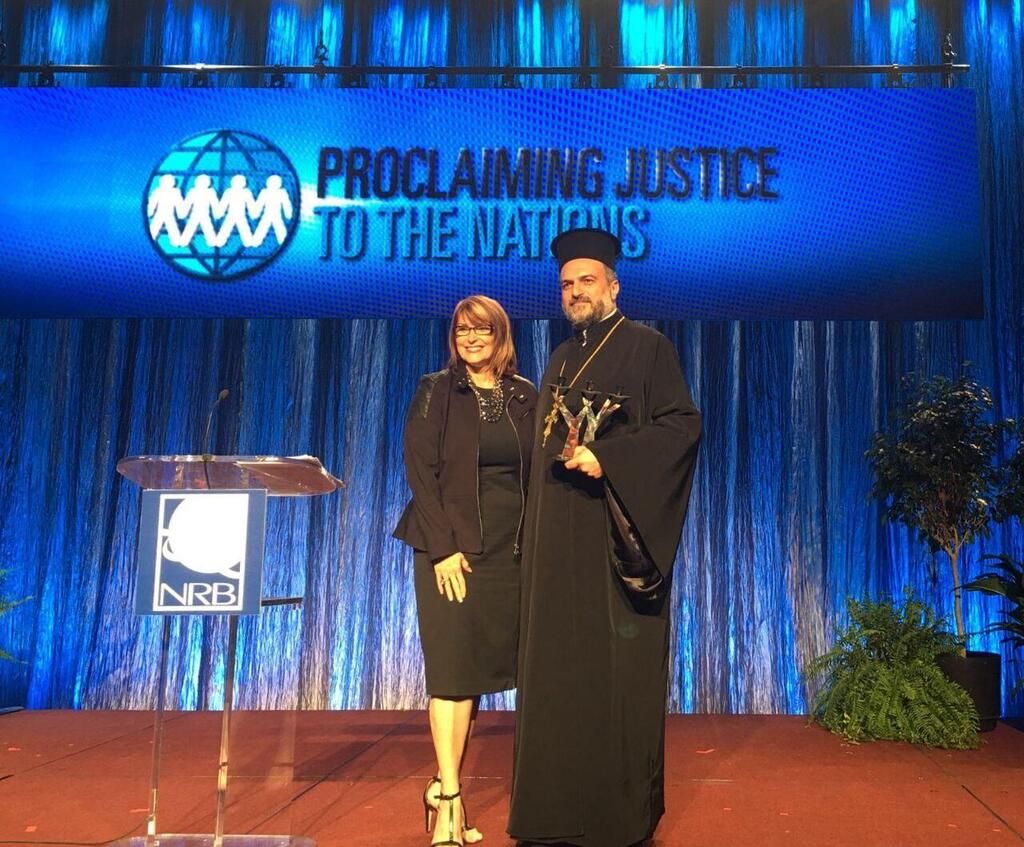
Laurie Cardoza Moore with Israeli priest Father Gabriel Naddaf
(Photo: Courtesy of Proclaiming Justice to the Nations (PJTN))
For Christians who take the Bible seriously, this reality carries moral and spiritual implications. Standing with Israel is not merely a political position; it is a biblical responsibility rooted in God’s unchanging promises.
God’s everlasting Covenant with Abraham
The foundation of the Christian duty to stand with Israel begins with God’s Covenant with Abraham. “Go from your country… to the land I will show you… I will make of you a great nation… and in you all the families of the earth shall be blessed.” (Genesis 12:1–3)
This Covenant is reaffirmed and clarified in Genesis 13, 15 and 17, where God promises Abraham’s physical descendants a specific land as an everlasting possession. The language of Scripture is unmistakable: this Covenant is unilateral, unconditional and eternal. God alone passes between the covenant pieces (Gen. 15), signifying that the promise rests on His faithfulness—not human performance.
To stand with Israel, then, is to honor the Covenant which God Himself established and declared everlasting.
Israel’s history includes disobedience, exile and judgment—but never rejection. Scripture makes a clear distinction between discipline and abandonment. “Yet for all that… I will not reject them or abhor them so as to destroy them completely, breaking my covenant with them.” (Leviticus 26:44)
Moses prophesied that Israel would be scattered among the nations, but also regathered. “The LORD your God will gather you again from all the peoples where the LORD your God has scattered you.” (Deuteronomy 30:3–5)
Christian Zionism holds that exile was temporary, corrective and purposeful. The land promise was never revoked. Therefore, Israel’s return to the land aligns not with human ambition but with divine foresight.
The Hebrew prophets repeatedly describe a future restoration of Israel which is geographical, national and unmistakably physical.
Ezekiel speaks of dry bones coming together before spiritual renewal (Ezek. 37), Isaiah foretells a worldwide regathering “a second time” (Isa. 11:11–12), Amos declares that Israel will be planted in the land “never again to be uprooted” (Amos 9:14–15) and Jeremiah ties Israel’s endurance to the fixed order of creation itself (Jer. 31:35–37).
These prophecies describe events that transcend the ancient return from Babylon and point toward a latter-day restoration after global dispersion. Christians who believe the Bible should recognize the hand of God in Israel’s return to Zion.
The New Testament does not negate these promises—it confirms them. The Apostle Paul confronts the idea that Israel has been replaced: “Has God rejected His people? By no means!” (Romans 11:1) Paul goes further: “The gifts and the calling of God are irrevocable.” (Romans 11:29)
Israel’s current unbelief does not annul God’s covenant. Rather, Scripture teaches that Israel’s story is still unfolding. The Church is grafted in—not substituted in.
To stand with Israel is to agree with Paul’s theology rather than centuries of supersessionist error.
Blessing Israel is a moral imperative
God’s promise to Abraham includes a warning as well as a blessing: “I will bless those who bless you, and whoever curses you I will curse.” (Genesis 12:3)
This is not a vague spiritual principle—it is a covenantal reality repeated throughout Scripture. Nations and individuals are judged by how they treat God’s covenant people.
For Christians, standing with Israel is not about endorsing every policy or decision of a modern state. It is about refusing to curse whom God has chosen to bless, and aligning ourselves with God’s redemptive purposes rather than resisting them.
Scripture consistently places Zion and Jerusalem at the center of God’s future work. Zechariah foretells global conflict centered on Jerusalem (Zech. 12–14).
The existence of Israel is not incidental to biblical prophecy—it is essential to it. To deny Israel’s right to exist in the land is, at its core, to deny the framework of biblical eschatology itself.
Israel, like every nation, is accountable to God. But Scripture demands that Christians approach Israel differently—not as just another nation, but as a Covenant People through whom God brought Scripture and Salvation to the world. Christian support for Israel is theological, not partisan. Covenantal, not cultural. Biblical, not ideological.
To stand with Israel and Zion is to stand with the faithfulness of God Himself. It is to affirm that God keeps His promises, that Scripture means what it says and that history is moving toward a divinely ordained conclusion.
In an age of confusion, pressure and rising hostility toward Israel, Christians face a choice: align with the shifting winds of culture—or with the unchanging Word of God.
Biblical faithfulness demands clarity. Christians are called to stand with Israel—not because it is easy, but because it is right.