

The Karlovy Vary International Film Festival, one of the oldest and most respected events on the global festival circuit, is celebrating its 60th edition this year. Because the milestone edition overlaps with the World Cup now taking place in North America, festival organizers had to adjust to the sporting event drawing global attention and chose to follow the familiar American saying: if you can’t beat them, join them.
So at the opening ceremony, held over the weekend in the colorful and ornate Czech spa town, the festival screened The Match, a new and fascinating documentary that reconstructs the 1986 World Cup quarterfinal between old rivals England and Argentina at Mexico City’s Azteca Stadium.
That match, charged by the legacy of the Falklands War, ended in a 2-1 Argentine victory and is remembered above all for Diego Maradona’s two goals. One was a dazzling slalom through England’s defense. The other was scored with his hand, unseen by the referee. Maradona’s later remark that the goal was scored “a little with the head of Maradona and a little with the hand of God” gave it its iconic nickname.
In The Match, Argentine directors Juan Cabral and Santiago Franco skillfully reconstruct the match and show its political significance through interviews with some of those involved. Gary Lineker, who scored England’s goal, was not especially eager at first to take part in the film. But after watching early versions, he was convinced. In his interview, he imagines what might have happened had Maradona’s goal been disallowed.
The festival’s opening host also poked fun at the Czech national team’s poor World Cup showing after it finished last in its group with just one point and was eliminated, joking that at least the festival would not have to rearrange its screening schedule around Czech matches. Naturally, the joke drew loud laughter in the hall.
The opening ceremony managed to combine glamour and humor, music and cinema, including songs from the different decades in which the festival has operated. Well-known Czech singers performed versions, sometimes in Czech, of famous pop hits. The leadership of the Cannes, Venice and Berlin festivals could learn from Karlovy Vary how to stage a ceremony that is sexy, entertaining, funny and even moving.
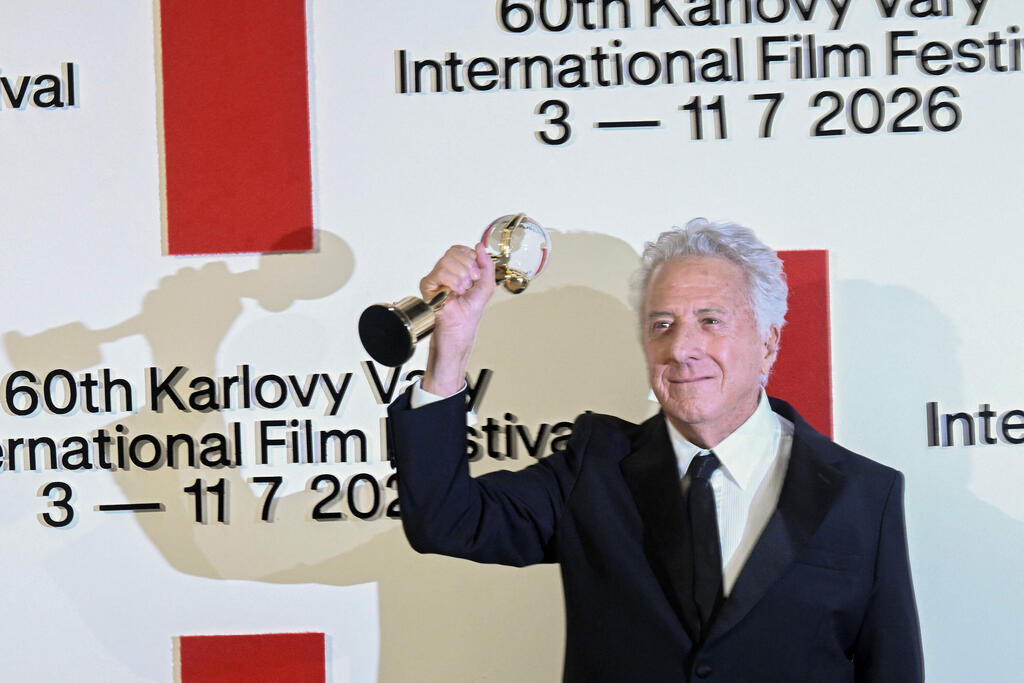
The peak of the opening event was the presentation of a lifetime achievement award to Jewish American star Dustin Hoffman for his extraordinary artistic contribution to world cinema.
Hoffman, one of the greatest character actors of all time, already has plenty of statuettes at home, including two Oscars. Still, he was visibly moved as he held the Crystal Globe, thanking them for the honor of the award. “I first fell in love with acting because it was the first time I felt lost in time,” he continued. “I knew instinctively that this was how I wanted to live. I wanted to be lost in time", he said.
The ceremony featured a clip reel drawn from Hoffman’s magnificent career, including scenes from The Graduate, Kramer vs. Kramer, Midnight Cowboy, All the President’s Men, Rain Man, Tootsie and Meet the Parents. The montage left Hoffman emotional.
As Hoffman will celebrate his 89th birthday, he said that seeing his life's work on screen staring back at him makes him feel emotional and grateful to have had the chance to do what he loves. As he finished, the audience rose to its feet and gave Hoffman a long ovation.
On Saturday, Hoffman attended a screening of his breakout film, The Graduate, Mike Nichols’ 1967 dramedy, which will mark its 60th anniversary next year. The film caused a sensation at the time, with Hoffman playing a young college graduate drawn into an affair with Mrs. Robinson, the older married woman played by Anne Bancroft. Made on a budget of just $3 million, The Graduate became a box-office hit and launched the career of the young, then little-known Hoffman.
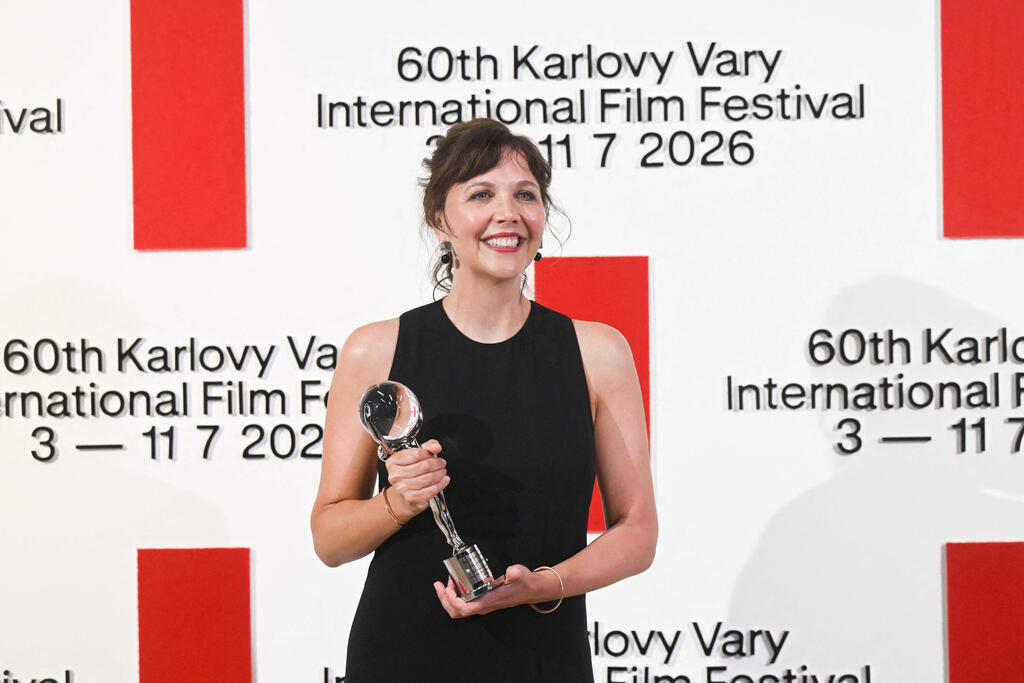
Maggie Gyllenhaal at the Karlovy Vary film festival
(Photo: MICHAL CIZEK/AFP)
Another honor at Karlovy Vary, the festival president’s award, was presented to actor and director Maggie Gyllenhaal, who is recovering from the failure of The Bride!, the ambitious, star-filled film she directed. Gyllenhaal thanked the festival for the recognition and recalled a visit she made to the Czech Republic when she was young, a trip that stirred in her the desire to become a director. This year, she arrived at the festival with her husband, Hollywood actor Peter Sarsgaard, who received his own tribute at Karlovy Vary last year.
It is worth noting that both Hoffman and Gyllenhaal, both Jewish, avoided political statements in their speeches. Gyllenhaal instead delighted the local audience by pronouncing several words in Czech perfectly and sharing anecdotes about her admiration for Czech director Milos Forman and her previous visit to the country.
Another Jewish American Hollywood figure also stood out at Karlovy Vary over the weekend: actor and director Jesse Eisenberg, known for The Social Network, Now You See Me and A Real Pain. Eisenberg received the festival president’s award on Saturday, followed by a screening of one of his lesser-known films, The Double, a 2013 black comedy and psychological thriller.
In the film, Eisenberg plays a dual role: Simon James, a shy and invisible government clerk whose life is thrown into chaos when a new employee arrives at his workplace. The newcomer, James Simon, looks exactly like him but has confidence and charisma.
Eisenberg said he chose The Double because its atmosphere suited the part of the world where the festival takes place. Having worked several times in Eastern Europe, including directing *A Real Pain* in Poland, he said he feels strangely at home in the region. He added that his family lived in Eastern Europe for far longer than in America, making him feel more Czech and Polish than American, and that returning there with an awareness of his own history makes him feel comfortable there.
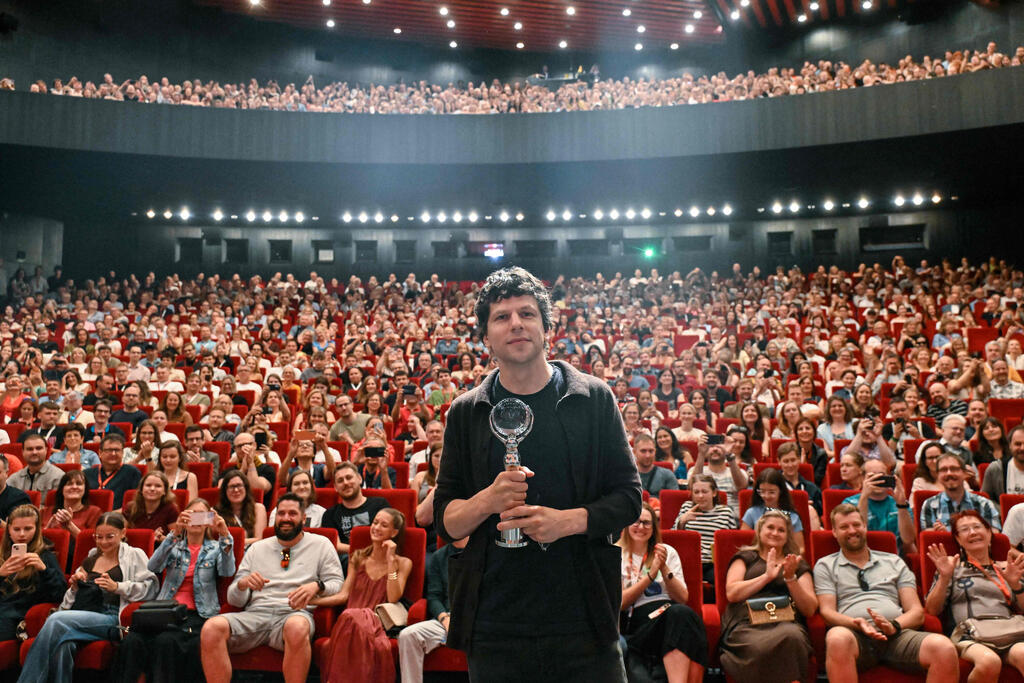
Jesse Eisenberg at the Karlovy Vary film festival
(Photo: MICHAL CIZEK/AFP)
Unfortunately, and disappointingly, there is no Israeli representation this year in any of the festival’s sections. That absence is striking because Karlovy Vary has traditionally been welcoming to Israeli cinema, including several major wins.
In 1999, Arik Kaplun’s Yana’s Friends won the Crystal Globe, awarded to the festival’s best film. In 2005, Eyal Halfon’s What a Wonderful Place won the Special Jury Prize, while Uri Gavriel won best actor. In 2011, Yossi Madmoni’s Restoration won the Crystal Globe, and in 2018, Moshe Folkenflik won best actor for his performance in Redemption, directed by Madmoni and Boaz Yehonatan Yacov.
Even after October 7, the festival leadership did not exclude Israeli cinema, unlike many other festivals worldwide. In 2024, director Omer Tobi’s Tropicana competed in Proxima, the festival’s second-most important section. Last year, Nadav Lapid’s Yes and Tom Shoval’s A Letter to David were screened.
Given that history, one is left to wonder whether the absence of Israeli cinema from Karlovy Vary 2026 reflects deliberate exclusion, an attempt to avoid trouble, demonstrations and protests, or simply a programming decision by festival leaders who found no new Israeli film considered suitable for this year’s lineup.
These are good and difficult questions, and they only underscore the challenges Israeli cinema has faced in recent years against the backdrop of the wars in Gaza and Iran.