

It is becoming increasingly difficult to disappear. Just ask Israeli mother and daughter Mali and Liel Yahalomi, who became the focus of a frantic search before they were found in Argentina and finally left alone.
Security cameras watch streets, railway stations, airports, shopping centers and stadiums. All you have to do is look up and scan your surroundings. In many places, you will spot municipal signs warning that cameras are operating in the area, supposedly to protect us and keep us safe. But do they?
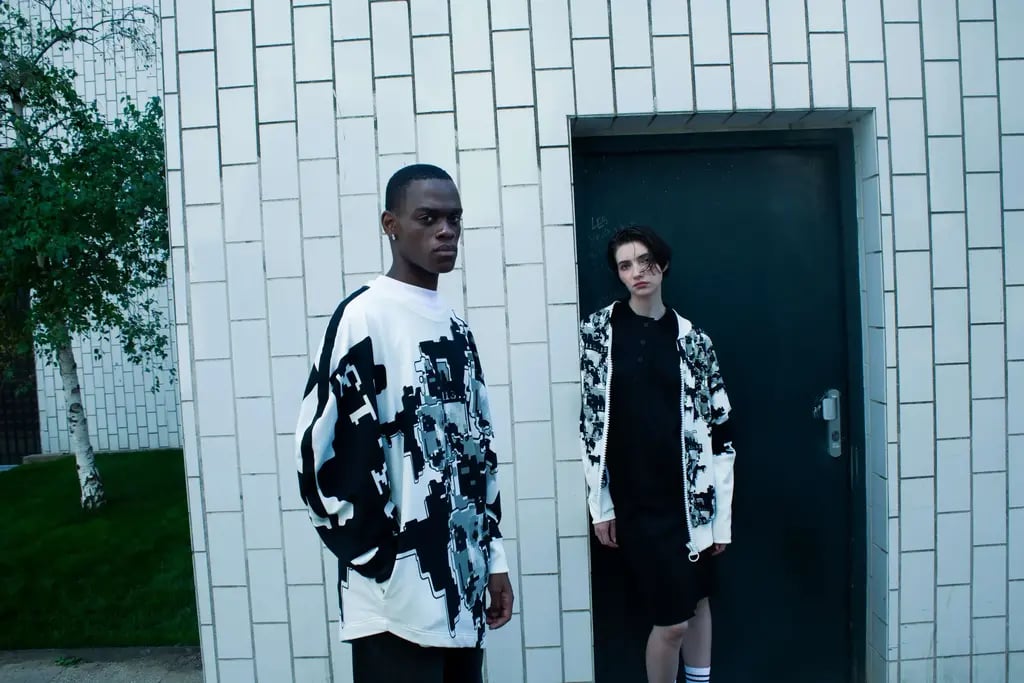
Large-scale prints are used to confuse facial recognition algorithms. Clothing by Urban Privacy
(Photo: urban-privacy.com)
In 2026, AI-powered systems are capable not only of recording people but of identifying them, tracking them and potentially linking appearances across different public spaces.
In Britain, for example, police have expanded their use of Live Facial Recognition systems, including plans to install permanent cameras on Oxford Street, alongside deployment of the technology at London Underground stations. In Israel, meanwhile, the Knesset in May 2026 extended the temporary order governing the country’s biometric database.
As the technology spreads, so does anxiety about its use. Studies have found that in some systems, Black and Asian people face a higher risk of being misidentified than white people. In Britain, public concern is already significant: a recent poll cited by The Guardian found that about 60% of respondents viewed facial recognition technology as “another step toward turning Britain into a surveillance society.”
Now, a new generation of British designers is positioning privacy as fashion’s next big trend, using clothing to weaken facial recognition systems through “adversarial clothing”, incorporating sophisticated combinations of shapes, colors and repeating motifs designed to exploit weaknesses in computer vision systems and disrupt its ability to identify faces. Experts caution, however, that their effectiveness varies depending on the surveillance system and the conditions in which they are used.
Nick Tidball, co-founder of tech-focused fashion brand Vollebak, does not currently produce clothing designed to hinder recognition, but he believes “anti-surveillance fashion” is on the verge of breaking into the mainstream.
“Anti-surveillance feelings are so widespread that all it would take is for a single celebrity to wear one of these garments to a high-profile event for it to take off,” he told The Guardian. Currently it is “popular in the countercultural fashion world,” he said.
Nick Tidball, co-founder of Vollebak
One of the most prominent brands in the field is Urban Privacy, based in Leipzig, Germany. The label was founded in 2017 by designer Nicole Scheller as part of her fashion design graduation project, and product designer Daniel Preuß later joined her. On its website, the brand says it has developed a range of clothing and accessories intended to protect users’ privacy by disrupting data transmission.
Urban Privacy video on privacy in public spaces
Designs by Urban Privacy
Among its products is OFLAIN, a smart smartphone pouch that promises to “make you disappear from the network whenever you want.” In practice, it works like a Faraday cage, using conductive material to surround the device to block or weaken electromagnetic signals. When the phone is inside the pouch, it should no longer be able to communicate normally with cellular networks, Wi-Fi, Bluetooth or GPS.
Urban Privacy’s OFLAIN smart smartphone pouch
Preuß explained that no garment can guarantee immunity from surveillance systems, but the company’s designs use oversized prints and asymmetrical cuts to confuse facial recognition algorithms. The Urban Ghost coat, for example, incorporates LED lights into its hood that emit infrared light intended to disrupt surveillance cameras equipped with night vision.
Preuß said the designs exploit a relatively simple weakness in facial recognition systems. “Facial recognition systems freak out when they see multiple faces at once,” he told The Guardian. “Our patterns play with that chaos, confuse algorithms and make it way harder to pin you down,” he explained.
Another brand operating in this space is Cap_able, which offers colorful clothing covered in abstract prints. “When I started doing this in 2018, people thought I was designing masks to rob banks,” founder Rachele Didero said, according to The Guardian. “But now these concerns are no longer niche. New generations are increasingly afraid of AI and concerned for their privacy. Those wearing these products are the vanguard. The mainstream is quickly coming up behind them,” she added.
Clothing by Cap_able
Social media has already embraced the aesthetic of surveillance cameras. British fashion figure Alexa Chung recently shared an Instagram post showing her look through the security camera outside her London home. She joins other influencers and celebrities who have adopted the camera’s point of view as part of their visual language, but the next step may no longer be simply posing in front of a surveillance camera; it may be wearing one.
Alexa Chung photographs herself for Instagram through the security camera outside her home
In June, Meta and eyewear giant EssilorLuxottica unveiled Meta Glasses, a new range of AI-enabled smart glasses starting at $299. The lineup includes several frame designs as well as a collection created with Kylie Jenner and inspired by her personal style.
Kylie Jenner and Meta’s smart glasses
Behind what looks like a conventional fashion accessory is a system incorporating a camera, microphones and speakers connected to Meta’s AI technology.
Surveillance technology thus becomes harder to recognize as surveillance: instead of being mounted on a street pole or at a building entrance, it is worn on the face, making it seem less threatening and therefore less likely to provoke resistance.