

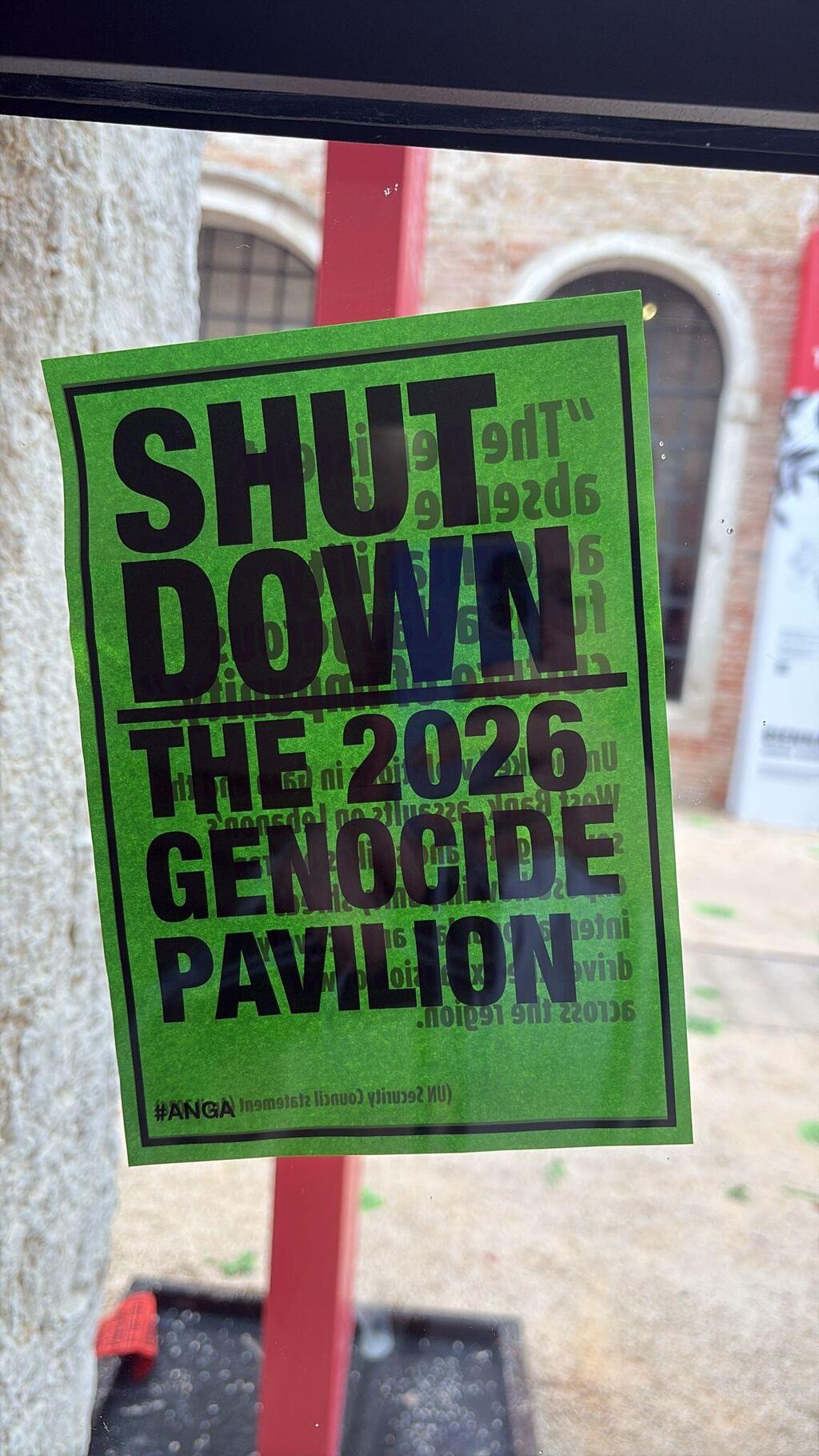
The 2026 Venice Biennale is shaping up to be one of the most complex and charged in the history of the Israeli pavilion. Even before it officially opened Saturday, drama had already unfolded outside the Israeli pavilion in the city’s Arsenale complex. Inside, supporters and friends embraced the international Israeli artist Belu-Simion Fainaru, while outside, several dozen pro-Palestinian demonstrators held a brief but stormy protest, chanting slogans such as “Free Palestine” and “From the River to the Sea,” alongside event-specific calls such as “Shut down the 2026 genocide pavilion.”
Businessman and art enthusiast Eyal Waldman, who lost his daughter Danielle on October 7, was also there to support Fainaru. When the glass doors were locked against the backdrop of the protest, he went out to the crowd and tried to explain and engage in dialogue, but was met with shouts including “murderer.” It was not the last demonstration. Another protest was also held over the weekend, and it is reasonable to cautiously assume that more protests will be held outside the pavilion.
Venice Biennale, Israeli pavilion
(Video: Yulia Prilik Niv)


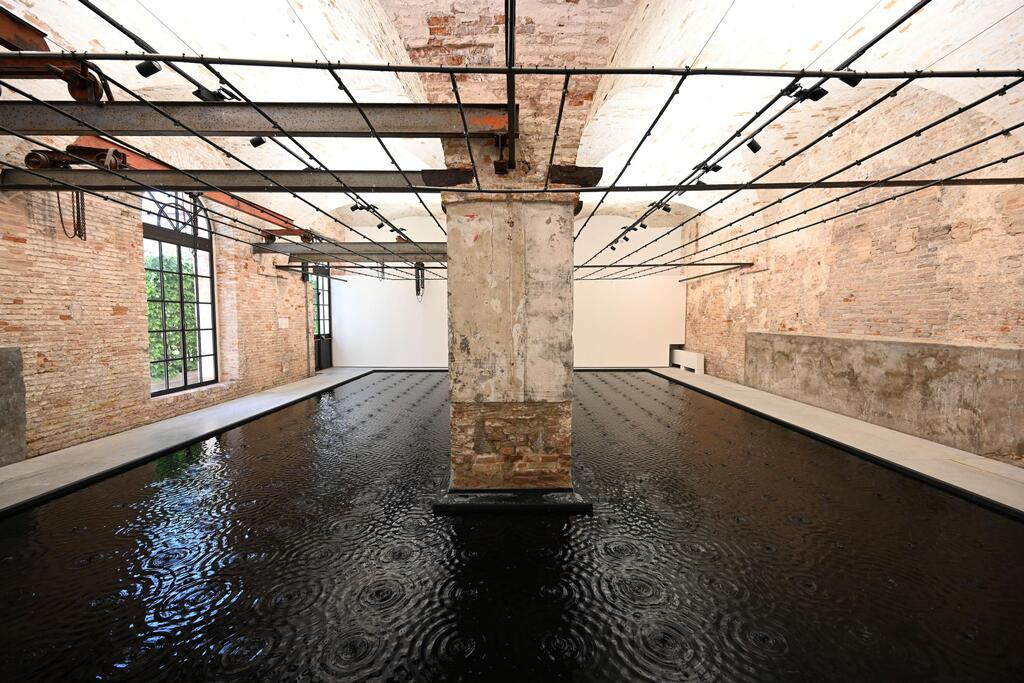
There is a sharp dissonance between Fainaru’s almost meditative installation, “Rose of Nothingness” — curated by Avital Bar-Shay, Fainaru’s partner, and Sorin Heller — and the dramas taking place outside. And it is not only this demonstration. It is likely the first of many signs of tension at the 61st Art Biennale, held under the theme “In Minor Keys” and on view until Nov. 22. Fainaru says he faced heavy pressure, both in Israel and abroad, to refuse to participate.
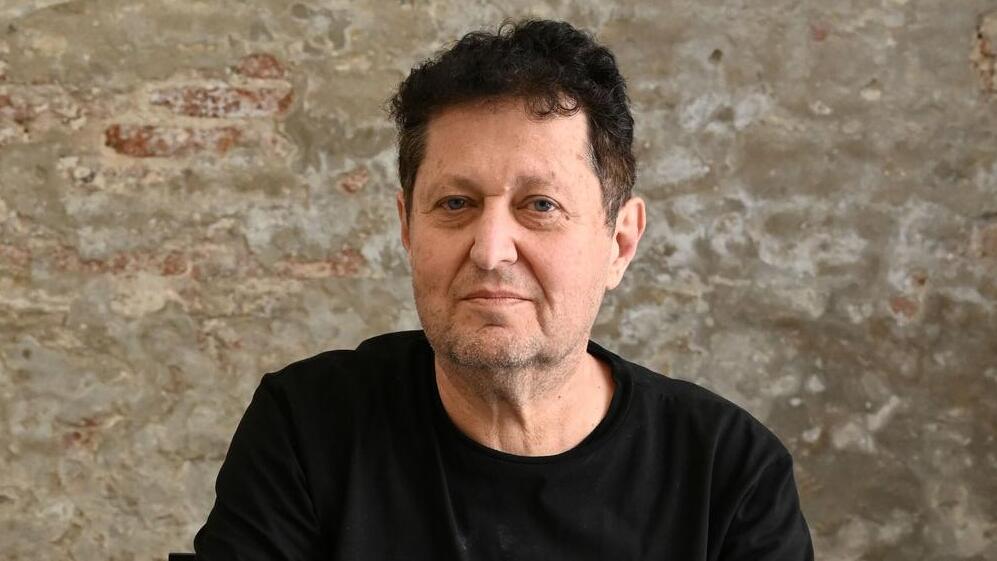
“The reactions I received in Israel were, ‘Don’t exhibit,’ ‘You represent an extremist government’ and ‘You are becoming a state artist,’” he recalled in an interview with ynet. “But I know that art and state do not go together. As someone born in Romania during the communist period, I understand that back then, there were artists of the regime who were invited to create propaganda. But I do not represent the government. People I know, and people I do not know, spoke out against me, both in Israel and abroad.”
Are you essentially going against the current?
“Yes. The message, both from home and from outside, is basically, ‘You have no place.’ Two galleries abroad where I exhibit warned me that this move was not good for me, and that there was concern they would be identified with Israel. They warned of boycotts. International curators also approached me and said this was not the time to exhibit in the Israeli pavilion. They told me, ‘What you are going through will also happen to us. We do not want to be connected to boycotts.’ There is pressure and there are phone calls from every side.”
Belu-Simion Fainaru, Venice Biennale
(Photo: Warhaftig Venezian)
How are you coping? After all, in 2019, you represented Romania.
“People are not happy that Israel is represented here. It is enormous pressure. I do not know how, but I manage to disconnect. At the same time, I also receive support and hugs. For example, when the jury resigned a few days ago over the participation of Israel and Russia, I received full support from the Italian culture minister, Alessandro Giuli. He not only spoke with me and apologized for the way I am being treated, he also issued an official statement. That shows the focus should be on the art. I do not think he called other artists. Italian Prime Minister Giorgia Meloni also addressed it.”
'Rose of Nothingness' installation at the Venice Biennale
(Video: Yulia Prilik Niv)
What did the minister tell you after the resignation?
“He said very beautiful things about me, and backed me and my art 100%. Of course, he cannot intervene, because the Biennale Foundation is independent, but he promised to promote me going forward as well.”
Is it easier to represent Romania or Israel?
“Romania. When you represent Israel, they see the passport first. But I say: Look at me as an artist. Alongside the difficulty, I also receive embraces — personal, quiet and moving ones. By contrast, the boycott is loud and public. It creates great pressure.”
Protest outside the Israeli pavilion at the Venice Biennale
(Photo: Yulia Prilik Niv)
‘We fixed mezuzahs and hung locks with words like “love” and “joy”’
The 67-year-old artist was born in Romania and works between Haifa and Belgium. During the previous round of fighting with Iran, Operation Rising Lion, the home of Fainaru, Bar-Shay and their children in Haifa was damaged. In September 2025, he wrote: “We are in the midst of restoring and rebuilding the house and studio, which were hit by an Iranian missile. It is not an easy process, but it is full of hope and faith in a return to routine. I hope the work will be completed ahead of the new year, and that the space will once again become a place of creation, light and quiet.”
Fainaru is a distinctive figure: an artist, curator, entrepreneur and researcher of identity and space. His works deal with memory, wandering and inspiration from the worlds of poetry and Judaism. He is the recipient of the 2025 Israel Prize for design and interdisciplinary art.
After the Israeli pavilion remained closed in protest in 2024, it is returning with a powerful work in a historic structure more than 500 years old. Against the backdrop of calls for a boycott, the selection committee chose Fainaru, an artist with an international presence, as a cultural bridge. If he succeeds in realizing his vision, visitors may see the Israeli pavilion not as an arm of public diplomacy, but as a contemporary, complex and thought-provoking work of art within a charged reality.
There is a fairly good chance that the dramas surrounding Israel’s participation in the 61st Biennale will actually help the pavilion and Fainaru stand out. Alongside the extensive media exposure, the resignation of the jury led to an unusual change: Visitors, too, will be able to vote directly, similar to the Eurovision system, in which the public vote carries significant weight.
Fainaru in the more than 500-year-old former warehouse space
(Photo: Warhaftig Venezian)
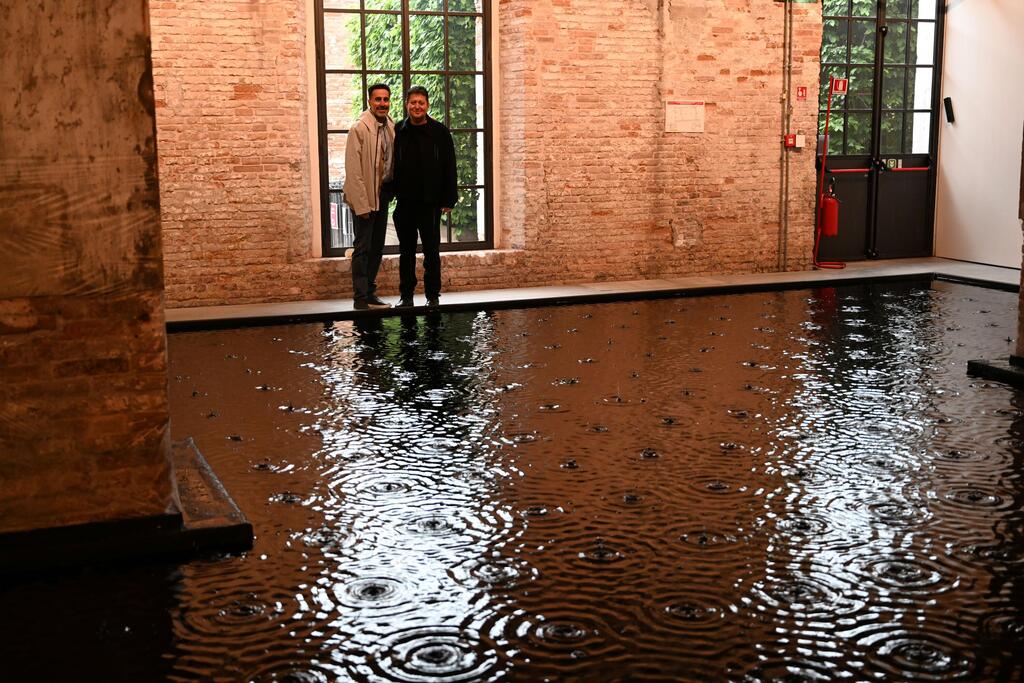
Even before that, Fainaru describes a long series of challenges, not all of them directly connected to Israel’s standing in the world. He had previously shown “Rose of Nothingness,” centered on a dark pool and a cyclical drip irrigation system, at leading museums, including a museum in Vienna and Art Basel in Paris. His selection and the installation of the work took place in a race against time, with a shortage of budget and manpower. He says it was almost a miracle that the work was set up in time inside the Arsenale, a historic warehouse complex once used by Venice’s naval fleet.
“It is a very complex work,” he says. “They liked the idea that it uses drip irrigation, an Israeli invention. I thought it was especially suited to the Israeli pavilion and also to the architecture of the space. I had submitted my candidacy in the past and was not accepted. This time I was, but under difficult conditions.”
Why difficult conditions?
“There is the attitude toward Israel in the world, and there is the time factor. Usually, there is at least a year to prepare, raise funds and get organized. The government budget is about $1.5 million — very little compared with countries such as the United States, which reach $5 million and more.”
And then you have to raise donations?
“Yes. Others managed to double the budget, but they had time. We did not. We only started in December-January, and now it is already May and we are exhibiting.”
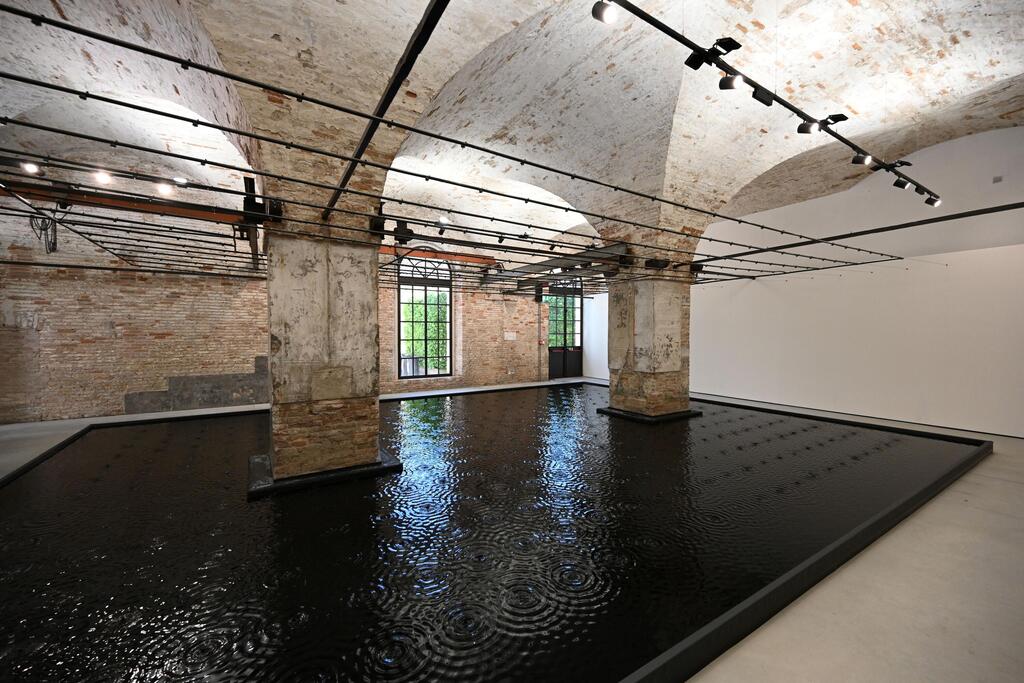
Black water and cyclical dripping
(Photo: Warhaftig Venezian)
Did you know in advance that it would be in the Arsenale?
“No. When we arrived, it was a warehouse full of equipment. There was not even a key. We worked under difficult conditions, with tenders and bureaucracy. And at the same time, there was pressure and criticism from every direction.”
What does the jury’s resignation mean?
“I understand that the selection will be more democratic — the audience will decide, including online voting, like at Eurovision.”
In addition to the main work, the pavilion includes several smaller works by Fainaru. Visitors entering the space are immediately exposed to a real freezer in which a single black rose is framed on a block of ice. The work, “Black Rose,” symbolizes for Fainaru an inner search that moves between darkness and light, between good and evil. Another work is the sleeve of a white shirt with a pocket filled with soil from Jerusalem, a 2012 work by Fainaru titled “Jerusalem in the Pocket.”
For “Rose of Nothingness,” the arch-filled space was filled with a cyclical water-dripping system, a work rich in symbols, from the obvious connection to water in the city of Venice to spiritual, kabbalistic and Jewish meanings. “We fixed mezuzahs and hung locks with words like ‘love’ and ‘joy,’” Fainaru says.
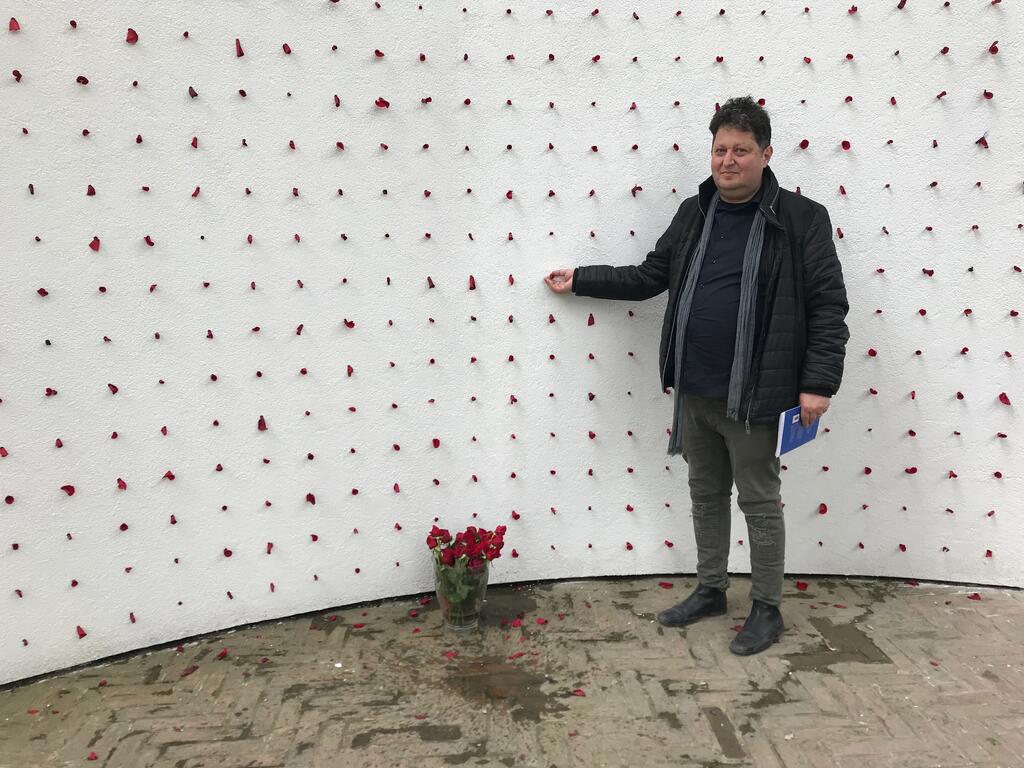
From the 2019 Venice Biennale, when Fainaru represented Romania, his birthplace
(Photo: Debbie Luzia)
Why water?
“Water is the source of life. It can also be a source of conflict and a basis for peace. There is also a connection here to birth, agriculture and spirituality. When the dripping stops, the surface of the water becomes a mirror. It is a calm moment, even though the water is black, like ink.”
- The reporter was invited to cover the exhibition as part of public relations for the Israeli pavilion at the Biennale.