

In an age when words flicker across screens and paper is increasingly treated as disposable, Israeli artist Lahav Barak has chosen to work in the opposite direction - slowly, manually, and almost ritualistically.
From her studio in Tel Aviv, stacks of abandoned books wait for their second life. Some were pulled from recycling bins, others from forgotten shelves. All of them, in Lahav’s hands, become sculptures.
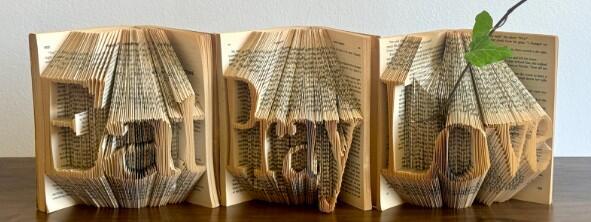
From technology student to unexpected artist
Lahav’s path into art was anything but planned. Originally studying technology and business, she envisioned a career shaped by innovation, systems, and digital tools - not paper, books and hours of manual work.
That makes her current profession, she admits, a surprise even to herself.
Her relationship with books as material began almost accidentally during a student exchange in France in 2021. There, she found herself drawn less to classes and more to flea markets and second-hand bookstores. Among piles of forgotten novels, she began experimenting with folding pages - first as a curiosity, then as a practice.
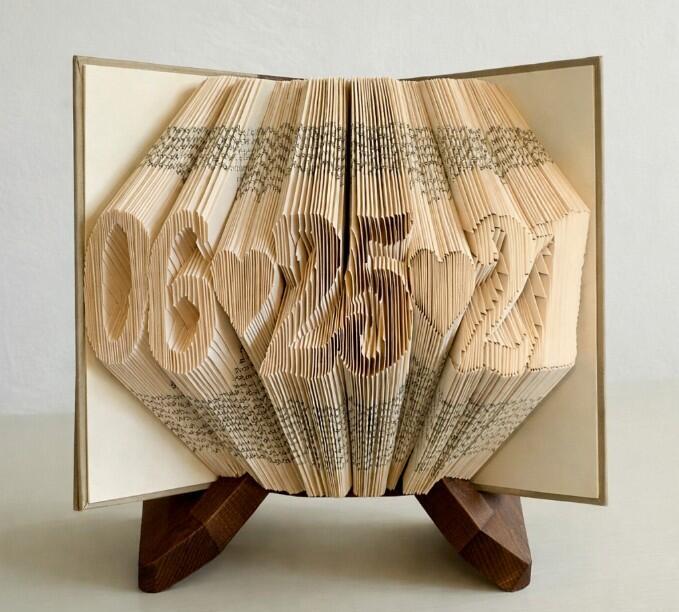
Without formal training, she developed her own techniques: measured folds that create typography, sculptural hearts and dates, and layered forms emerging from within the book itself. What started as improvisation evolved into a precise, almost architectural language built entirely from measuring and folding.
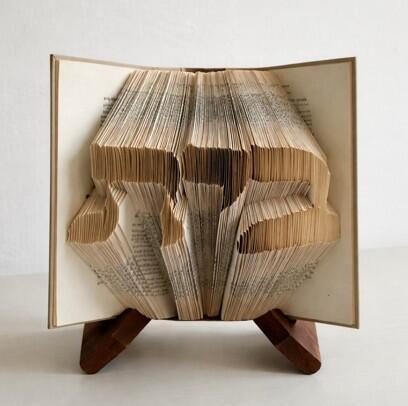
(Photo: Lahav Barak)
For Lahav, the material is inseparable from the message. Each book she chooses has already been thrown away. By turning it into art, she says, she is “not just folding pages, but interrupting the moment something is about to be forgotten.”
Her works sit somewhere between sculpture, memory object, and design artifact — intimate pieces that often mark personal milestones such as weddings, anniversaries, or family histories.
A turning point: when the art became the path
Although Barak has worked in creative and entrepreneurial fields for years, only in the past year has she fully committed to book art as the center of her professional life.
She now divides her time between creating commissions and leading workshops, where participants learn to transform old books into sculptural forms themselves.
The workshops, she says, are not just about technique. “They’re about giving people permission to slow down and make something with their hands again.”
Why now?
At a time defined by speed, disposability, and digital overload, Barak believes the growing interest in her work reflects something deeper. People, she suggests, are looking for tangible experiences - objects that carry time inside them.
Lahav Barak
(Lahav Barak)
And perhaps that is what folded books offer: not just decoration, but a quiet resistance to forgetting.
Lahav puts it simply: “I feel like this is what the world needs from me right now.”