

With the National Religious Broadcasters (NRB) convention just days away, Troy Miller isn’t pretending the timing is easy. But the NRB president and CEO is betting that thousands of attendees will arrive ready to talk—and ready to build—at a moment when faith, politics, and technology are colliding fast.
“This is the largest gathering of Christian communicators,” Miller said, describing an event he called unmatched not only in the U.S. but worldwide. The week will open with a “state of broadcasting” session and updates on NRB initiatives that reflect how much the organization’s agenda has broadened. He cited priorities ranging from Israel and global Christian persecution to veterans’ ministries and a major effort titled “America Reads the Bible.”
The convention’s structure is meant to mirror the modern media ecosystem. NRB will run multiple stages, including forums focused on the legal landscape, courts, legislation, culture, and mainstream media. Alongside those panels, the schedule includes hands-on talks and workshops—hundreds of sessions in all, Miller said—including a full stage dedicated to artificial intelligence.
A centerpiece event will lean hard into history. NRB plans a Thursday night celebration of America’s upcoming 250th anniversary, a “real fun night,” Miller promised, though he said he couldn’t yet name every speaker. He did confirm participation from PragerU, David and Tim Barton of Wall Builders, Core Ridge Ministries, and Seth Dillon of The Babylon Bee.
NRB is also expanding its exhibit floor. Miller said more than 230 exhibitors will fill two rooms this year, and the America 250 team will bring what he described as a traveling museum: a mobile truck designed to tour the country and spotlight America’s founding, with an emphasis on what he called the Judeo-Christian influence behind it.
That phrase—Judeo-Christian—captures what Miller says is a deliberate shift at NRB. In a polarized America, he argued, the answer is broader unity, not narrower lanes. He compared today’s divisions to the disputes between states during the country’s founding, saying the essential lesson is that “they all came together.” NRB, he said, has worked in recent years to build greater unity “in the body of Christ” and to expand cooperation to “our Jewish brothers and sisters,” along with Catholic participants. He described shared ground on “pro-life” and “pro-family” issues, and said global Christian persecution remains a central concern.
Iran, he added, will be a major focus at the convention. Miller said NRB plans a press statement “standing in solidarity with the people of Iran,” framing it as both foreign policy and a human rights issue.
Gallery
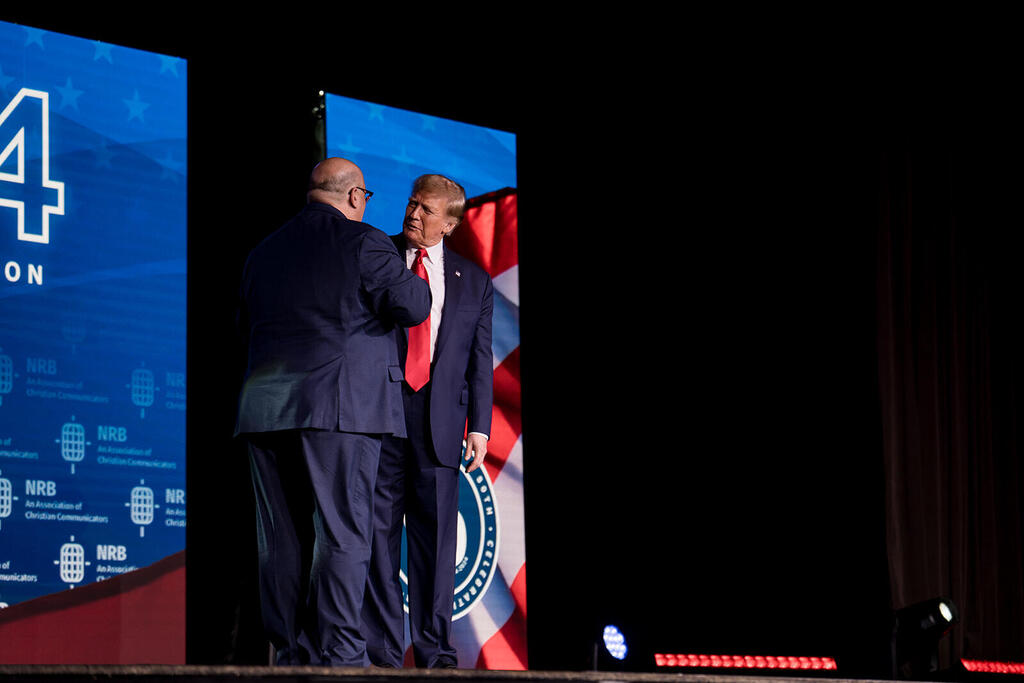
US President Donald Trump and NRB President and CEO Troy Miller at the NRB convention 2024
(Courtesy: National Religious Broadcasters)
The conversation turned to antisemitism, which Miller framed as inseparable from hostility toward Christians. “Absolutely,” he said when asked whether hatred of Jews also implicates hatred of Christians, pointing to Christianity’s Jewish roots and arguing that antisemitism carries an implicit anti-Christian dimension. He also pointed to what he described as gestures of mutual support, citing comments he said were made by Israeli Prime Minister Benjamin Netanyahu about Christian persecution and Israel’s commitment to protecting Christians globally. Miller recalled remarks by Deputy Foreign Minister Sharon Haskell, saying she spoke about Christians somewhere in the world experiencing “an October 7th every day.” “We need to lock arms if we’re going to defeat this,” he said.
Not every Christian community is aligned. Asked about a recent controversy involving the Greek Orthodox Church and criticism of Christian Zionists, Miller emphasized internal diversity within Orthodoxy and suggested local pressures shaped the episode. He called the stance “unfortunate,” but said the broader trend remains one of cooperation, noting that members of the Coptic Orthodox Church will attend NRB and describing widespread unity on antisemitism and persecution.
From there, the conversation shifted to Israel’s internal debate over Judea and Samaria—also known as the West Bank—and the competing language used to describe it. Miller blamed “outside influence” for complicating the conflict and said his preference is for international actors to step back while Israel and local authorities work toward practical arrangements. He pointed to the United Arab Emirates as an example of cracking down on radicalism and building a more unified society where “Arabs, Christians and Jews are getting along.” He also said many Christians are firm in viewing the territory as Judea and Samaria, referencing biblical narratives as part of that understanding.
Iran returned as the dominant theme. Miller spoke from personal experience, recalling his U.S. Navy service in the 1980s and months spent in the Persian Gulf during a period when Iran sought to disrupt oil routes. He also described working with Iranian employees during his time in the tech industry at Gateway, Inc. Those connections, he said, sharpen his focus on the Iranian people rather than the regime.
He described what he said he had heard from an Iran-focused ministry: “tens of thousands” killed in a crackdown, with “tens, even hundreds of thousands” confined to their homes and facing shortages and infrastructure cutoffs. “This is a human rights issue that the world should just be screaming about,” he said, adding that he doesn’t understand why Iran “gets a pass.” He said he hopes U.S. leadership will respond forcefully, pushing Iran toward serious negotiations, while warning that Iran’s proxies also brutalize populations across the region. In his view, reducing Tehran’s reach would “save millions and millions of lives.”
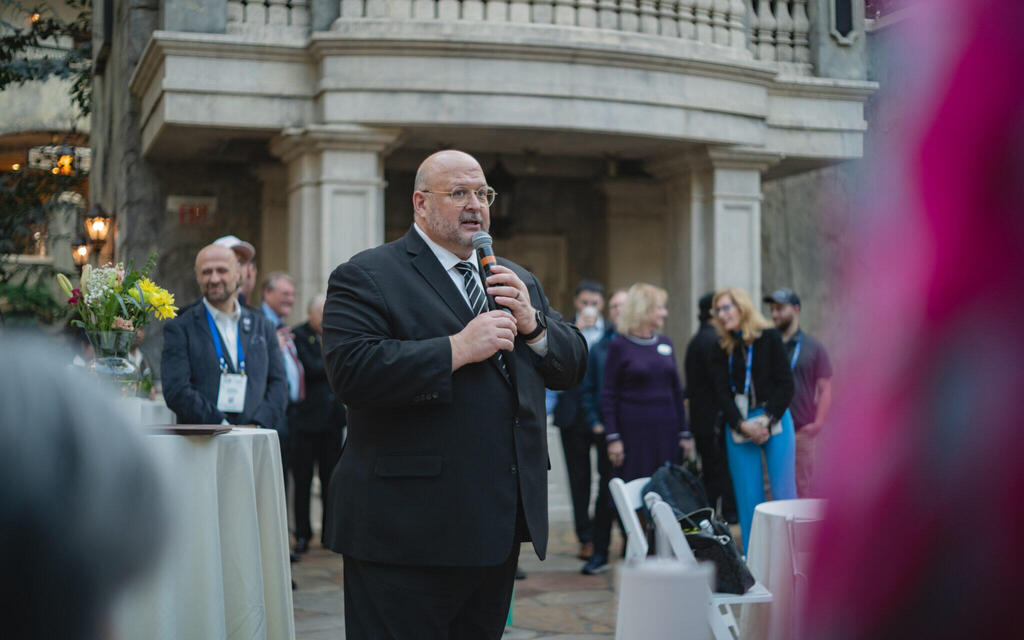
NRB President and CEO Troy Miller at the ACLI Reception
(Courtesy: National Religious Broadcasters)
From geopolitics, the discussion moved to artificial intelligence—an issue Miller says is already reshaping media faster than ethics can keep up. He pointed to a line from Jurassic Park: “You didn’t stop to think about whether you should.” The quote, he suggested, captures the problem with the current sprint to deploy AI tools.
Miller said NRB plans to confront thorny questions: what to do with fully AI-generated music; how to address the fact that models “learn from somebody” rather than create from the “human spirit”; whether AI-written sermons cross a line; and whether virtual reality pastors, deepfakes, and synthetic content threaten trust. The goal, he said, isn’t to halt innovation but to set moral guardrails before the technology remakes the field.
The conversation ended with the question of youth and faith. Miller said he sees signs of renewed interest among younger Americans: increased church attendance, higher turnout at youth events, and growing online searches related to belief. He attributed some momentum to a recent tragedy—the murder of Charlie Kirk—which he said had a significant impact on young people in the U.S. More broadly, he argued that many young people are confronting “emptiness” and loneliness, and are discovering that secular culture does not fill the gap.
He also described a rise in youth-led media aimed at reaching peers—a generation raised with constant media and fluent in how to use it. But, he warned, the low barrier to entry can reward popularity over truth. Christian media, he said, remains “one of the most well-kept secrets” and faces bias and marginalization on digital platforms and in traditional broadcasting. Even so, he called this a pivotal time to teach journalism, integrity, and truth “over the number of likes.”
On media ethics, Miller was blunt. “It’s gone,” he said, arguing that much of mainstream and legacy news has become “propaganda houses.” He invoked the idea of the press as a “fourth leg of the stool” meant to balance the executive, legislative, and judicial branches, and said that role has been undermined by partisanship. What the country needs, he said, is a free press that is “uninfluenced and unadulterated.”
For Miller, the coming NRB convention is not just a gathering of broadcasters. It is a test of whether faith-based communicators can hold a coalition together—across Christian denominations and with Jewish partners—while confronting the pressures of a polarized political climate, a volatile Middle East, and a technological revolution that can manufacture reality on demand.