

You can feel it before you understand it. The moment you step into Haim’s space, the air changes. Not in a mystical, movie-scene way, but in the unmistakable sense that you’ve entered a world built with intention. Crystals everywhere: amethyst cathedrals, calcite clusters, sharp quartz points, labradorite shimmering like hidden fire. And the host, only 21, speaks about each piece as if it has a biography.
Haim introduces himself simply. He is 21, autistic, and crystals became his main occupation, his passion and his livelihood. In a traditional workplace, he says, he would struggle. Customer service, fast food, crowded environments, constant social friction. Here, he is calm. Here, he is the expert. The subject is his, and the confidence comes with it.
“I can make a living,” he explains, “and actually enjoy it.” He describes the space as a kind of safe zone: a place where he controls the atmosphere, the knowledge, and the energy of the day.
The first stone and the beginning of a language
Haim’s first crystal wasn’t purchased. It was gifted. When he was seven, his aunt brought him a Brazilian amethyst cluster. At the time, he didn’t understand geology or mineral families. He simply felt drawn to it, the way children are sometimes pulled toward a certain object without needing a reason.
He remembers school trips where other kids looked at the landscape. He looked at the ground, scanning for details, searching for what might be hiding in plain sight. It wasn’t insecurity, he says. It was curiosity. A belief that the earth is full of things worth noticing.
That curiosity later expanded into knowledge: what can be found locally in Israel (calcite, quartz, fossils like ammonites near Eilat), what is rare, what is mislabeled abroad, and why certain “Israeli” stones, like Eilat stone, are increasingly difficult to source as mines close or shift.
Choosing pieces one by one, across the world
Haim doesn’t travel to mines himself. Instead, he builds relationships with suppliers and chooses inventory through video calls, sometimes even receiving live footage from the mine after material is extracted. He speaks about selecting stones the way others speak about casting actors: slowly, carefully, based on presence.
He refuses to fill the room with repetitive stock. “If the crystals are going to sit with you until they find the right person,” he says, “you have to love them.”
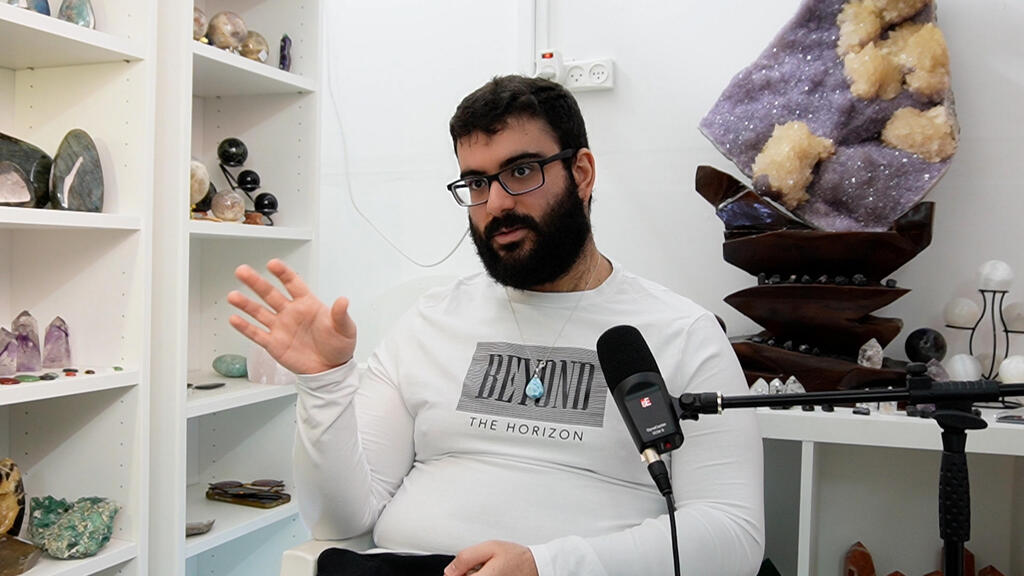
The largest and most expensive piece in his space weighs 17 kilograms. It isn’t a typical hollow “cave” geode with a heavy base. It’s a flatter amethyst formation that is mostly crystal itself, requiring a stand for stability. It dominates the room, not just visually, but emotionally. You notice it immediately.
Some stones, Haim explains, are “beginner-friendly.” Others are not. A massive piece changes the atmosphere of a home the way a powerful scent changes a room. Or, as he puts it in a surprisingly modern metaphor: like a Wi-Fi router, crystals have a kind of “range” determined by size, purity and structure.
Real, altered and fake: the ethics of the crystal market
Haim keeps a small personal cabinet not only for favorites, but also for education. Some items are altered, coated or fully synthetic, and he keeps them intentionally to show people how deception works.
He isn’t harsh about it. Some people love polished stones. Some connect more with raw pieces that look like they were washed and lifted straight from the earth. Taste evolves. What matters is transparency.
He explains phenomena collectors look for: “phantom” formations, where the shape of an earlier crystal remains visible inside a newer layer, like a fossil of growth. Rainbow fractures that appear when light hits internal breaks. “Sugar quartz” textures that sparkle because tiny formations grew on top of larger ones, raising both beauty and value.
And then there’s citrine, a topic that always divides collectors. Natural citrine exists, but much of what is sold as citrine is heat-treated amethyst. Haim doesn’t sell the heated version. He doesn’t judge people who love it, but he prefers stones shaped by time rather than a furnace.
Touch, energy and why everyone leaves with something
In big crystal shops, hundreds of people touch everything. Haim believes that matters. Not because crystals are fragile emotionally, but because he sees them as absorbers of “human residue,” the mood of a day, the weight of someone’s stress. In his home-based setup, the atmosphere is more personal. Visitors usually ask before touching. They slow down.
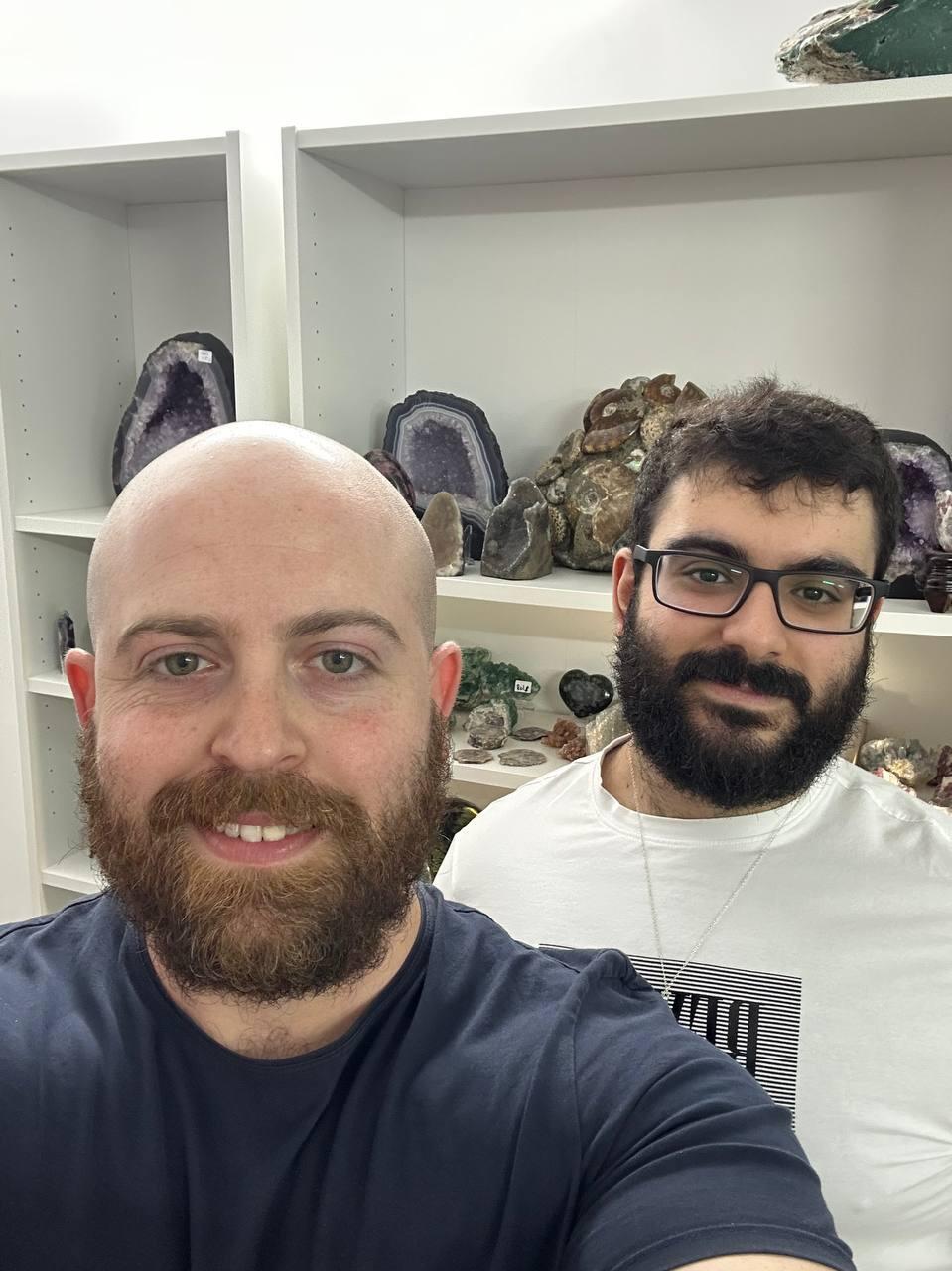
Haim and People & Collectors podcast host Bar Gindy
(Photo: Bar Gindy)
He also speaks openly about “crystal water” trends, where people put stones into bottles. His advice is practical, not mystical: some minerals can be toxic, some contain metals, some are safe only if separated by glass and polished stones may carry residues from tumbling processes. “Do your research,” he says. “Know what you’re putting into your body.”
The collector community, he adds, is mostly women, often in their twenties and up, frequently arriving through a spiritual doorway. Men tend to enter through geology and formation patterns. But both groups, he says, are often looking for the same thing: a feeling of alignment.
Many people come with lists, convinced they need specific stones for specific outcomes. Then they walk around, feel something unexpected and leave with a completely different choice. Haim calls it intuition. Not everyone believes in it, but in his experience, it’s how most first purchases happen.
His entry-level items can start at around 50 shekels, and a first-time visitor is often encouraged to keep it small. “You don’t want to be overwhelmed,” he says. But the other end of the spectrum is dramatic: his most expensive piece is priced at 16,000. It isn’t for someone buying their first stone. It’s for someone ready to live with something that changes a room.
This is not a store where people wander out empty-handed. In Haim’s world, if someone comes, they came for a reason. They might take a tiny stone. They might take something meaningful. But they leave with something.
Not because they were pressured. Because the space invites a decision.
In Haim’s crystal room, the collection is not the point. The point is that he built a place where he can be fully himself, and where every stone, somehow, helps tell that story.
- For more stories from Haim and other collectors, check out the People and Collectors podcast. The full interview is available with subtitles in English and 50 other languages.
First published: 22:05, 03.09.26